
Women & Super Gap Awareness
Summary
In Australia, women typically reach retirement with 20–40% less super than men, due to pay gaps, career breaks, part-time work, and system design. Recent changes like super on Paid Parental Leave help, but targeted contributions, smart fund choices, and settlement decisions in separations remain essential to narrowing the gap.
Table of Contents
- Introduction
- What Is the Gender Super Gap?
- Why Does the Super Gap Exist?
- Pay, Hours, and the Design of the Super System
- Career Breaks, Parental Leave, and Unpaid Care
- Divorce, Separation, and the Super Gap
- Women, Longevity, and Retirement Adequacy
- Checking Your Own Position
- Contribution Strategies That Target the Super Gap
- Women Who Are Self-employed or Contracting
- SMSFs, Business Property, and the Super Gap
- Strategies by Life Stage
- How James Hayes Works with Women on Super Gap Issues
- FAQs
- Superannuation & SMSFs Knowledge Bundle
Introduction
For women in the Sutherland Shire and Sydney CBD, the superannuation system applies the same rules to everyone, but outcomes differ markedly by gender. Lower lifetime earnings, unpaid care, and career breaks translate into systematically lower balances by retirement.
This article explains what the gender super gap is, why it persists, and which levers women can realistically use in 2025–26 to improve retirement outcomes. It is general information only, not personal advice or legal guidance.
It connects with:
What is Superannuation and How Does It Work? (system and tax settings)
How to Grow Your Super Balance (contribution and investment strategy)
Super Contribution Rules 2025 and Tax Benefits of Super Contributions (caps and tax treatment)
Super for the Self-Employed (for women running businesses or contracting)
Super and Divorce / Relationship Splits (super in property settlements)
Ethical & Sustainable Super Funds (aligning values and retirement planning)
James Hayes is an ASIC-licensed financial planner based in Caringbah, advising clients across the Sutherland Shire and Sydney CBD on super, retirement, and SMSFs. He does not assist with Centrelink Jobseeker support, debt consolidation using super, or schemes aimed at early access.
What Is the Gender Super Gap?
The gender superannuation gap is the difference between the super balances of women and men at a given age. It reflects differences in pay, hours worked, time out of the workforce, and use of the system over many years.
Recent figures show:
ASFA analysis of ATO data to June 2023 estimates average balances of $192,119 for men and $154,641 for women, a gap of around 19.5% across all ages.
KPMG reports median balances for men aged 60–64 at $204,107 and women at $146,900, a gap of 28% in the years just before retirement.
Other studies summarised by ANZ suggest women close to retirement typically hold 20–25% less super than men.
The gap varies by industry, income level, and relationship history, but it is consistently present.
If you’re unsure how your own balance compares, the Women’s Super Gap Action Plan includes a simple snapshot tool to check whether your super is roughly on track for your age group.
Why Does the Super Gap Exist?
The gap is not caused by a single factor. It accumulates from multiple structural elements across a working life.
The 2025 Status of Women Report Card notes that the national median gender pay gap in 2025 is 11.9%, meaning women earn about 88.1 cents for each dollar earned by men. Superannuation is tied to employment income, so this pay gap directly influences contributions.
WGEA’s paper on Women’s Economic Security In Retirement highlights that the super system assumes continuous, full-time work over many years, which often does not match women’s actual work patterns.
Drivers include:
Lower average pay in many female-dominated industries
More part-time or casual work
Longer and more frequent breaks for unpaid caring
Lower access to bonuses and variable pay that attract additional super
Relationship breakdowns where super is not considered carefully in settlements
Each driver can be managed in different ways, which the rest of this article addresses.
If you want help identifying the main drivers behind your own gap, download the Women’s Super Gap Action Plan. It includes a checklist to identify which factors—like pay, work pattern, or life events—have influenced your balance the most.
Pay, Hours, and the Design of the Super System
Superannuation contributions are generally a percentage of ordinary time earnings. That means lower pay and fewer hours flow directly into lower contributions.
The WGEA 2025 Employer Gender Pay Gaps report confirms:
A national median gender pay gap of 18.6%
72.2% of employers reporting a pay gap favouring men
Significant gaps in finance, mining, and construction, sectors that also pay higher super amounts in dollar terms
Super law itself is neutral, but when the contribution formula is applied to unequal pay patterns, the outcome is unequal balances.
Women working part-time also accumulate less super, even if their hourly rates match men’s. Previous rules excluding workers earning under $450 per month from Super Guarantee contributions were abolished from 1 July 2022, which improved coverage for low-income and casual workers, particularly women.
Career Breaks, Parental Leave, and Unpaid Care
Unpaid care is one of the largest contributors to the gender super gap.
WGEA notes that women are more likely to take extended time out of paid work for child-rearing and other care responsibilities, often during years when earnings would otherwise be rising most strongly. During breaks from paid work, Super Guarantee contributions typically stop unless employers or partners make specific arrangements.
From 1 July 2025, the Australian Government will pay super contributions on its Paid Parental Leave (PPL) scheme. Eligible parents with babies born or adopted on or after that date will receive an additional super contribution equal to 12% of their PPL payment, paid into their nominated fund.
This measure is expected to add around $5,100 in super per child, or about $14,500 for a mother of two by retirement, depending on returns. It helps, but it does not address periods of unpaid care beyond the PPL scheme, nor differences in pay or hours.
For women planning time out of the workforce, contribution strategies and partner arrangements become critical. These are covered later and in more depth in How to Grow Your Super Balance.
Divorce, Separation, and the Super Gap
Relationship breakdown can widen the super gap if super is overlooked in negotiations. Super is property under the Family Law Act 1975 and can be split between spouses or de facto partners via agreement or court order.
If one partner has spent more time in unpaid care and holds much less super, a settlement that ignores super can entrench the disparity. Conversely, appropriate super splits or offsets can rebalance retirement resources between partners.
Mechanics, time frames, and SMSF issues are handled in Super and Divorce / Relationship Splits. Here, the key point is that super needs explicit attention when negotiating property settlements.
Women, Longevity, and Retirement Adequacy
Australian women live longer on average than men, which increases the number of years that retirement savings must support. ABS and industry data show women have higher life expectancy and are more likely to spend the later stages of life alone.
At the same time:
KPMG reports that women aged 60–64 have median balances around $146,900, compared with $204,107 for men.
The Status of Women Report Card 2024 put 60–64-year-old women’s pre-retirement balances at 25.1% below men’s.
For all working ages (18–59), the average balance gap narrowed by only 4 percentage points over seven years (from 28% to 24% by 2020–21).
However, for women in their 30s, the gap has not narrowed at all, remaining stagnant at approximately 20%.
Longer life expectancy and smaller balances create a straightforward mathematical challenge. Bridging even part of the gap can have a material effect on sustainable retirement income, especially for women aged 55–65.
Retirement income strategies and drawdown planning are explained in Accessing Your Super (Before & After Retirement) and Superannuation Death Benefits.
Checking Your Own Position
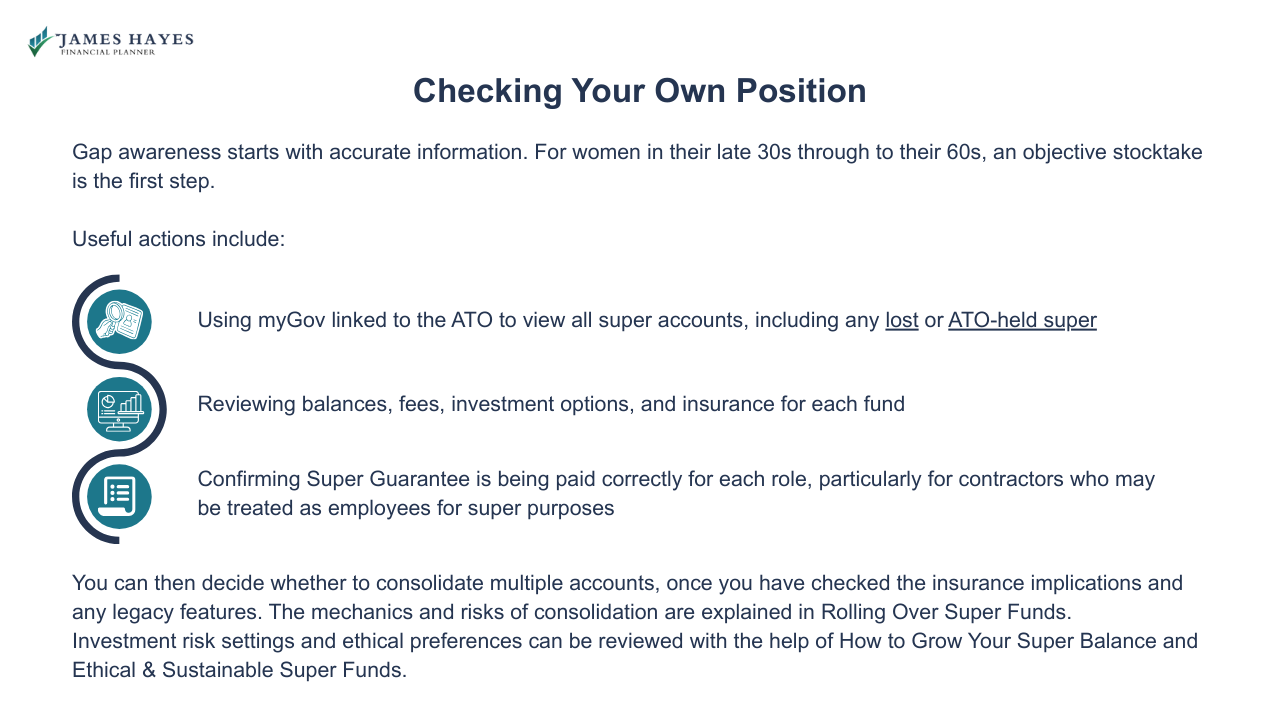
Gap awareness starts with accurate information. For women in their late 30s through to their 60s, an objective stocktake is the first step.
Useful actions include:
Using myGov linked to the ATO to view all super accounts, including any lost or ATO-held super
Reviewing balances, fees, investment options, and insurance for each fund
Confirming Super Guarantee is being paid correctly for each role, particularly for contractors who may be treated as employees for super purposes
You can then decide whether to consolidate multiple accounts, once you have checked the insurance implications and any legacy features. The mechanics and risks of consolidation are explained in Rolling Over Super Funds.
Investment risk settings and ethical preferences can be reviewed with the help of How to Grow Your Super Balance and Ethical & Sustainable Super Funds.
Free eBook: Women's Super Gap Snapshot and Action Plan (Instant Download)
〰️
Free eBook: Women's Super Gap Snapshot and Action Plan (Instant Download) 〰️
Contribution Strategies That Target the Super Gap
The super rules themselves do not differ by gender, but some strategies are particularly relevant for women due to income patterns, career breaks, and family arrangements.
Key levers, all subject to contribution caps and eligibility rules in Super Contribution Rules 2025, include:
Personal concessional contributions: Extra before-tax contributions (including salary sacrifice) up to the concessional cap, usually taxed at 15% in the fund.
Catch-up concessional contributions: Using unused cap amounts from the previous five years if your total super balance is below the relevant threshold.
Non-concessional contributions: After-tax contributions to boost balances where cashflow allows.
Government co-contribution: For eligible low and middle-income earners who make personal (non-deducted) contributions.
Low Income Super Tax Offset (LISTO): A refund of contributions tax, up to a capped amount, for low-income earners.
Spouse contributions and contribution splitting:– A higher-earning partner boosts, or redirects, contributions to the lower-balance partner
The tax mechanics and numerical comparisons are covered in Tax Benefits of Super Contributions. Here, the focus is on the fact that contribution splitting and spouse contributions can directly narrow the gap between partners’ balances.
If you’d like a structured way to choose which contribution levers suit your situation, the Women’s Super Gap Action Plan provides a list of options and helps you narrow it down to a few realistic next steps.
Women Who Are Self-employed or Contracting
Many women in the Sutherland Shire and Sydney CBD run businesses or work as contractors. When you are genuinely self-employed, there is no employer required to pay Super Guarantee for you. You are responsible for organising contributions from business or contracting income.
The ATO confirms that since 1 July 2022, Super Guarantee applies to most employees regardless of monthly earnings, but this does not cover genuine sole traders or partners unless specific arrangements are in place.
For self-employed women, helpful steps often include:
Setting a baseline percentage of business profit to contribute to super each quarter
Using personal deductible contributions to manage tax and build balances
Employing catch-up concessional contributions in stronger years
These patterns, and how they interact with company or trust structures and SMSFs, are covered in Super for the Self-Employed and Self-Managed Super Funds (SMSFs) Explained.
SMSFs, Business Property, and the Super Gap
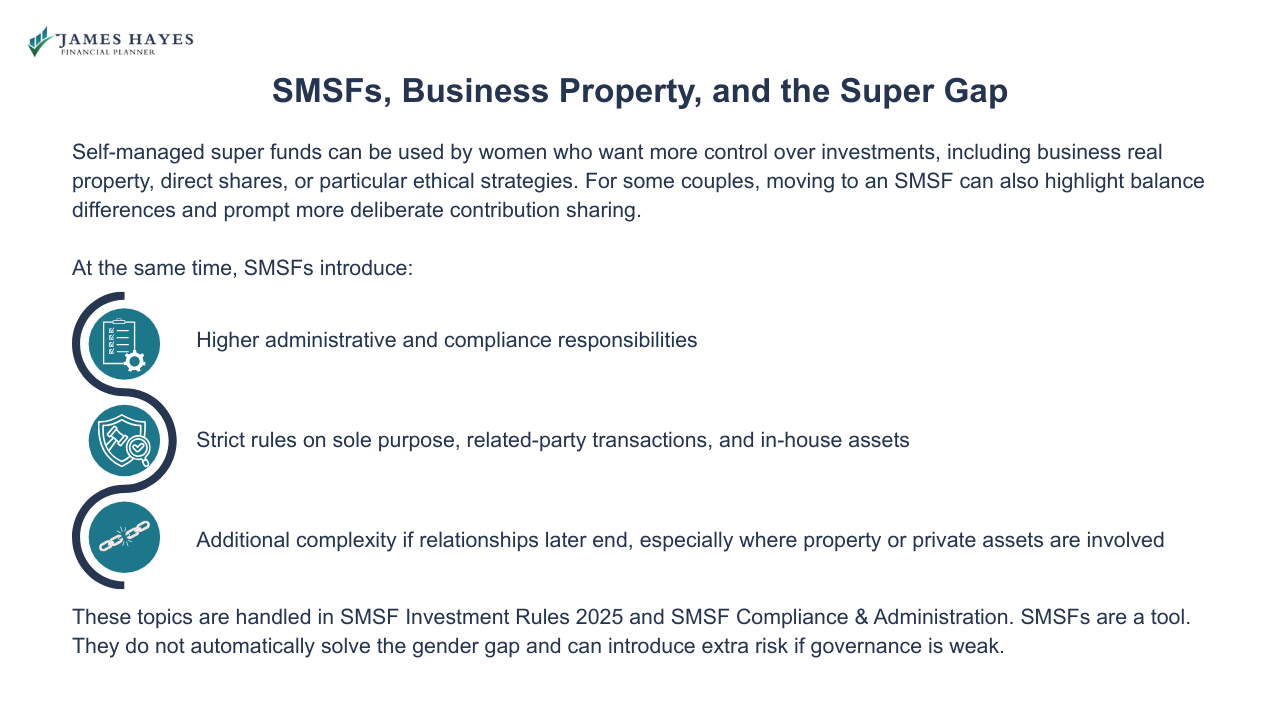
Self-managed super funds can be used by women who want more control over investments, including business real property, direct shares, or particular ethical strategies. For some couples, moving to an SMSF can also highlight balance differences and prompt more deliberate contribution sharing.
At the same time, SMSFs introduce:
Higher administrative and compliance responsibilities
Strict rules on sole purpose, related-party transactions, and in-house assets
Additional complexity if relationships later end, especially where property or private assets are involved
These topics are handled in SMSF Investment Rules 2025 and SMSF Compliance & Administration. SMSFs are a tool. They do not automatically solve the gender gap and can introduce extra risk if governance is weak.
Strategies by Life Stage
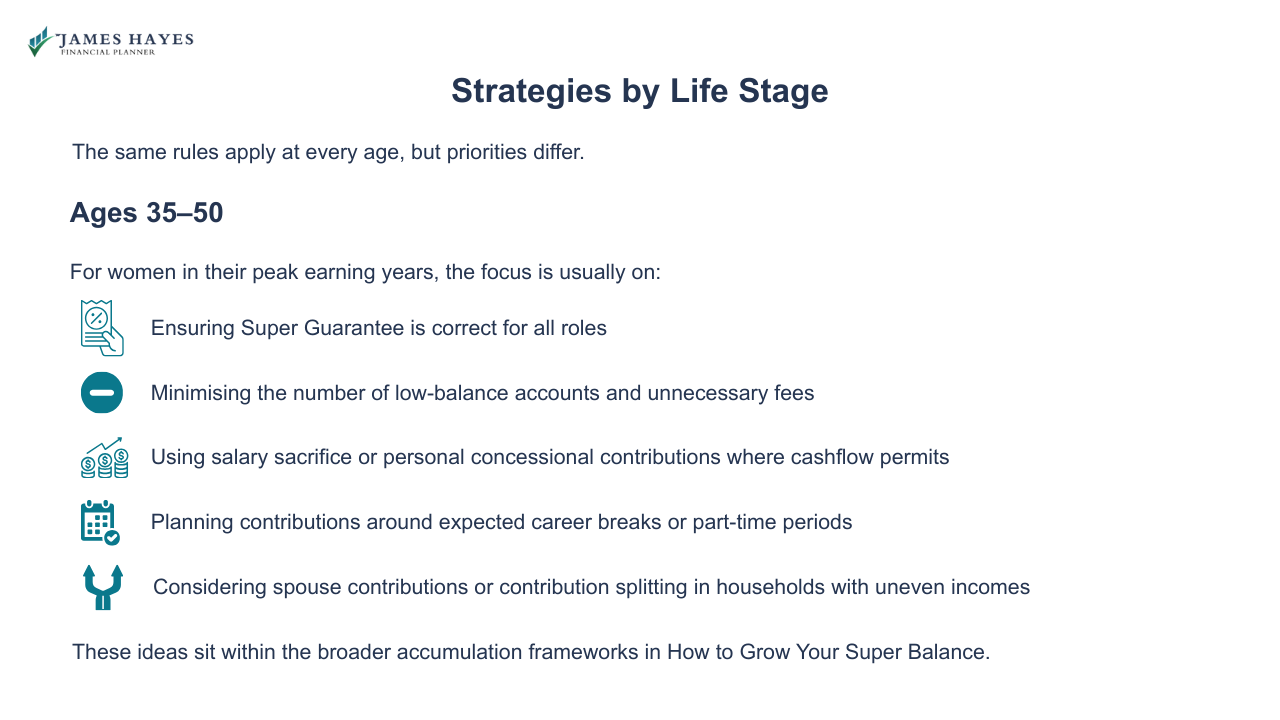
The same rules apply at every age, but priorities differ.
Ages 35–50
For women in their peak earning years, the focus is usually on:
Ensuring Super Guarantee is correct for all roles
Minimising the number of low-balance accounts and unnecessary fees
Using salary sacrifice or personal concessional contributions where cashflow permits
Planning contributions around expected career breaks or part-time periods
Considering spouse contributions or contribution splitting in households with uneven incomes
These ideas sit within the broader accumulation frameworks in How to Grow Your Super Balance.
Ages 55–65
For women closer to retirement, priority tends to shift to:
Assessing whether current balances support a desired retirement income
Considering targeted catch-up contributions, if eligibility criteria are met
Reviewing investment risk ahead of moving into pension phase
Re-examining estate planning, death benefit nominations, and insurance
This is also where the consequences of earlier decisions – including any super splits from relationship breakdowns – become fully visible. Detailed retirement income planning is covered in Accessing Your Super (Before & After Retirement) and Superannuation Death Benefits.
If you want age-specific guidance, the Women’s Super Gap Action Plan outlines different actions for women in their 30s, 40s, 50s, and 60s, helping you focus on the levers that matter most at your stage of life.
How James Hayes Works with Women on Super Gap Issues
Within this broader legal and policy environment, James focuses on:
Mapping current super balances, income patterns, and contribution history.
Identifying gaps between current trajectory and retirement income needs.
Structuring contribution and investment strategies consistent with Super Contribution Rules 2025 and Tax Benefits of Super Contributions.
Coordinating advice for women who are self-employed, in SMSFs, or affected by relationship splits, using the related cluster articles as reference frameworks
He does not provide services related to Centrelink Jobseeker support, debt consolidation via super, or early-release schemes. Book a complimentary 15-minute call with him.
FAQs
-
Estimates vary by data source and age group, but studies commonly show women near retirement having around 20–30% less super than men. For example, KPMG reports median balances of $204,107 for men and $146,900 for women aged 60–64, a gap of 28%, based on recent Australian data.
-
Key reasons include lower average pay, more part-time or casual work, longer career breaks for caring, and fewer years in senior roles. Super is tied to employment income and assumes near-continuous full-time work, which often does not match women’s work patterns. Relationship breakdowns and longer life expectancy can widen the gap further.
-
Super on government Paid Parental Leave from 1 July 2025 will help, but only partially. Eligible parents receive a 12% super contribution on their PPL payments, which may add roughly $5,000–7,000 per child by retirement. This improves outcomes, yet does not fully offset extended periods of unpaid or part-time care.
-
Couples can consider strategies such as spouse contributions, contribution splitting from the higher earner to the lower-balance partner, and deliberate sharing of voluntary contributions. In separation, super should be explicitly valued and included in property settlements. Formal legal documents and independent advice are important when implementing super splits or offsets.
-
In most cases, yes. Since 1 July 2022, the $450-per-month threshold has been removed, so eligible employees should receive Super Guarantee contributions regardless of monthly earnings. Exceptions can apply for very young workers or contractors, so it is important to check ATO guidance and your specific contract.
-
Options may include maximising concessional contributions up to the cap, using catch-up concessional amounts if eligible, making non-concessional contributions, and reviewing investment settings. The right combination depends on income, total super balance, and time to retirement. Modelling can show how these strategies interact with tax and Age Pension considerations.
-
An SMSF provides control over investments and contribution decisions but does not automatically reduce the gap. The effect depends on how contributions are shared, how investments are chosen, and how relationship and estate issues are managed. SMSFs also introduce additional compliance duties and costs, which must be weighed carefully.
-
Both housing security and super are important. The right balance depends on age, mortgage size, interest rates, and current super levels. Many people prioritise essential housing costs, then use surplus cashflow for tax-effective super contributions. Scenario modelling can help quantify trade-offs between faster debt reduction and higher retirement income.
Superannuation & SMSFs Knowledge Bundle
- What is Superannuation and How Does It Work?
- How to Grow Your Super Balance
- Super Contribution Rules 2025
- Tax Benefits of Super Contributions
- Accessing Your Super (Before & After Retirement)
- Superannuation Death Benefits
- Self-Managed Super Funds (SMSFs) Explained
- Setting Up an SMSF
- SMSF Investment Rules 2025
- SMSF Compliance & Administration
- Rolling Over Super Funds
- Ethical & Sustainable Super Funds
- Super for the Self-Employed
- Super and Divorce / Relationship Splits
Disclaimer
The information in this article is provided as a general guide only. It does not constitute personal financial advice and should not be relied upon as such. Readers should seek advice from a licensed financial adviser before making any financial decisions. James Hayes and his associated entities accept no responsibility or liability for any loss, damage, or action taken in reliance on the information contained in this article. Links to third-party websites are provided for reference purposes only. We do not endorse or guarantee the accuracy of their content.