
Setting Up an SMSF in Australia
Summary
Setting up an SMSF involves choosing a trustee structure, signing a compliant trust deed, registering with the ATO for an ABN and TFN, opening a dedicated bank account, signing trustee declarations, documenting an investment strategy, arranging an ESA for SuperStream rollovers, and organising ongoing administration, audit, and compliance arrangements.
Table of Contents
- Introduction
- Before You Set Up an SMSF
- How to Set Up an SMSF in 2025–26 in 9 Steps
- Step 1: Confirm Members and Choose Your Trustee Structure
- Step 2: Draft and Execute the SMSF Trust Deed
- Step 3: Check Residency and “Australian Super Fund” Status
- Step 4: Appoint Trustees/Directors and Sign the SMSF Trustee Declaration
- Step 5: Apply for an ABN, TFN, and ATO SMSF Registration
- Step 6: Open a Dedicated SMSF Bank Account
- Step 7: Document the SMSF Investment Strategy (Including Insurance)
- Step 8: Set Up an Electronic Service Address (ESA) and SuperStream Capability
- Step 9: Roll Over Existing Super and Start Contributions (Within the Rules)
- Legal and Residency Requirements to Consider at Setup
- Documentation and Record-keeping at Establishment
- Costs, Timing, and Professional Roles in SMSF Setup
- Common Setup Mistakes and How to Avoid Them
- How SMSF Setup Links to Your Broader Super and Inheritance Plan
- How James Hayes Assists with SMSF Setup
- FAQs
- Superannuation & SMSFs Knowledge Bundle
Introduction
For wealth builders in their 30s and 40s, and pre-retirees or retirees in their 50s and 60s, setting up a self-managed super fund (SMSF) is primarily a governance and compliance project, not just an investment choice.
This article sets out the practical steps to establish an SMSF correctly in 2025–26 and explains the key decisions, forms, and legal tests involved.
It connects directly with:
Self-Managed Super Funds (SMSFs) Explained (what SMSFs are, and when they may or may not be appropriate)
SMSF Investment Rules 2025 (what you can and cannot invest in)
SMSF Compliance & Administration (ongoing record-keeping, audit, and reporting)
Rolling Over Super Funds (moving money from existing funds to your SMSF)
It also sits within the broader super framework alongside Super Contribution Rules 2025, Tax Benefits of Super Contributions, and Accessing Your Super (Before & After Retirement).
James Hayes is an ASIC-licensed financial planner based in Caringbah, working with clients across the Sutherland Shire and Sydney CBD on super, retirement, and SMSF strategies. He does not assist with Centrelink Jobseeker support, debt consolidation using super, or schemes aimed at early super release.
Before You Set Up an SMSF
An SMSF is a type of trust set up solely to provide retirement benefits to members or their dependants. Members are also trustees (or company directors), responsible for all decisions and compliance.
ASIC and the ATO stress that SMSFs are not suitable for everyone. ASIC guidance and its 2025 review of SMSF advice highlight that many Australians were advised to establish SMSFs without adequate analysis of costs, risks, or their ability to manage trustee responsibilities.
This article assumes you have already worked through whether an SMSF is appropriate – that assessment is covered in Self-Managed Super Funds (SMSFs) Explained and related ASIC and Moneysmart material. Here, the focus is how to set one up correctly once the decision is made.
Thinking about setting up an SMSF? You can use the SMSF Ready Assessment & Setup Roadmap to check whether you’re realistically prepared for the responsibilities before you move into the setup phase.
How to Set Up an SMSF in 2025–26 in 9 Steps
The ATO breaks SMSF establishment into a series of structured steps. In practice, there are nine stages most new trustees work through, often with professional assistance.
Step 1: Confirm Members and Choose Your Trustee Structure
Every SMSF must have no more than six members, and each member must either be an individual trustee or a director of a corporate trustee.
At this stage you:
Decide who will be members.
Decide between individual trustees and a corporate trustee (a company that acts as trustee).
The ATO outlines different requirements for each structure. For example:
With individual trustees, you must have at least two and no more than six. Each member is a trustee, and each trustee is a member.
With a corporate trustee, each member is a director of the company. This structure often simplifies membership changes and estate planning.
You must also ensure each trustee or director is eligible (not a disqualified person, and not prohibited by the trust deed or law).
Suitability of trustee structure is explored in more detail in Self-Managed Super Funds (SMSFs) Explained.
Step 2: Draft and Execute the SMSF Trust Deed
An SMSF is created by a trust deed and initial settlement.
At this step you:
Engage a document provider or solicitor to prepare a deed that meets Superannuation Industry (Supervision) Act 1993 and tax law requirements.
Ensure the deed allows for key features you may need (for example, pensions, reversionary pensions, binding death benefit nominations, and up to six members).
Arrange for the initial settlement (usually a nominal amount) and have all trustees sign the deed in line with state or territory witnessing and stamping requirements.
The date of execution generally marks the establishment date of the fund, provided at least one asset is located in Australia.
This is the point where you should also ensure the deed aligns with your estate planning strategy and the approach described in Superannuation Death Benefits.
Step 3: Check Residency and “Australian Super Fund” Status
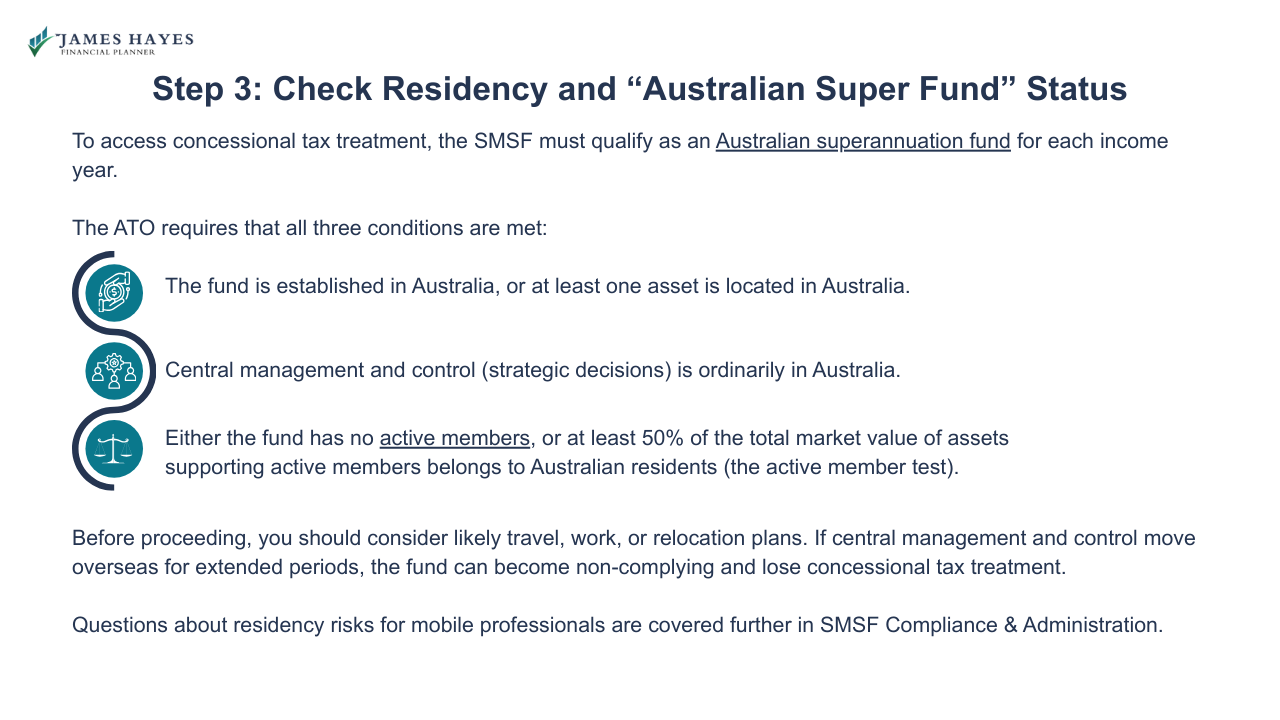
To access concessional tax treatment, the SMSF must qualify as an Australian superannuation fund for each income year.
The ATO requires that all three conditions are met:
The fund is established in Australia, or at least one asset is located in Australia.
Central management and control (strategic decisions) is ordinarily in Australia.
Either the fund has no active members, or at least 50% of the total market value of assets supporting active members belongs to Australian residents (the active member test).
Before proceeding, you should consider likely travel, work, or relocation plans. If central management and control move overseas for extended periods, the fund can become non-complying and lose concessional tax treatment.
Questions about residency risks for mobile professionals are covered further in SMSF Compliance & Administration.
Step 4: Appoint Trustees/Directors and Sign the SMSF Trustee Declaration
Once the deed is prepared and residency issues considered, you formally appoint trustees or directors and complete statutory declarations.
Key actions:
Each trustee or director formally consents in writing to act in that role.
Each new trustee or director must complete the ATO Trustee declaration (NAT 71089) within 21 days of becoming a trustee or director.
The ATO’s trustee declaration confirms that each trustee understands their obligations. The ATO and specialist law firms now recommend that declarations be retained for the life of the fund, not just ten years, given their significance in audits.
The Self-Managed Super Funds (SMSFs) Explained article touches upon the obligations you are accepting at this point.
You can also download the SMSF Ready Assessment & Setup Roadmap to sense-check whether you fully understand what you’re signing up for as a trustee. It includes a simple checklist to help you identify any areas you’re unsure about.
Step 5: Apply for an ABN, TFN, and ATO SMSF Registration
After establishment and trustee appointment, you register the fund with the ATO.
Typically you (or your accountant):
Apply for an Australian Business Number (ABN) and Tax File Number (TFN) for the SMSF through the Australian Business Register.
Elect to be a regulated super fund so the SMSF becomes eligible for concessional tax treatment and rollovers from other funds.
The ATO may request supporting documents, especially for new funds or where risk indicators are present. Registration details must be correct and kept updated, as they drive SuperStream rollovers and employer contributions.
Step 6: Open a Dedicated SMSF Bank Account
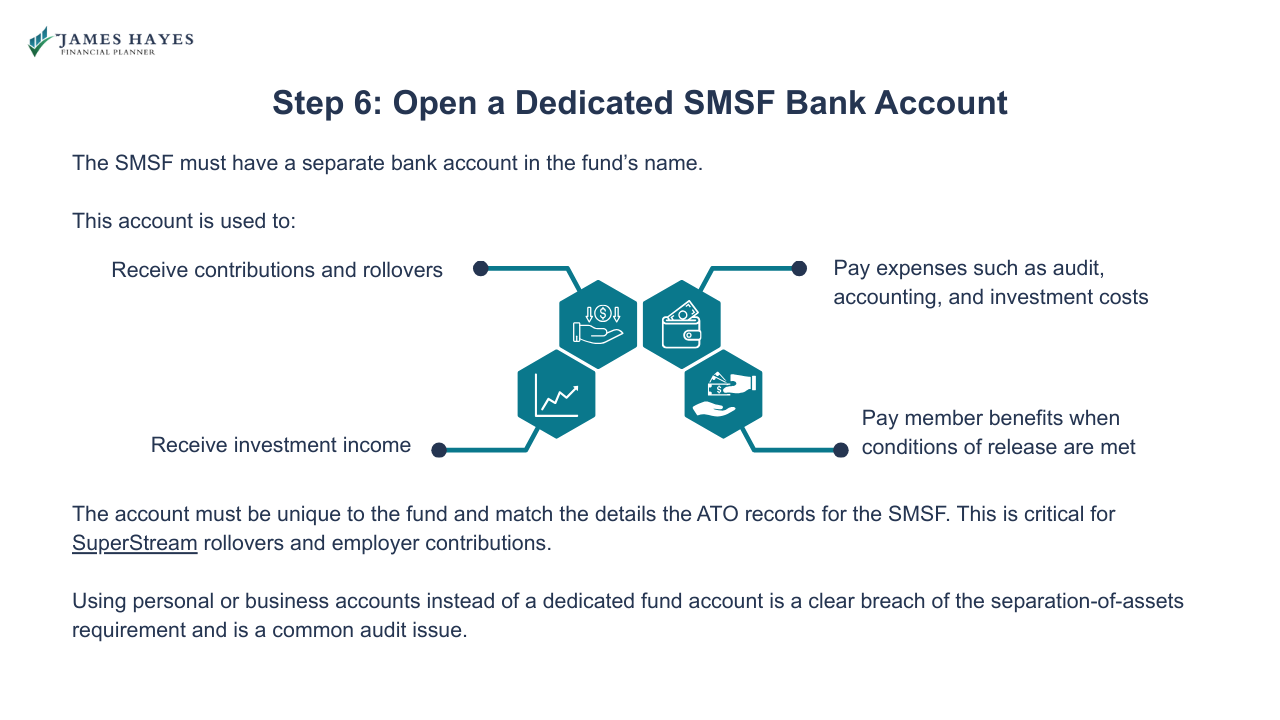
The SMSF must have a separate bank account in the fund’s name.
This account is used to:
Receive contributions and rollovers
Pay expenses such as audit, accounting, and investment costs
Receive investment income
Pay member benefits when conditions of release are met
The account must be unique to the fund and match the details the ATO records for the SMSF. This is critical for SuperStream rollovers and employer contributions.
Using personal or business accounts instead of a dedicated fund account is a clear breach of the separation-of-assets requirement and is a common audit issue.
Step 7: Document the SMSF Investment Strategy (Including Insurance)
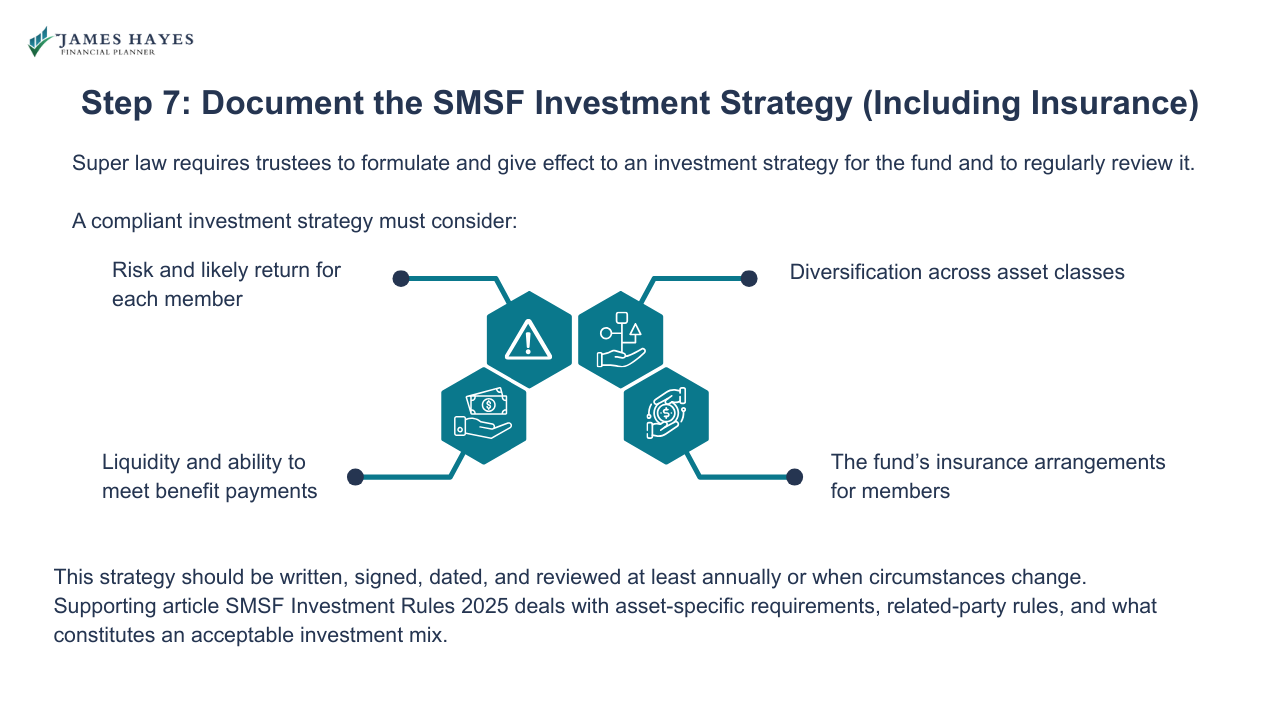
Super law requires trustees to formulate and give effect to an investment strategy for the fund and to regularly review it.
A compliant investment strategy must consider:
Risk and likely return for each member
Diversification across asset classes
Liquidity and ability to meet benefit payments
The fund’s insurance arrangements for members
This strategy should be written, signed, dated, and reviewed at least annually or when circumstances change. Supporting article SMSF Investment Rules 2025 deals with asset-specific requirements, related-party rules, and what constitutes an acceptable investment mix.
Step 8: Set Up an Electronic Service Address (ESA) and SuperStream Capability
From 1 October 2021, all SMSF rollovers to and from other funds must use the SuperStream data and payment standard, with limited exceptions (such as some in-specie rollovers and certain internal transfers).
To be SuperStream-ready, your SMSF needs:
A registered ESA (Electronic Service Address) from a SuperStream messaging provider recognised by the ATO.
Consistent member details across the SMSF, ATO records, and the transferring fund.
Without a valid ESA and accurate ATO records, rollovers can be delayed or rejected, and auditors may have to report contraventions.
Further operational detail appears in Rolling Over Super Funds and SMSF Compliance & Administration.
Step 9: Roll Over Existing Super and Start Contributions (Within the Rules)
Once the SMSF is registered, has a bank account, and is SuperStream-ready, members can request rollovers from existing funds and arrange contributions to be paid into the SMSF.
At this stage you:
Lodge rollover requests with existing funds (which must process standard rollovers as soon as practicable, and no later than 3 business days after receiving all required information).
Provide the SMSF’s ABN, ESA, bank account details, and member details.
Update employer records so future SG or salary-sacrifice contributions are paid to the SMSF using SuperStream where relevant.
All contributions must comply with contribution caps, age rules, and work tests, as outlined in Super Contribution Rules 2025 and Tax Benefits of Super Contributions. Rollovers are not counted towards contribution caps, but mis-coded transfers can create reporting issues, so clear documentation is important.
Free eBook: SMSF Ready Assessment and Setup Roadmap (Instant Download)
〰️
Free eBook: SMSF Ready Assessment and Setup Roadmap (Instant Download) 〰️
Legal and Residency Requirements to Consider at Setup
Setting up an SMSF is not just a paperwork sequence. Certain legal and residency conditions must be satisfied from day one.
Requirements include:
Sole purpose test: The fund must be maintained solely to provide retirement benefits or death benefits; using assets for personal use or current-day benefits breaches this test.
Australian super fund status: The three residency conditions (establishment or asset in Australia, central management and control in Australia, and active member test) must be met to qualify for concessional tax.
Trustee eligibility: Trustees must not be disqualified persons, and each must sign a trustee declaration acknowledging duties.
These conditions are revisited in SMSF Compliance & Administration, along with scenarios where members move overseas, or central management and control shifts.
Documentation and Record-keeping at Establishment
When an SMSF is set up, trustees need to retain specific records from the outset.
The ATO’s requirements and professional practice materials expect you to keep:
The executed trust deed and any variations
Written consents from trustees or directors
Completed trustee declarations (NAT 71089) for each trustee or director, signed within 21 days
Minutes or resolutions confirming key decisions (such as acceptance of trustees, approval of investment strategy)
Evidence of initial settlement and bank account establishment
The formal record-keeping and retention timeframes for different document types are broken down in SMSF Compliance & Administration.
Costs, Timing, and Professional Roles in SMSF Setup
The ATO and ASIC note that SMSFs usually involve establishment costs (trust deed, company registration if a corporate trustee is used, advice) and ongoing costs (accounting, audit, ATO levy, and investment costs).
While exact figures vary, a typical SMSF setup process may involve:
Professional fees for advice on suitability and structure
Deed and corporate trustee registration costs
Time to collate identity documents, sign forms, and complete ATO registrations
4–8 weeks from initial decision to full operation, depending on provider and rollover timeframes
ASIC’s information sheet on SMSF advice and its 2025 review emphasise the need for advisers to compare projected SMSF costs and risks with alternatives, rather than assuming SMSFs are cheaper or better.
The cost-effectiveness and suitability question is discussed in Self-Managed Super Funds (SMSFs) Explained and How to Grow Your Super Balance.
Common Setup Mistakes and How to Avoid Them
Several recurring issues appear in ATO guidance, contravention reports, and industry commentary.
Examples include:
Opening bank accounts in personal names instead of the fund’s name.
Establishing the fund but failing to lodge ABN/TFN registration or elect to be regulated.
Not arranging an ESA and SuperStream capability before requesting rollovers.
Not signing trustee declarations within 21 days, or not retaining them.
Failing to document an investment strategy, including insurance considerations.
Using fund assets for personal use, or entering into related-party transactions that breach investment rules.
Many of these points are audited and, if serious, must be reported to the ATO by the approved SMSF auditor. The article SMSF Compliance & Administration explains how contraventions are identified and what rectification may involve.
Many of the common setup mistakes stem from gaps in trustee readiness. The SMSF Ready Assessment & Setup Roadmap helps you spot those gaps early so you can address them before the fund is established.
How SMSF Setup Links to Your Broader Super and Inheritance Plan
Setting up an SMSF should not be done in isolation. It interacts with:
Contribution strategy – which is covered in Super Contribution Rules 2025, Tax Benefits of Super Contributions, and Super for the Self-Employed
Investment approach – addressed in How to Grow Your Super Balance, SMSF Investment Rules 2025, and Ethical & Sustainable Super Funds
Retirement access options – discussed in Accessing Your Super (Before & After Retirement)
Death benefits and estate planning – coordinated through Superannuation Death Benefits, Super and Divorce / Relationship Splits, and the inheritance cluster
For many households, the main reasons to consider an SMSF are control, specific investment needs, and estate planning. Those themes sit across the SMSF and inheritance content rather than inside this setup article alone.
How James Hayes Assists with SMSF Setup
ASIC’s 2025 review of SMSF advice found that a majority of advice files did not adequately demonstrate that SMSF recommendations were in clients’ best interests.
Against this regulatory background, James:
Assesses whether an SMSF is appropriate compared with existing industry or retail funds, (see Self-Managed Super Funds (SMSFs) Explained).
Designs contribution and investment strategies (see How to Grow Your Super Balance, Super Contribution Rules 2025, and Tax Benefits of Super Contributions).
Coordinates with accountants and SMSF administrators to implement the practical steps outlined in this article.
Integrates SMSF structures with retirement access and death-benefit strategies, (see Accessing Your Super (Before & After Retirement) and Superannuation Death Benefits)
He does not use SMSFs for debt consolidation, early access, or schemes that attempt to circumvent contribution and release rules. Book a free 15-minute call with him.
FAQs
-
You choose members and a trustee structure, execute a compliant trust deed, appoint trustees or directors and sign trustee declarations, register with the ATO for an ABN, TFN, and regulated status, open a dedicated SMSF bank account, document an investment strategy, obtain an ESA for SuperStream, and then arrange rollovers and contributions.
-
An SMSF can have between one and six members. Every member must be either an individual trustee or a director of the corporate trustee, and each trustee or director must sign the ATO trustee declaration. The fund must also meet residency conditions and the sole purpose test to retain concessional tax treatment.
-
Each new trustee or director must sign the ATO Trustee declaration (NAT 71089) within 21 days of taking on the role. A separate declaration is required for each person. The declaration should be read carefully, kept with fund records, and retained for at least the life of the SMSF.
-
An ESA is required so the SMSF can use the SuperStream data and payment standard for employer contributions, rollovers, and certain ATO release authorities. From 1 October 2021, most rollovers to and from SMSFs must use SuperStream, and a valid ESA, ABN, and bank account are essential.
-
No. An SMSF must follow the same contribution and condition-of-release rules as other super funds. Using an SMSF to access super early for personal expenses, debt repayment, or property deposits is generally illegal. The ATO actively targets illegal early-release schemes, and penalties can be significant for trustees.
-
A corporate trustee is not compulsory, but the ATO highlights key differences between individual and corporate structures. Corporate trustees often simplify membership changes, ownership records, and some estate-planning steps but involve company registration and compliance. The decision should consider cost, succession plans, and legal advice, not just convenience.
-
Timeframes vary, but a typical SMSF setup may take several weeks from initial decision to full operation. This period includes preparing and executing the deed, obtaining trustee declarations, applying for ABN and TFN, opening a bank account, arranging an ESA, and allowing time for SuperStream rollovers to complete.
-
Most people use a mix of professionals, typically a financial planner for suitability and strategy, a lawyer or document provider for the trust deed and company documents, an accountant or administrator for registrations and ongoing reporting, and an approved SMSF auditor. Roles should be clearly defined, and advice duties documented.
Superannuation & SMSFs Knowledge Bundle
- What is Superannuation and How Does It Work?
- How to Grow Your Super Balance
- Super Contribution Rules 2025
- Tax Benefits of Super Contributions
- Accessing Your Super (Before & After Retirement)
- Superannuation Death Benefits
- Self-Managed Super Funds (SMSFs) Explained
- SMSF Investment Rules 2025
- SMSF Compliance & Administration
- Rolling Over Super Funds
- Ethical & Sustainable Super Funds
- Super for the Self-Employed
- Super and Divorce / Relationship Splits
- Women & Super Gap Awareness
Disclaimer
The information in this article is provided as a general guide only. It does not constitute personal financial advice and should not be relied upon as such. Readers should seek advice from a licensed financial adviser before making any financial decisions. James Hayes and his associated entities accept no responsibility or liability for any loss, damage, or action taken in reliance on the information contained in this article. Links to third-party websites are provided for reference purposes only. We do not endorse or guarantee the accuracy of their content.