
Superannuation and Divorce/Relationship Splits
Summary
In Australia, superannuation is treated as property in a divorce or separation and can be divided between spouses or de facto partners by agreement or court order. Super usually stays inside the system, either by splitting a balance, flagging a benefit, or offsetting it against other assets as part of the overall property settlement.
Table of Contents
- Introduction
- The Significance of Super in a Divorce or Separation
- How Australian Law Treats Super in Relationship Breakdowns
- Options for Dealing with Super When You Separate
- Steps from Discovery to Implementation
- How Super Splitting Works in Practice
- Tax, Preservation Age, and Access Rules After a Split
- Strategic Considerations for Different Life Stages
- Super, Children, and Blended Families After Separation
- Common Pitfalls to Avoid
- How a Financial Planner Can Help (And the Limits)
- Next Steps for Couples in the Sutherland Shire and Sydney CBD
- FAQs
- Superannuation & SMSFs Knowledge Bundle
Introduction
For many couples in the Sutherland Shire and Sydney CBD, superannuation is the second largest asset after the family home. When a relationship ends, deciding what happens to super is a major part of the financial settlement, alongside property, cash, and investments.
This guide explains, in practical terms, how super is treated under Australian family law, how splitting orders work, and what that means for your retirement planning. It is general information, not legal advice. You still need a family lawyer for documents and court processes, and a financial planner for modelling your long-term position.
James Hayes does not assist with Centrelink Jobseeker claims, debt consolidation, or schemes to withdraw super early.
The Significance of Super in a Divorce or Separation
When a marriage or eligible de facto relationship ends, Australian family law usually treats super as part of the property pool to be divided. Super does not disappear into the background simply because it is preserved for retirement. It is counted, valued, and considered in the same framework as other assets.
Super also behaves differently from cash or property. Even when it is split, it generally remains locked in the super system until you meet a condition of release such as reaching preservation age and retiring. That makes it important to think about both short-term housing and long-term income when considering offers.
If you want to keep track of every super interest early on, download the Separation & Super Checklist. It helps you list all funds and old accounts in one place.
How Australian Law Treats Super in Relationship Breakdowns
Under the Family Law Act 1975, superannuation is treated as property, and there is a specific regime for splitting super between separating partners. This framework applies to both married couples and, in most cases, de facto couples, including same-sex couples (Western Australia has some differences but still allows super splitting).
Super as “Property” Under the Family Law Act 1975
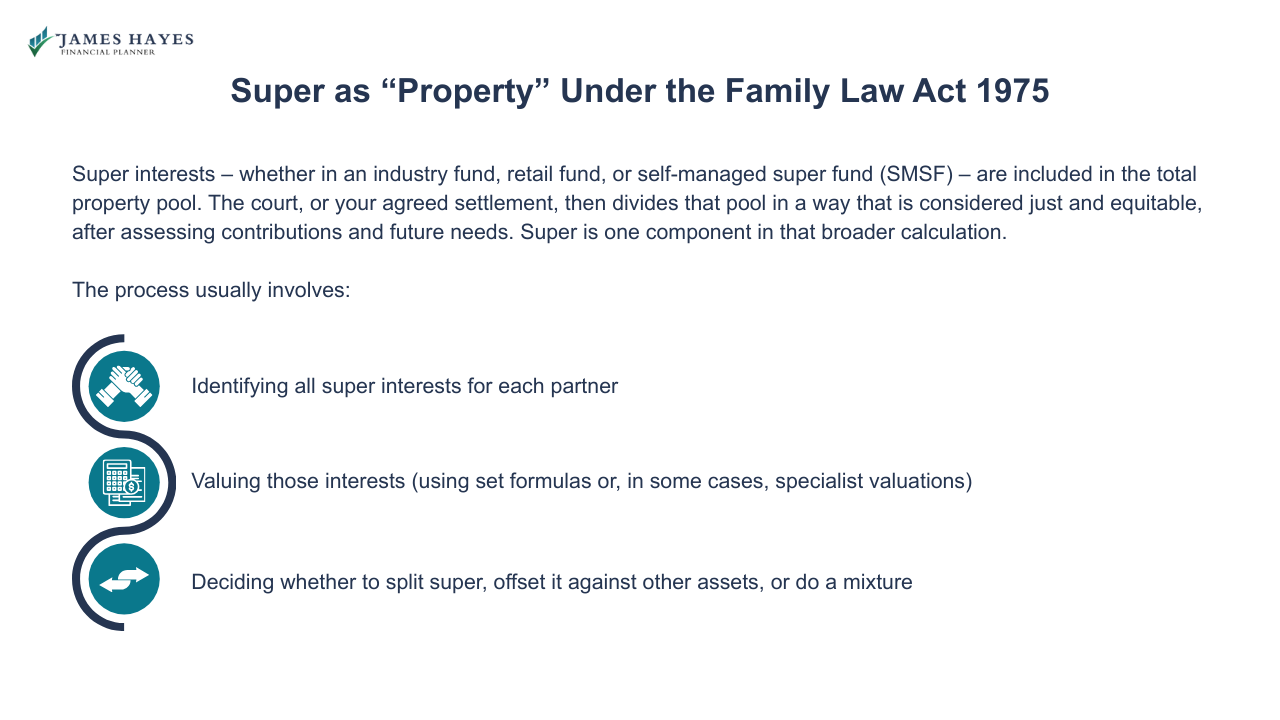
Super interests – whether in an industry fund, retail fund, or self-managed super fund (SMSF) – are included in the total property pool. The court, or your agreed settlement, then divides that pool in a way that is considered just and equitable, after assessing contributions and future needs. Super is one component in that broader calculation.
The process usually involves:
Identifying all super interests for each partner
Valuing those interests (using set formulas or, in some cases, specialist valuations)
Deciding whether to split super, offset it against other assets, or do a mixture
Married vs De Facto Couples
For married couples, super can be divided as part of a property settlement at any time after separation. If you apply to the court, you usually need to start proceedings within 12 months of your divorce becoming final.
For de facto couples (outside WA), super can also be split under the same federal law, provided certain criteria are met – for example, a relationship of at least two years, a child of the relationship, or substantial contributions. Applications for property settlement generally need to be made within 2 years of separation if court orders are required.
It helps to have everything documented early to avoid confusion later. The Separation & Super Checklist gives you a simple structure for listing each fund, flagging defined benefit interests, and capturing uncertainties you may need your lawyer to request formally.
Options for Dealing with Super When You Separate
When you negotiate property settlement or ask the court to decide, there are several ways super can be treated. The right approach depends on your ages, account balances, other assets, and retirement goals.
Splitting Orders and Agreements
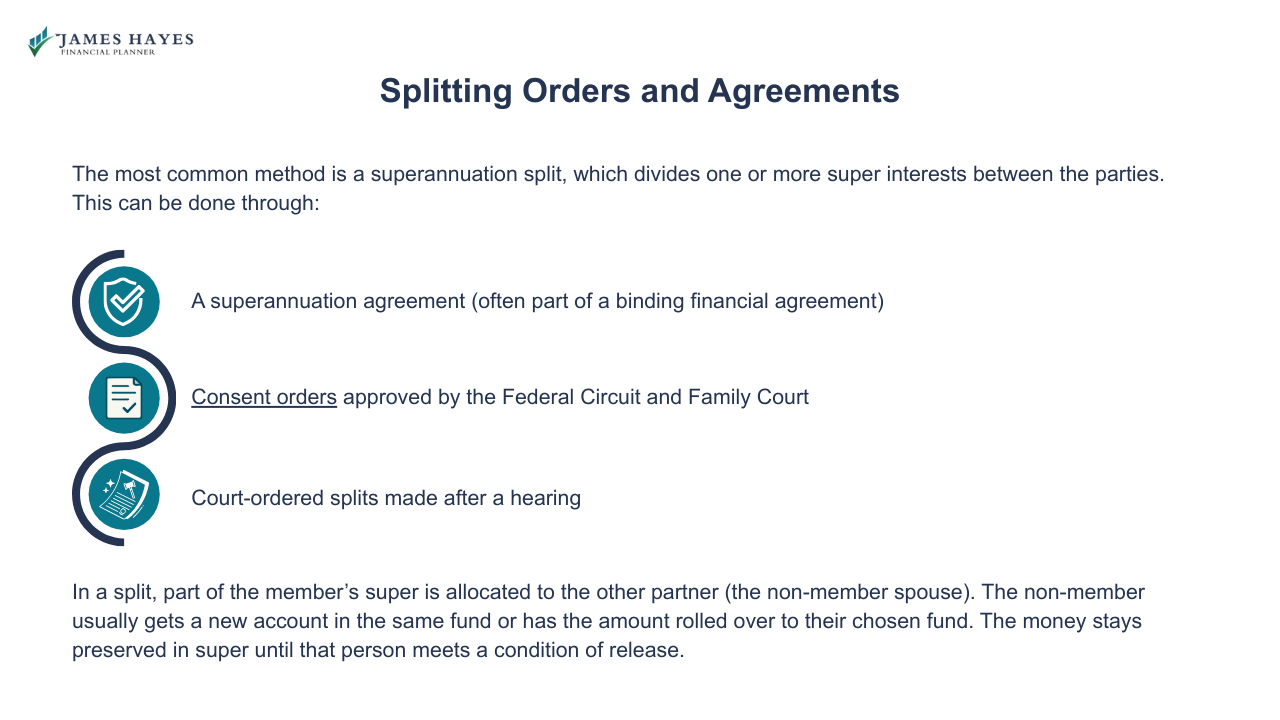
The most common method is a superannuation split, which divides one or more super interests between the parties. This can be done through:
A superannuation agreement (often part of a binding financial agreement)
Consent orders approved by the Federal Circuit and Family Court
Court-ordered splits made after a hearing
In a split, part of the member’s super is allocated to the other partner (the non-member spouse). The non-member usually gets a new account in the same fund or has the amount rolled over to their chosen fund. The money stays preserved in super until that person meets a condition of release.
Flagging, Offsetting, and Leaving Super Untouched
In some cases, super may be flagged instead of immediately split. A flagging order or agreement tells the fund not to pay out a benefit until a later event (for example, retirement), at which point it can be dealt with under the settlement or court orders.
Alternatively, you may decide not to split super, but to offset its value against other assets. For example, one partner may keep more of the family home or investments, while the other keeps more super. This still requires accurate valuation. Offsetting can suit couples where one person needs housing stability and the other has higher retirement savings.
If you’re weighing splits, offsets, or flagging, download the Separation & Super Checklist. It helps you gather the statements and valuation details needed to compare your options.
Steps from Discovery to Implementation
Dealing with super in a relationship split is not just about the final numbers. There is a structured process, involving information requests, legal documentation, and formal instructions to super funds.
Step 1: Gather Super Information
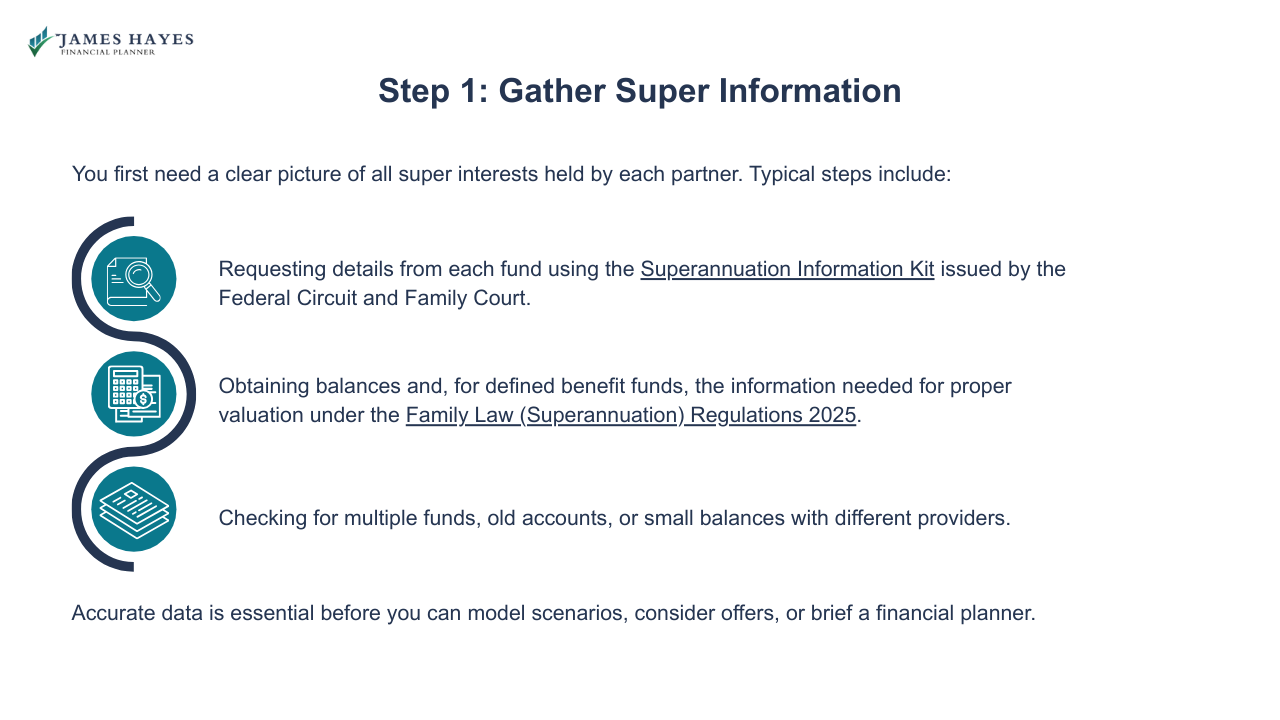
You first need a clear picture of all super interests held by each partner. Typical steps include:
Requesting details from each fund using the Superannuation Information Kit issued by the Federal Circuit and Family Court.
Obtaining balances and, for defined benefit funds, the information needed for proper valuation under the Family Law (Superannuation) Regulations 2025.
Checking for multiple funds, old accounts, or small balances with different providers.
Accurate data is essential before you can model scenarios, consider offers, or brief a financial planner.
Step 2: Agreeing the Split or Seeking Orders
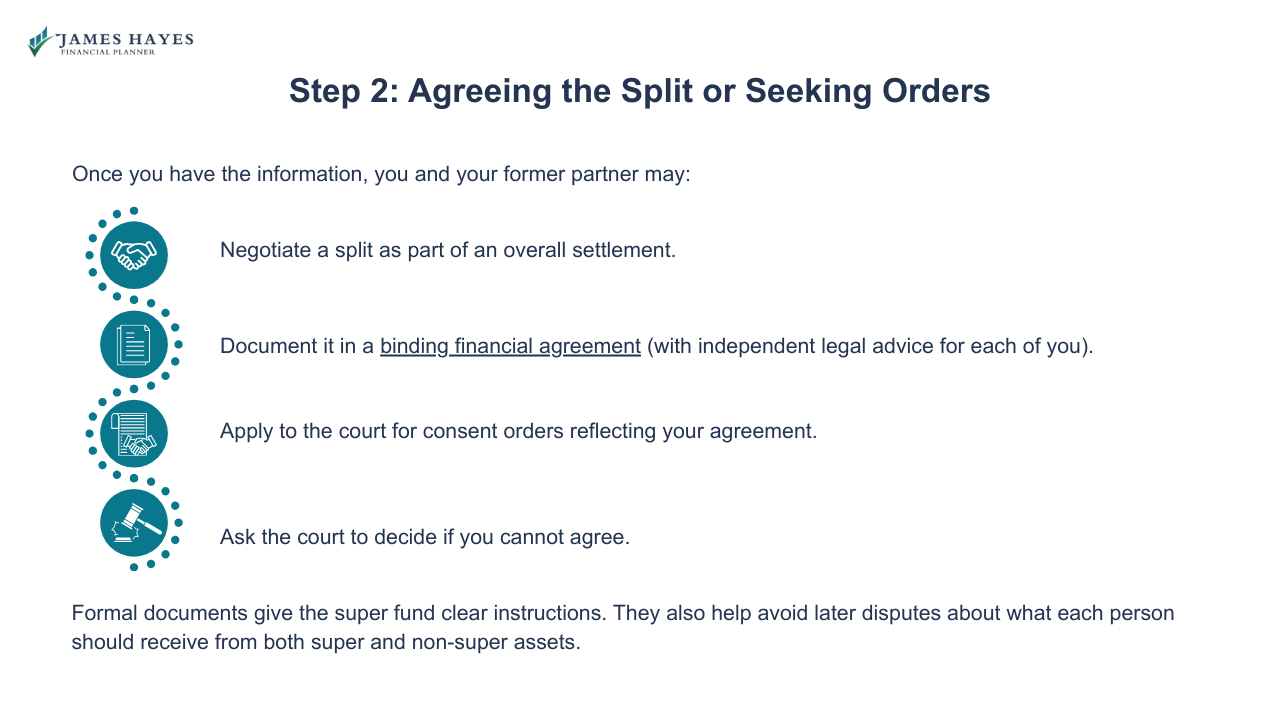
Once you have the information, you and your former partner may:
Negotiate a split as part of an overall settlement.
Document it in a binding financial agreement (with independent legal advice for each of you).
Apply to the court for consent orders reflecting your agreement.
Ask the court to decide if you cannot agree.
Formal documents give the super fund clear instructions. They also help avoid later disputes about what each person should receive from both super and non-super assets.
Step 3: Putting the Split into Effect with the Fund
After orders or agreements are finalised, they must be served on the super fund trustee. This usually involves:
Sending a sealed copy of the orders or agreement
Providing any required forms or trustee-specific wording
Allowing time for the fund to confirm and implement the split
The trustee then either:
Carves out an amount into a new interest for the non-member spouse, or
Rolls the amount to the non-member’s nominated super fund
You should check fund fees, investment settings, and insurance once the split appears.
Missing statements can hold up settlements. Download the Separation & Super Checklist to track what’s collected and what still needs to be requested.
How Super Splitting Works in Practice
The mechanics of a super split depend on the type of fund and the wording of the orders. Getting the structure right is important for both fairness now and flexibility later.
Account-based Super Funds
For most industry and retail funds, the split is applied to an account balance. Orders often specify either:
A base dollar amount (for example, “$150,000 to the non-member spouse”), or
A percentage of the balance at a stated date
The fund then calculates the amount, creates or credits the non-member spouse’s account, and adjusts the member’s balance accordingly. Both amounts stay inside super, and the usual preservation and tax rules continue to apply.
Defined Benefit Funds and Public Sector Schemes
Defined benefit and some public sector funds do not simply hold an account balance. Instead, they measure a benefit by salary and service. Valuation and splitting can be more technical, often involving:
Specialist actuarial formulas under the regulations
A base amount that is adjusted over time rather than a simple percentage
In some cases, a flag until the benefit becomes payable
If either partner has a defined benefit fund, expert advice from both a family lawyer and a financial planner is often prudent.
SMSFs in Divorce
For SMSFs, super splitting occurs inside a private trust where both partners may be trustees or directors. That raises additional issues, including:
Control of the fund and trustee decisions
Whether assets (such as property or unlisted investments) need to be sold or transferred in-specie
Liquidity to pay out a rollover to the non-member’s new fund
Ongoing compliance with SIS legislation and the trust deed
If you are considering an SMSF split, it is worth reading the related articles Self-Managed Super Funds (SMSFs) Explained, Setting Up an SMSF, and SMSF Compliance & Administration for more context.
Different fund types need different data. The Separation & Super Checklist helps you note key details — especially for defined benefit and SMSF interests.
Free eBook: Seperation and Super Checklist (Instant Download)
〰️
Free eBook: Seperation and Super Checklist (Instant Download) 〰️
Tax, Preservation Age, and Access Rules After a Split
A common misconception is that splitting super in a divorce gives immediate cash. In reality, the split usually just changes who holds which super interest, not when the money becomes accessible.
Tax Treatment of Super Splits
For most family-law splits:
The transfer from the member’s fund to the non-member’s account is treated as a rollover, not a taxable withdrawal.
The tax-free and taxable components of the benefit are adjusted and carried across to the receiving spouse.
Later, when each person draws a pension or lump sum, they are taxed under the usual rules based on age, component mix, and whether the benefit is taken as income or capital.
This means the tax impact is generally felt at retirement, not at the time of the split.
What Changes (And What Doesn’t) for Retirement Access
After a split:
Each person’s super is preserved until they meet a condition of release (for example, reaching preservation age and retiring, or turning 65)
Super that has been split still counts towards later caps, such as the transfer balance cap when you start a retirement-phase pension
The split may influence eligibility for the Age Pension or other benefits, although James Hayes does not assist with Centrelink Jobseeker claims
For a deeper look at withdrawal ages, transition-to-retirement income streams, and lump sums, see “Accessing Your Super (Before & After Retirement)”.
You may also want to read “Tax Benefits of Super Contributions” and “Super Contribution Rules 2025” if you plan to rebuild your balance after a settlement.
Strategic Considerations for Different Life Stages
The right approach to super in a split looks different at 40 compared with 60. The trade-off between short-term housing and long-term retirement income becomes sharper as retirement draws closer.
Ages 35–50
For wealth builders in their late 30s or 40s, a settlement often involves weighing up:
Keeping more equity in the home versus retaining more super
The impact of losing compounding years on your balance
How child-related costs affect your capacity to contribute in the future
A 40-year-old giving up $150,000 in super today may need to contribute significantly more over time to reach the same retirement income target, depending on returns. In some cases, contribution strategies, including salary sacrifice or spouse contributions, can help rebuild balances once the property settlement is finalised.
These topics link naturally with How to Grow Your Super Balance and Super for the Self-Employed if you run your own business or contracting practice.
Ages 55–65
For those already approaching retirement, the focus often shifts to:
Maintaining sufficient super to fund a stable income stream
Avoiding forced asset sales at a poor time in the market
Coordinating any account-based pensions, defined benefit income, and non-super investments
A split at 60 might reduce your ability to start, or maintain, a retirement-phase pension at the level you expected. You may need to revisit drawdown rates and asset allocation to manage sequencing risk.
Given the link between super and estate outcomes at this age, it is worth reviewing Superannuation Death Benefits and the inheritance cluster, including Inheritance & Estate Planning Explained.
Super, Children, and Blended Families After Separation
Super is not paid directly to children in a property settlement, but decisions about super affect how much other property is available to house and support them. Later, super can also form part of what you leave to children and stepchildren.
After separation or divorce, it is important to review:
Death benefit nominations in each super fund (binding or non-binding)
Any reversionary pension arrangements
Life and TPD insurance held inside super
Your will, enduring power of attorney, and broader estate plan
If you do not update these documents, a former spouse may still be a nominated beneficiary or the main beneficiary under your will, which may be inconsistent with your current intentions. Super death benefits follow fund rules and death benefit nominations, so this is directly linked to the topics covered in Superannuation Death Benefits, Inheritance & Estate Planning Explained, and Blended Families & Estate Disputes.
Common Pitfalls to Avoid
Certain patterns appear frequently in property settlements involving super. Being aware of them can help you ask better questions of your lawyer and financial planner.
Typical pitfalls include:
Ignoring super altogether and focusing only on the home and cash.
Accepting “you keep your super, I’ll keep mine” without checking the relative balances, ages, and contributions.
Over-reliance on asset values today, without modelling retirement income at 60, 65, and 70.
Complex SMSF asset splits that create liquidity or compliance problems later.
Assuming early access to super will be approved outside the strict hardship or compassionate grounds set by law (James Hayes does not assist with early access schemes).
Discussing these points early often leads to more practical settlement structures, particularly for couples with uneven earning histories or large differences in super balances.
How a Financial Planner Can Help (And the Limits)
A financial planner cannot give legal advice or draft family law documents, but can add value alongside your lawyer by:
Modelling different split and offset scenarios for both partners.
Showing the impact on retirement income, Age Pension entitlement, and investment risk.
Helping select suitable super funds or pension options after a rollover.
Reviewing insurance and contribution strategies post-settlement.
James Hayes focuses on super strategy, retirement planning, SMSFs, and investment advice. He does not provide services for Centrelink Jobseeker support, debt consolidation, or early-release-of-super schemes. Clients usually work with both a family lawyer and a financial planner to cover all aspects of their position.
Next Steps for Couples in the Sutherland Shire and Sydney CBD
If you are separated or considering separation, it is useful to:
Compile a list of all super funds for both partners.
Request formal information using the court’s Superannuation Information Kit.
Seek independent legal advice about your options.
Engage a financial planner to test settlement scenarios against your retirement goals.
When you are ready to stress-test different super split structures and plan how to rebuild your retirement savings, you can book a free 15-minute meeting with James Hayes to discuss your situation in more detail.
FAQs
-
No. Super must be identified and valued, but it does not always have to be divided directly. Couples can split super through orders, flag a benefit, or offset super against other assets, provided the overall settlement is just and equitable under the Family Law Act 1996.
-
You can agree to keep your own super if that arrangement is fair in the context of all assets and debts. This should still be documented via a binding financial agreement or consent orders, after both partners receive legal advice, to reduce the risk of future disputes or claims.
-
Usually not. In most cases, a super split just transfers an interest from one partner’s fund to the other partner’s account or chosen fund. The money remains preserved in super, and you can only access it when you meet a condition of release, such as retirement, permanent incapacity, or reaching age 65.
-
For eligible de facto couples (including same-sex couples), super is treated in a similar way to married couples. It is part of the property pool and can be split through agreements or court orders, generally within two years of separation if court proceedings are required. Western Australia has some differences.
-
An SMSF still needs to comply with super law during and after a split. You may need to change trustees, update the trust deed, sell or transfer assets, or roll benefits to separate funds. SMSF splits can be complex, so specialist legal, tax, and financial advice is usually appropriate.
-
Super is part of the overall property settlement, so general time limits apply. For court applications, married couples usually have 12 months from divorce, while de facto couples typically have 2 years from separation. You can settle earlier by agreement. Extensions are possible, but require court permission.
-
A lawyer prepares and reviews binding financial agreements and consent orders, while a financial planner models the long-term effects of different super split structures and contribution strategies. Working with both usually gives a clearer picture of fairness today and retirement adequacy over the next 10–30 years.
Superannuation & SMSFs Knowledge Bundle
- What is Superannuation and How Does It Work?
- How to Grow Your Super Balance
- Super Contribution Rules 2025
- Tax Benefits of Super Contributions
- Accessing Your Super (Before & After Retirement)
- Superannuation Death Benefits
- Self-Managed Super Funds (SMSFs) Explained
- Setting Up an SMSF
- SMSF Investment Rules 2025
- SMSF Compliance & Administration
- Rolling Over Super Funds
- Ethical & Sustainable Super Funds
- Super for the Self-Employed
- Women & Super Gap Awareness
Disclaimer
The information in this article is provided as a general guide only. It does not constitute personal financial advice and should not be relied upon as such. Readers should seek advice from a licensed financial adviser before making any financial decisions. James Hayes and his associated entities accept no responsibility or liability for any loss, damage, or action taken in reliance on the information contained in this article. Links to third-party websites are provided for reference purposes only. We do not endorse or guarantee the accuracy of their content.