
SMSF Compliance & Administration
Summary
SMSF compliance and administration involves meeting ATO rules each year: keeping prescribed records, valuing assets, arranging an independent audit, lodging the SMSF annual return (SAR) and TBAR events on time, maintaining SuperStream/ESA details, and rectifying any breaches. Trustees remain personally responsible, even when using administrators, accountants, or advisers.
Table of Contents
- Introduction
- What SMSF Compliance and Administration Involves
- Core SMSF Trustee Obligations Under SIS and Tax Law
- Annual SMSF Lifecycle
- SMSF Record-Keeping Requirements
- SMSF Minutes and Decision-Making Documentation
- Annual SMSF Compliance Audit
- SMSF Annual Return (SAR), Supervisory Levy, and Deadlines
- SuperStream, ESA, and Rollovers
- Valuations, Investment Strategy Reviews, and Documenting Risk
- Pensions, PAYG Withholding, and TBAR Reporting
- Notifying the ATO of Changes
- Managing Breaches, Rectification, and ATO Penalties
- Compliance Patterns for 35–50 and 55–65-Year-Olds
- How This Links to Broader Super, SMSF, and Inheritance Advice
- How James Hayes Supports SMSF Trustees with Compliance and Administration
- FAQs
- Superannuation & SMSFs Knowledge Bundle
Introduction
An SMSF is not just a different investment platform. For trustees in the Sutherland Shire and Sydney CBD, it is a regulated structure with ongoing administration, reporting, and compliance duties that sit beside investment decisions.
This article explains SMSF compliance and administration for 2025–26, focusing on the work required after the fund has been set up, rather than the establishment process itself.
It links directly with:
Self-Managed Super Funds (SMSFs) Explained (what an SMSF is, and when it may or may not be suitable)
Setting Up an SMSF (the steps to create and register a fund)
SMSF Investment Rules 2025 (what you can and cannot invest in)
Super Contribution Rules 2025 and Tax Benefits of Super Contributions (contribution and tax settings)
Accessing Your Super (Before & After Retirement) and Superannuation Death Benefits (benefit payments and estate issues)
James Hayes is an ASIC-licensed financial planner based in Caringbah. His practice focuses on super, SMSFs, and retirement planning for clients across the Sutherland Shire and Sydney CBD. He does not assist with Centrelink Jobseeker support, debt consolidation using super, or early access schemes.
What SMSF Compliance and Administration Involves
Once an SMSF is established, trustees must keep the fund compliant each year. The ATO summarises this as: arranging an annual audit, keeping appropriate records, and reporting the fund’s operations.
In practice, that means:
Maintaining accurate accounting and member records
Documenting trustee decisions and investment strategy reviews
Appointing an approved SMSF auditor each year
Lodging the SMSF annual return (SAR) and paying the supervisory levy
Reporting transfer balance account events via TBAR
Keeping ATO registration, bank, and Electronic Service Address (ESA) details current
The rest of this guide unpacks each of these areas, then shows how they connect back to investment rules, contribution strategies, and retirement planning.
If you’re not sure whether you’re realistically ready for the audits and reporting involved in an SMSF, our SMSF Ready Assessment & Setup Roadmap includes a checklist to help you test that before you walk down the path.
Core SMSF Trustee Obligations Under SIS and Tax Law
Trustees and corporate trustee directors must run the fund in line with the Superannuation Industry (Supervision) Act 1993 and tax law. The ATO highlights several ongoing obligations:
Maintain the fund for the sole purpose of providing retirement or permitted death benefits.
Keep assets separate from personal or business assets.
Ensure investments follow the documented investment strategy.
Keep required records for the specified periods.
Arrange an independent SMSF audit each year.
Lodge the SMSF annual return by the correct due date, and pay the supervisory levy.
Notify the ATO of changes to trustees, directors, members, and contact details.
Even when you outsource bookkeeping or administration, each trustee remains personally responsible.
More detailed discussion of trustee duties appears in Self-Managed Super Funds (SMSFs) Explained.
Annual SMSF Lifecycle
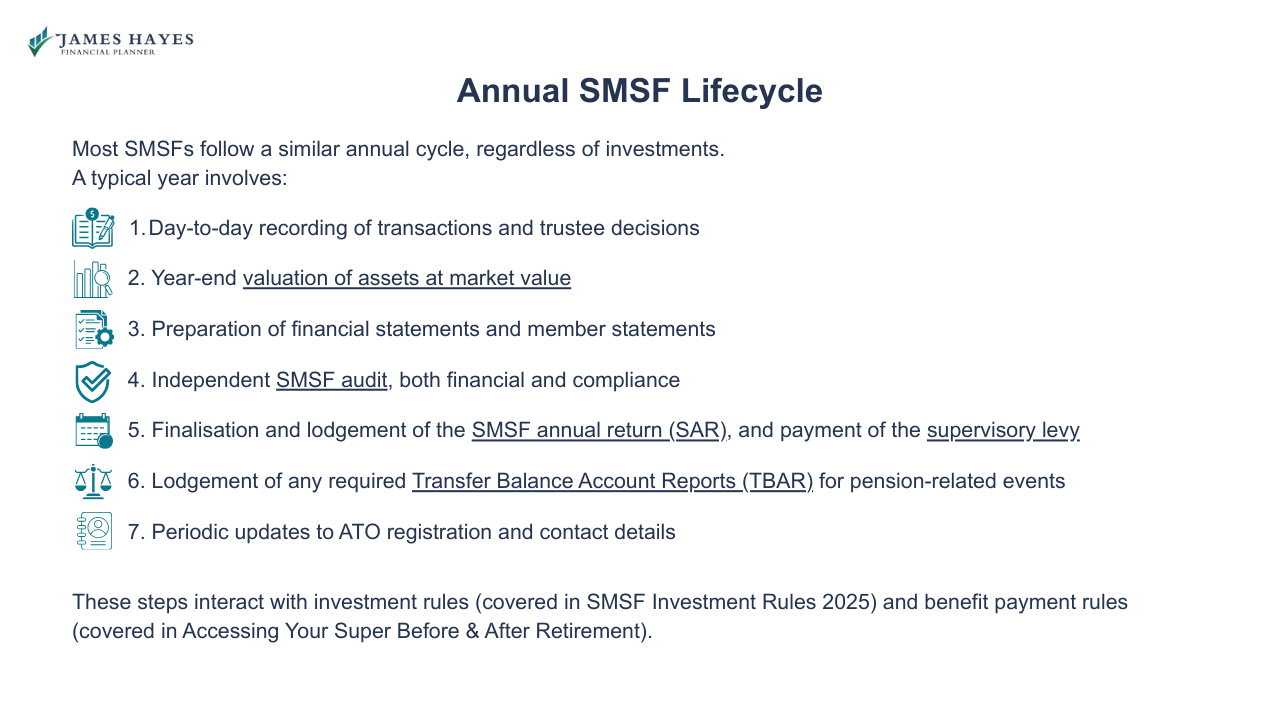
Most SMSFs follow a similar annual cycle, regardless of investments.
A typical year involves:
Day-to-day recording of transactions and trustee decisions
Year-end valuation of assets at market value
Preparation of financial statements and member statements
Independent SMSF audit, both financial and compliance
Finalisation and lodgement of the SMSF annual return (SAR), and payment of the supervisory levy
Lodgement of any required Transfer Balance Account Reports (TBAR) for pension-related events
Periodic updates to ATO registration and contact details
These steps interact with investment rules (covered in SMSF Investment Rules 2025) and benefit payment rules (covered in Accessing Your Super Before & After Retirement).
SMSF Record-Keeping Requirements
The ATO’s 2025 record-keeping guidance divides SMSF records into 5-year and 10-year categories.
For at least 5 years, trustees must keep:
Accurate and accessible accounting records explaining transactions and the fund’s financial position
Annual operating statements and statements of financial position
Documentation showing decisions about benefit payments (pension, lump sum, or combination) and which account they were paid from
Copies of all SMSF annual returns lodged
Copies of Transfer Balance Account Reports (TBAR) lodged
Copies of other statements lodged with the ATO or provided to other super funds
For at least 10 years, trustees must keep:
The fund’s trust deed and any variations
Minutes of trustee meetings and decisions
Details of the investment strategy and its regular reviews (including consideration of insurance)
Records of all changes of trustees and members
Signed trustee declarations (NAT 71089) for each trustee or director appointed after 30 June 2007
Members’ written consent to act as trustees or directors
Copies of reports given to members
Documented decisions about storage of collectables and personal-use assets
Records must be in English, or easily convertible into English, and must be accessible if the ATO or courts require them.
Setting Up an SMSF covers foundation documents such as trust deeds and trustee declarations. This article focuses on ongoing retention and organisation.
Paperwork feels daunting? Download the SMSF Ready Assessment & Setup Roadmap to assess whether a member is realistically willing and able to take on the record-keeping and documentation load.
SMSF Minutes and Decision-Making Documentation
Minutes sit at the centre of SMSF governance. The ATO expects trustees to minute:
Investment strategy approvals and reviews
Decisions to start, commute, or vary pensions
Decisions to pay lump sums
Decisions about collectables and storage
Key events such as trustee changes, contributions, and major investments
Minutes provide evidence that trustees discussed and agreed on important actions. If a decision is challenged, or an auditor reports a contravention, clear minutes can demonstrate that trustees acted in good faith and considered relevant rules.
SMSF Investment Rules 2025 and Accessing Your Super (Before & After Retirement) give examples of transactions that should be supported by detailed minutes.
Annual SMSF Compliance Audit
Every SMSF must undergo an annual audit by an approved SMSF auditor, regardless of size, activity level, or whether it received contributions that year.
Key points for trustees:
You must appoint an approved SMSF auditor at least 45 days before the due date of your SMSF annual return.
The audit has two parts:
Financial audit: Verifies that financial statements are fairly stated.
Compliance audit: Tests the fund against the Superannuation Industry (Supervision) Act 1993 and tax law requirements.
Trustees must sign the fund’s financial statements before the audit is finalised.
Auditors must lodge an Auditor/Actuary Contravention Report (ACR) to the ATO if they identify significant breaches, including certain SuperStream non-compliance, in-house asset breaches, or loans to members.
The audit process is explained in more detail in SMSF Compliance & Administration adjacent materials and linked industry guidance. Investment rule testing is handled in SMSF Investment Rules 2025.
Check out our SMSF Ready Assessment & Setup Roadmap which includes audit and reporting duties in its checklist, so you can see them as part of the ongoing responsibility before deciding if an SMSF is right for you.
SMSF Annual Return (SAR), Supervisory Levy, and Deadlines
The SMSF annual return (SAR) is more than a tax return. It combines:
The fund’s income tax return
Regulatory information (compliance status, residency, asset allocation, and other data)
Member contribution reporting
Payment of the SMSF supervisory levy
The ATO’s 2025 guidance emphasises that late or missing SARs can result in:
“Regulation details removed” status on Super Fund Lookup, which can block rollovers and employer contributions
Administrative penalties and risk-based ATO scrutiny
Typical lodgement patterns for 2023–24 and 2024–25 (similar settings are expected for 2025–26) are:
31 October: Some newly registered funds or funds with overdue prior-year SARs
28 February: Self-preparing SMSFs without earlier lodgement obligations
31 March: Certain high-income funds
15 May: Most funds lodging via a tax agent
Exact due dates depend on the fund’s circumstances, agent lodgement programs, and any ATO reviews, so trustees should confirm the applicable date each year.
Free eBook: SMSF Ready Assessment and Setup Roadmap (Instant Download)
〰️
Free eBook: SMSF Ready Assessment and Setup Roadmap (Instant Download) 〰️
SuperStream, ESA, and Rollovers
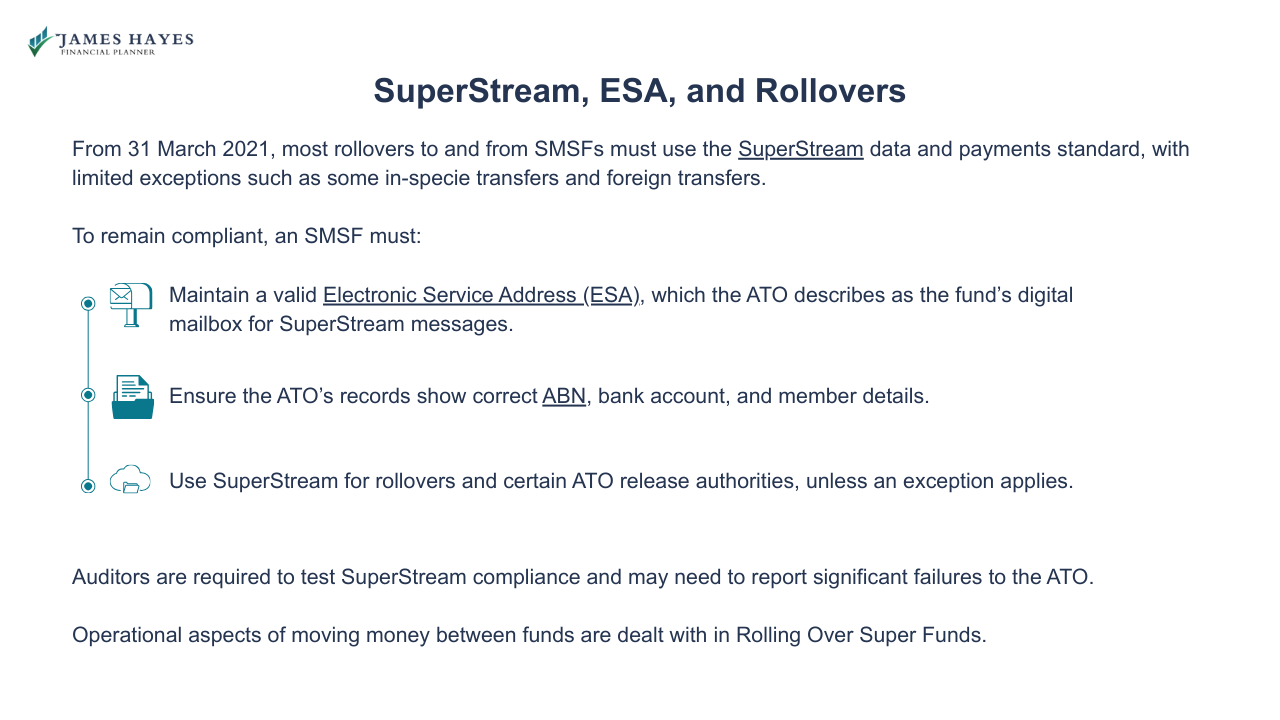
From 31 March 2021, most rollovers to and from SMSFs must use the SuperStream data and payments standard, with limited exceptions such as some in-specie transfers and foreign transfers.
To remain compliant, an SMSF must:
Maintain a valid Electronic Service Address (ESA), which the ATO describes as the fund’s digital mailbox for SuperStream messages.
Ensure the ATO’s records show correct ABN, bank account, and member details.
Use SuperStream for rollovers and certain ATO release authorities, unless an exception applies.
Auditors are required to test SuperStream compliance and may need to report significant failures to the ATO.
Operational aspects of moving money between funds are dealt with in Rolling Over Super Funds.
Valuations, Investment Strategy Reviews, and Documenting Risk
Each year, trustees must value all fund assets at market value for the financial statements and SAR. The ATO’s guidance on valuing SMSF assets states that valuations should be based on objective and supportable data, such as:
Market prices for listed securities
Recent comparable sales for property
Independent valuations where appropriate
In parallel, trustees must review the investment strategy, considering:
Risk and likely return for each member
Diversification, especially if a fund is heavily exposed to a single asset such as property
Liquidity to meet expenses and pension payments
Insurance considerations
The ATO has indicated that strategies must be specific and show that trustees have considered diversification and liquidity risks, particularly when concentrations arise.
This area overlaps with SMSF Investment Rules 2025 and How to Grow Your Super Balance, which cover asset allocation and risk in more depth.
Pensions, PAYG Withholding, and TBAR Reporting
Once an SMSF starts paying pensions, administration and reporting obligations increase.
Key ongoing tasks include:
Ensuring minimum pension payments are made each year, based on the member’s age and account balance, to maintain pension tax treatment.
Considering PAYG withholding and payment summaries where a member is under 60 and receives taxable income stream payments.
Reporting relevant events via the Transfer Balance Account Report (TBAR), including pension commencements, certain commutations, and some death-benefit pensions.
TBAR timing depends on the fund’s total super balance and the event date. Late or incorrect TBAR reporting can result in excess transfer balance determinations and commutation authorities.
The pensions and withdrawal side is explained further in Accessing Your Super (Before & After Retirement) and Superannuation Death Benefits.
Notifying the ATO of Changes
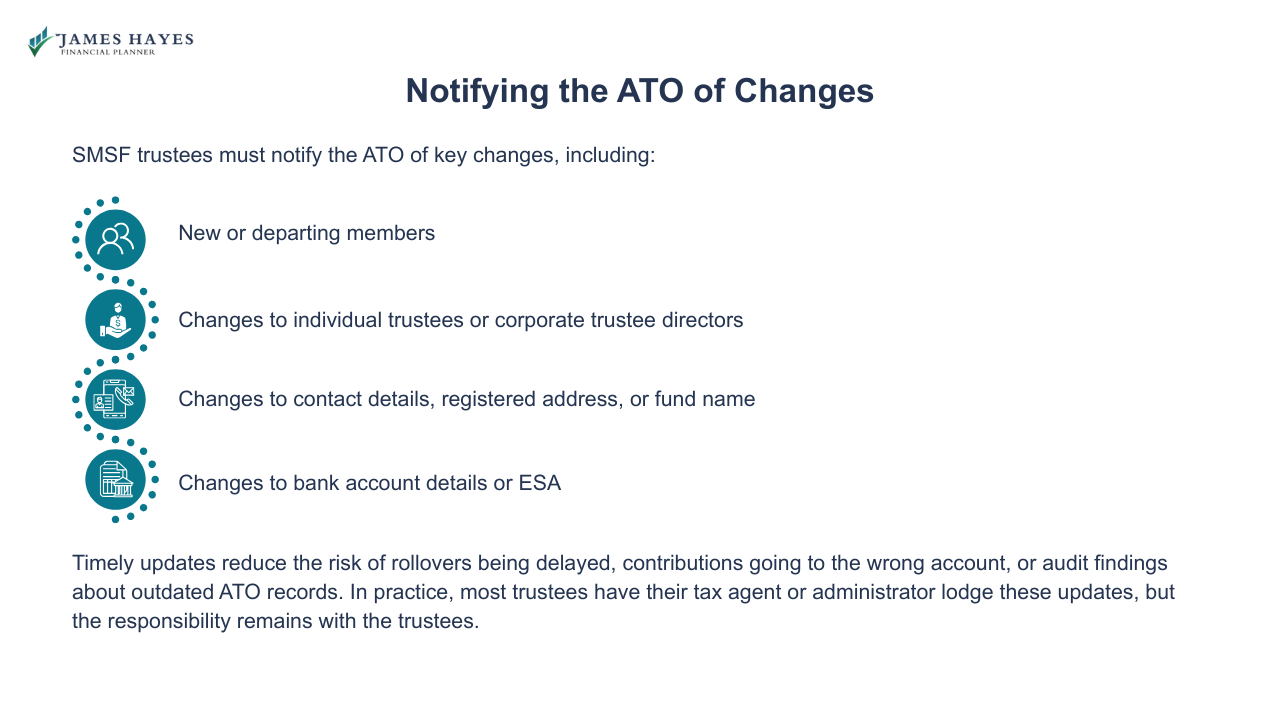
SMSF trustees must notify the ATO of key changes, including:
New or departing members
Changes to individual trustees or corporate trustee directors
Changes to contact details, registered address, or fund name
Changes to bank account details or ESA
Timely updates reduce the risk of rollovers being delayed, contributions going to the wrong account, or audit findings about outdated ATO records. In practice, most trustees have their tax agent or administrator lodge these updates, but the responsibility remains with the trustees.
Managing Breaches, Rectification, and ATO Penalties
Despite best efforts, breaches do occur. Common issues reported by auditors include loans to members, in-house asset breaches, missing documentation, and late SAR lodgement.
If a breach is identified:
Trustees should document what happened, why, and the rectification steps.
For certain breaches (for example, in-house assets exceeding 5%), trustees must prepare a written plan to correct the problem within the next income year
The auditor may lodge an Auditor Contravention Report. the ATO then determines whether to apply administrative penalties, education directions, or enforce rectification
Administrative penalties are charged personally to each individual trustee or director for specific breaches, and cannot be paid from SMSF assets. The ATO has also used targeted compliance programs in 2025 to address non-lodged SARs.
Breaches connected with illegal early access or schemes to avoid SuperStream are of particular concern. James does not assist with arrangements designed to access super early or consolidate personal debts using SMSF assets.
Compliance Patterns for 35–50 and 55–65-Year-Olds
Compliance issues often differ by life stage, even under the same rules.
For 35–50-year-olds, typical risks include:
Establishing an SMSF without fully understanding the record-keeping and audit work.
Property transactions that breach related-party rules or SuperStream processes.
Under-documented investment decisions or absence of regular investment strategy reviews.
For 55–65-year-olds, key risks shift towards:
Failing to meet minimum pension payments, which can threaten tax exemptions.
Missing TBAR reporting for new pensions or commutations.
Inadequate documentation around reversionary pensions, death-benefit nominations, or estate-linked decisions.
Those topics link directly into SMSF Investment Rules 2025, Accessing Your Super (Before & After Retirement), Superannuation Death Benefits, and the inheritance knowledge pack.
How This Links to Broader Super, SMSF, and Inheritance Advice
Compliance and administration sit beneath every other SMSF decision. The other articles in the ecosystem address:
How to Grow Your Super Balance (contributions, compounding, and investment mix)
Super Contribution Rules 2025 and Tax Benefits of Super Contributions (the tax environment that makes super effective)
Ethical & Sustainable Super Funds (investment selection frameworks inside and outside SMSFs)
Super and Divorce / Relationship Splits and Women & Super Gap Awareness (how compliance interacts with splitting orders, contributions, and the gender super gap)
For many trustees, the practical question is whether they have both the time and the structure to manage SMSF compliance on top of these strategic decisions.
How James Hayes Supports SMSF Trustees with Compliance and Administration
Regulators continue to focus on SMSF advice where costs, responsibilities, and compliance risks are not fully explained.
Within this environment, James works with SMSF trustees in the Sutherland Shire and Sydney CBD to:
Clarify trustee obligations and the annual compliance calendar.
Align investment strategy and contributions (see SMSF Investment Rules 2025 and Super Contribution Rules 2025).
Coordinate with administrators, accountants, and auditors so SAR, TBAR, and SuperStream requirements are met.
Integrate SMSF administration with retirement and inheritance planning covered in Accessing Your Super (Before & After Retirement) and Superannuation Death Benefits.
He does not use SMSFs for Jobseeker planning, debt consolidation, or early-access schemes. Book a complimentary 15-minute call with him.
FAQs
-
Each year, trustees must keep accurate accounting records, value assets at market value, prepare and sign financial statements, arrange an independent SMSF audit, lodge the SMSF annual return (SAR) and pay the supervisory levy, lodge any required TBAR events, and keep ATO registration, bank account, and ESA details up to date.
-
Financial records such as accounting records, annual financial statements, benefit payment documentation, SMSF annual returns, and TBAR reports must be kept for at least five years. Trustee records such as minutes, investment strategies and reviews, trustee declarations, member consents, and reports to members must be kept for at least ten years under ATO guidance.
-
Yes. Every SMSF must be audited annually by an approved SMSF auditor, regardless of whether it received contributions or made investments during the year. The audit covers both financial statements and compliance with super and tax law, and it must be finalised before the annual return is lodged.
-
Late SMSF annual returns can result in administrative penalties, targeted ATO compliance activity, and a “regulation details removed” status on Super Fund Lookup. That status can block rollovers and employer contributions until lodgements are brought up to date. Persistent non-lodgement increases the risk of more serious regulatory action.
-
Yes. Administrators and accountants can assist with bookkeeping, financial statements, and lodgements, but the ATO makes it clear that trustees remain personally responsible for SMSF compliance. If records are poor, or rules are breached, penalties apply to trustees or directors, not to the administrator or tax agent.
-
The Transfer Balance Account Report (TBAR) is used to report certain pension-related events to the ATO, including the commencement of retirement-phase pensions, some commutations, and some death-benefit income streams. Lodgement timing depends on fund and member thresholds, and late reporting can lead to excess transfer balance determinations and commutation notices.
-
An Electronic Service Address (ESA) is required for SuperStream-compliant rollovers and employer contributions. The ATO requires SMSFs to have an active ESA, correct ABN and bank details, and matching member information. Incorrect or missing ESA or bank details can delay rollovers, disrupt contributions, and attract auditor or ATO attention.
-
When a breach occurs, trustees should document the issue, take rectification steps, and work with their auditor and adviser. For significant breaches, auditors lodge an Auditor Contravention Report, and the ATO decides whether to apply penalties, issue education or rectification directions, or in severe cases, consider non-complying fund status.
Superannuation & SMSFs Knowledge Bundle
- What is Superannuation and How Does It Work?
- How to Grow Your Super Balance
- Super Contribution Rules 2025
- Tax Benefits of Super Contributions
- Accessing Your Super (Before & After Retirement)
- Superannuation Death Benefits
- Self-Managed Super Funds (SMSFs) Explained
- Setting Up an SMSF
- SMSF Investment Rules 2025
- Rolling Over Super Funds
- Ethical & Sustainable Super Funds
- Super for the Self-Employed
- Super and Divorce / Relationship Splits
- Women & Super Gap Awareness
Disclaimer
The information in this article is provided as a general guide only. It does not constitute personal financial advice and should not be relied upon as such. Readers should seek advice from a licensed financial adviser before making any financial decisions. James Hayes and his associated entities accept no responsibility or liability for any loss, damage, or action taken in reliance on the information contained in this article. Links to third-party websites are provided for reference purposes only. We do not endorse or guarantee the accuracy of their content.