
Super for the Self-Employed (Guide for Business Owners & Contractors)
Summary
If you are self-employed, no one is required to pay Super Guarantee for you. You can make personal contributions, usually claim a tax deduction up to the concessional cap, and use co-contribution and carry-forward rules. The main task is turning irregular business cashflow into consistent, tax-effective retirement saving.
Table of Contents
- Introduction
- Are You Actually Self-employed for Super Purposes?
- Super Options for Self-employed People
- Contribution Caps and Deduction Rules in 2025–26
- Tax Outcomes for Self-employed Concessional Contributions
- Government Incentives Like Co-contribution and LISTO
- Practical Contribution Frameworks for Irregular Income
- Super for Sole Traders, Companies, and Trusts
- When Do SMSFs for the Self-employed Make Sense?
- Business Real Property in Super
- Super Versus Reinvesting in the Business
- Insurance, Estate Planning, and Relationship Risks for the Self-employed
- How James Hayes Works with Self-employed Clients
- FAQs
- Superannuation & SMSFs Knowledge Bundle
Introduction
If you run a business in the Sutherland Shire or Sydney CBD, or work as a contractor, you do not automatically receive employer super contributions in the same way employees do. The structure of your business and the contracts you sign determine whether anyone must pay Super Guarantee for you.
This article explains super for the self-employed in 2025–26, focusing on:
When you are treated as an employee for super purposes
How to contribute if you are genuinely self-employed
Tax treatment of contributions and incentives for low and middle incomes
Practical contribution frameworks for irregular income
When SMSFs and business property strategies may or may not be appropriate
It fits into the wider ecosystem:
What is Superannuation and How Does It Work? (system and tax basics)
How to Grow Your Super Balance (strategy and portfolio design)
Super Contribution Rules 2025 and Tax Benefits of Super Contributions (caps and tax)
Self-Managed Super Funds (SMSFs) Explained, Setting Up an SMSF, and SMSF Investment Rules 2025 (SMSF structures)
Rolling Over Super Funds (moving between funds, or to an SMSF)
Women & Super Gap Awareness and Super and Divorce / Relationship Splits (structural gaps, family law, and equity)
James Hayes is an ASIC-licensed financial planner based in Caringbah, working with business owners, professionals, and retirees across the Sutherland Shire and Sydney CBD on super and retirement strategies. He does not help with Centrelink Jobseeker support, debt consolidation using super, or schemes to withdraw super early.
Are You Actually Self-employed for Super Purposes?
The first step is to confirm whether you are genuinely self-employed or an employee for super purposes. The distinction affects who must pay Super Guarantee (SG).
Under Australian law, an employer generally must pay SG (12% from 1 July 2025) on ordinary time earnings for eligible employees. Certain contractors paid mainly for their labour are treated as employees for super purposes, even if they have an ABN and invoice.
Common examples include:
A sole-trader consultant working under a contract where payment is mainly for personal labour or skills.
A contractor who cannot delegate the work and is paid by the hour, day, or job for their own labour.
If you fall into this category, the engaging business may be required to pay SG into a super fund you nominate. This is covered in more detail in What is Superannuation and How Does It Work? and Super Contribution Rules 2025.
If you are:
A sole trader genuinely in business,
A partner in a partnership, or
A company director where the company does not pay SG for you,
then you are effectively responsible for your own super, and the rest of this article assumes that position.
Super Options for Self-employed People
Self-employed people can use most of the same contribution types as employees, but the mechanics differ because there is no default employer.
Broadly, you can:
Make personal concessional contributions (before-tax) and claim a tax deduction.
Make personal non-concessional contributions (after-tax) without a deduction
Use carry-forward concessional cap rules if eligible.
Access government co-contribution and LISTO at lower incomes.
You can contribute to:
A large industry or retail fund, or
An SMSF, if it is appropriate and already established
The SMSF decision itself is treated in Self-Managed Super Funds (SMSFs) Explained and Setting Up an SMSF.
Contribution Caps and Deduction Rules in 2025–26
Contribution caps and deduction rules for the self-employed are the same as for other individuals.
For 2025–26:
The concessional contributions cap is $30,000 per person, per year. This covers employer contributions, salary sacrifice, and personal contributions you claim as a deduction.
The non-concessional contributions cap is $120,000 per person, per year, with bring-forward options for eligible individuals who stay under the general transfer balance cap and total super balance thresholds.
If you are self-employed and have no employer contributions, the entire $30,000 concessional cap is available for your personal deductible contributions, subject to cashflow and tax considerations.
To claim a deduction, you must:
Make a personal contribution to a complying super fund.
Give your fund a valid notice of intent to claim or vary a deduction.
Receive acknowledgment from the fund.
Lodge your tax return claiming the deduction in the same year.
These mechanics, including Division 293 for higher incomes and the interaction with marginal tax rates, are covered in more numerical detail in Tax Benefits of Super Contributions.
Not sure how much of your drawings or profit should go to super? Use the Self-Employed Super Cashflow Planner to figure out a percentage that fits your business cashflow.
Tax Outcomes for Self-employed Concessional Contributions
The tax logic is the same whether you are employed or self-employed.
If you have taxable business income of $120,000:
Without super contributions, that income is taxed at your marginal tax rate.
A personal concessional contribution of, say, $25,000 reduces your taxable income to $95,000.
The contribution is taxed at 15% in the fund (plus any Division 293 if applicable), rather than at your marginal rate.
For mid-income self-employed people, the immediate benefit is usually the difference between the marginal rate and 15% (for example, 30% minus 15% = 15% saving on each dollar contributed, ignoring Medicare and offsets).
Over time, the earnings on investments inside super are taxed at up to 15% in accumulation, and may be tax-free in retirement phase within the transfer balance cap. These longer-term tax effects are modelled step-by-step in How to Grow Your Super Balance and Tax Benefits of Super Contributions.
Government Incentives Like Co-contribution and LISTO
Self-employed people can access the same co-contribution and Low Income Super Tax Offset (LISTO) incentives as employees, provided they meet eligibility criteria.
At lower and middle incomes:
If you make a non-concessional contribution (and do not claim a deduction on it), you may receive a government co-contribution up to $500, subject to income thresholds and contribution amounts.
If your adjusted taxable income is at or below the LISTO threshold (and you have concessional contributions), you may receive a refund of 15% of your concessional contributions, up to $500, paid into your super.
These incentives are particularly relevant for:
Self-employed people with lumpy incomes who have years of lower income
Secondary earners in couples, where one partner is self-employed and contributes irregularly
The article Tax Benefits of Super Contributions details the specific thresholds and worked examples.
Practical Contribution Frameworks for Irregular Income
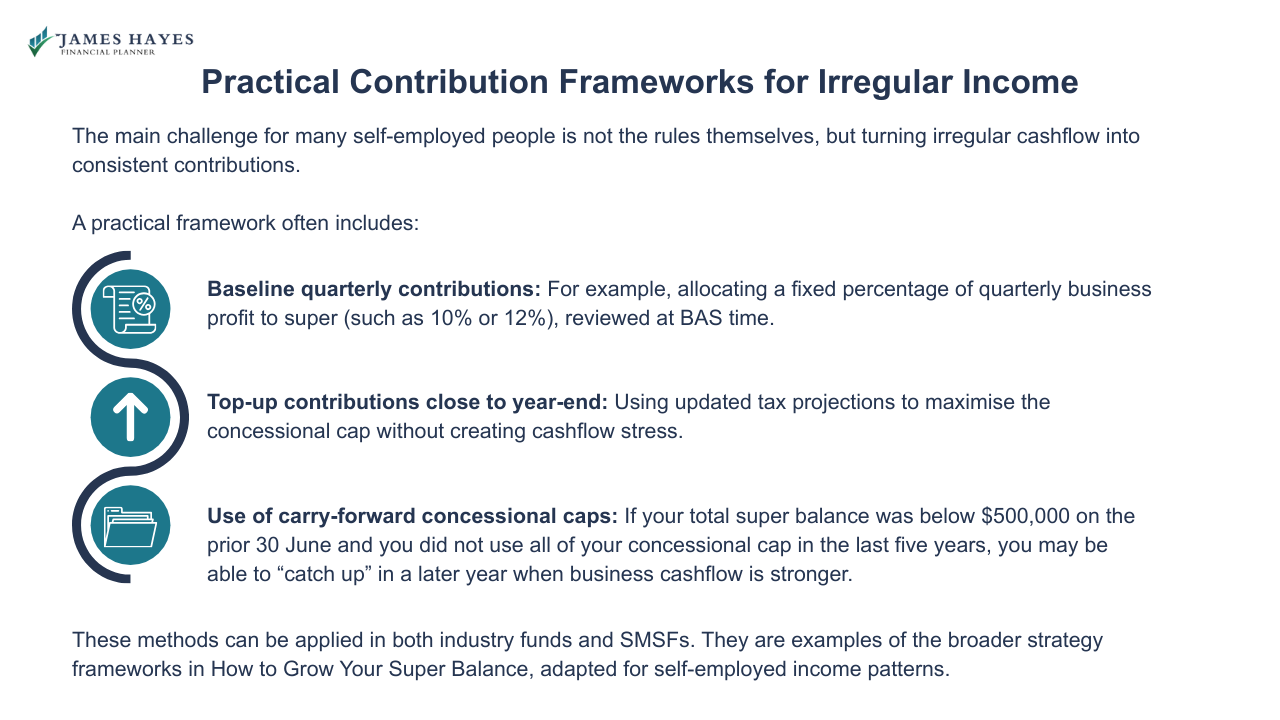
The main challenge for many self-employed people is not the rules themselves, but turning irregular cashflow into consistent contributions.
A practical framework often includes:
Baseline quarterly contributions: For example, allocating a fixed percentage of quarterly business profit to super (such as 10% or 12%), reviewed at BAS time.
Top-up contributions close to year-end: Using updated tax projections to maximise the concessional cap without creating cashflow stress.
Use of carry-forward concessional caps: If your total super balance was below $500,000 on the prior 30 June and you did not use all of your concessional cap in the last five years, you may be able to “catch up” in a later year when business cashflow is stronger.
These methods can be applied in both industry funds and SMSFs. They are examples of the broader strategy frameworks in How to Grow Your Super Balance, adapted for self-employed income patterns.
Want to turn irregular business income into consistent super? Download the Self-Employed Super Cashflow Planner. It shows you how to link your income to a quarterly contribution plan and gives you simple guidelines you can stick to.
Free eBook: Self-Employed Super Cashflow Planner (Instant Download)
〰️
Free eBook: Self-Employed Super Cashflow Planner (Instant Download) 〰️
Super for Sole Traders, Companies, and Trusts
How your business is structured affects how money flows into super, but not the core tax rules for contributions.
For a sole trader or partnership:
Business profit is taxed personally.
You usually make personal contributions from after-tax cash and claim a deduction, subject to caps.
For a company:
The company is a separate taxpayer.
The company can make employer contributions for you as a director or employee, which count towards your concessional cap.
Alternatively, you may draw salary or wages and arrange salary sacrifice.
For a trust:
Super contributions can be made for beneficiaries as employees, or you may take distributions and then contribute personally.
Tax and super strategy need to be co-ordinated across the trust and personal return.
Across all structures, you must still follow contribution caps, timing rules, and deduction mechanics, which are treated in Super Contribution Rules 2025 and Tax Benefits of Super Contributions.
Different structures handle contributions differently. The Self-Employed Super Cashflow Planner includes prompts for sole traders, companies, and trust setups so you can map your own process clearly.
When Do SMSFs for the Self-employed Make Sense?
SMSFs are frequently marketed to self-employed people, especially business owners interested in property strategies. They can be useful, but they are not automatically the best option.
They may be appropriate when:
Combined super balances are large enough that SMSF costs are efficient as a percentage of assets.
There is a clear business objective, such as owning business real property in super on commercial terms.
Members are prepared to meet the trustee duties and compliance workload.
They may be inappropriate where:
Balances are modest and the fee impact is high.
Business risk and cashflow volatility are already significant, and adding SMSF responsibilities would increase overall risk.
The main driver is a property proposal that does not fit the SMSF Investment Rules 2025 or is close to a scheme for early access.
The structural considerations, including sole purpose, in-house asset rules, and limited recourse borrowing arrangements, are explained in Self-Managed Super Funds (SMSFs) Explained, Setting Up an SMSF, and SMSF Investment Rules 2025.
Business Real Property in Super
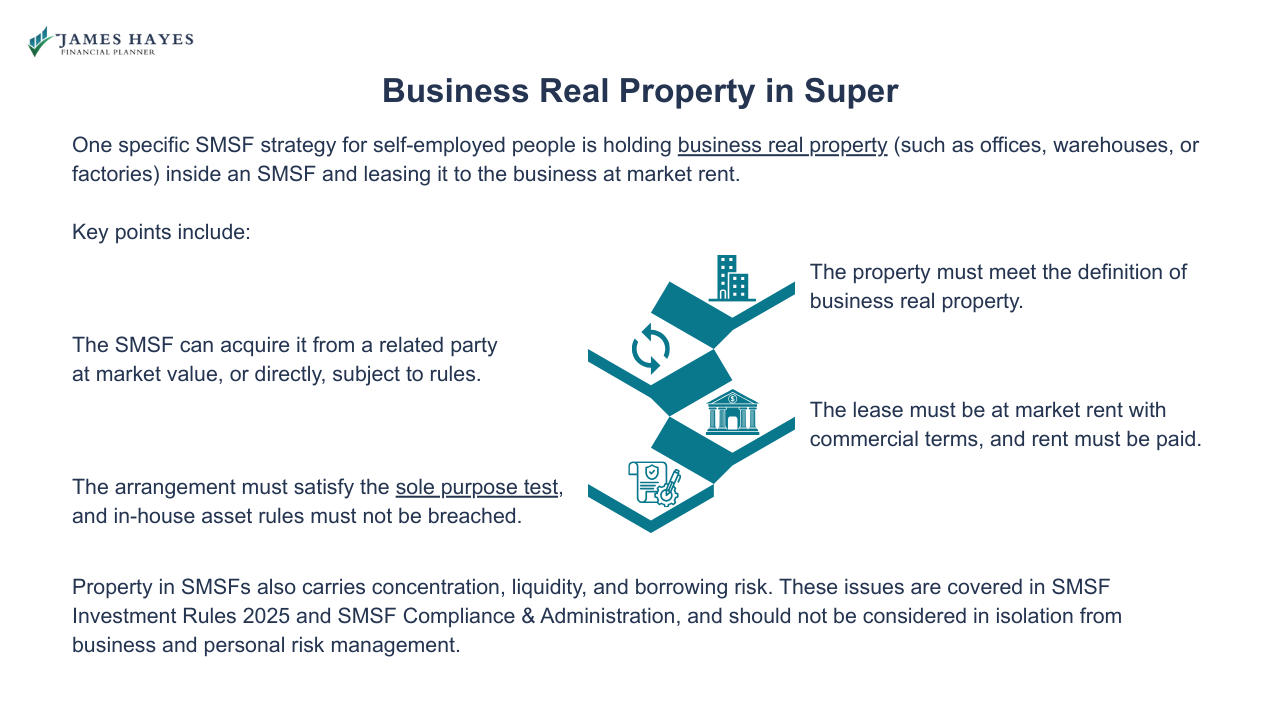
One specific SMSF strategy for self-employed people is holding business real property (such as offices, warehouses, or factories) inside an SMSF and leasing it to the business at market rent.
Key points include:
The property must meet the definition of business real property.
The SMSF can acquire it from a related party at market value, or directly, subject to rules.
The lease must be at market rent with commercial terms, and rent must be paid.
The arrangement must satisfy the sole purpose test, and in-house asset rules must not be breached.
Property in SMSFs also carries concentration, liquidity, and borrowing risk. These issues are covered in SMSF Investment Rules 2025 and SMSF Compliance & Administration, and should not be considered in isolation from business and personal risk management.
Super Versus Reinvesting in the Business
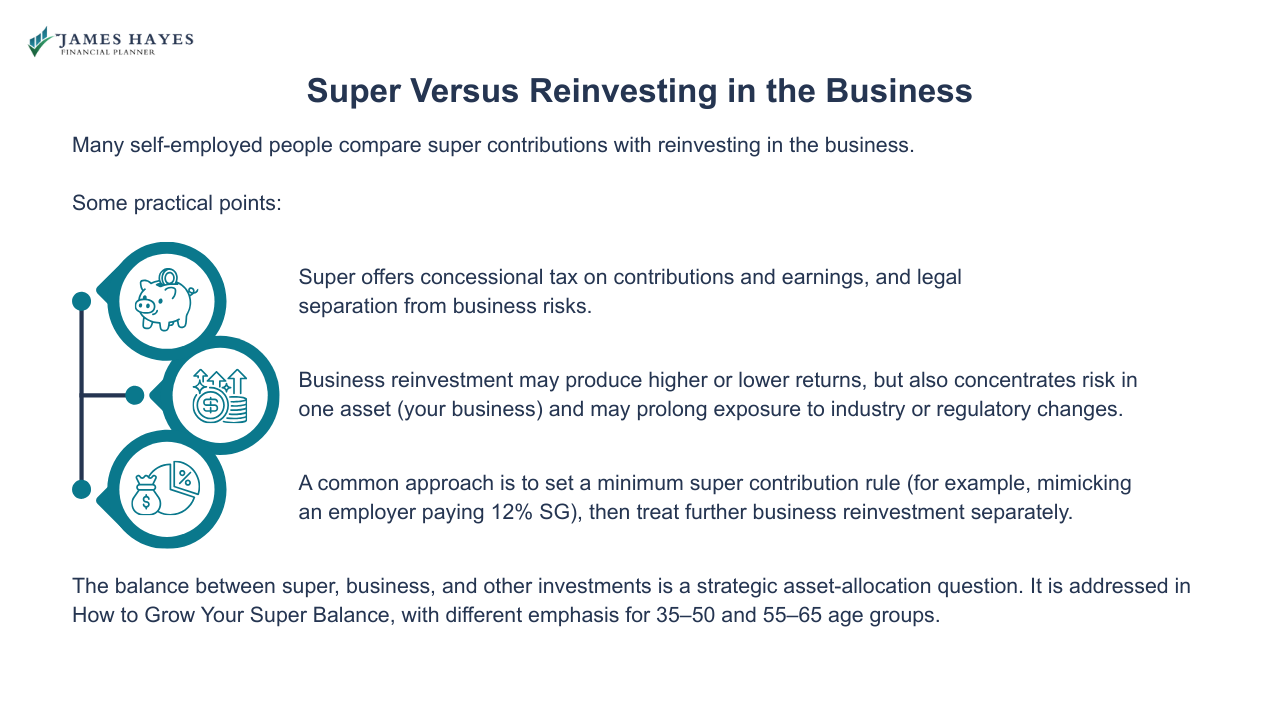
Many self-employed people compare super contributions with reinvesting in the business.
Some practical points:
Super offers concessional tax on contributions and earnings, and legal separation from business risks.
Business reinvestment may produce higher or lower returns, but also concentrates risk in one asset (your business) and may prolong exposure to industry or regulatory changes.
A common approach is to set a minimum super contribution rule (for example, mimicking an employer paying 12% SG), then treat further business reinvestment separately.
The balance between super, business, and other investments is a strategic asset-allocation question. It is addressed in How to Grow Your Super Balance, with different emphasis for 35–50 and 55–65 age groups.
Insurance, Estate Planning, and Relationship Risks for the Self-employed
Self-employed people often have:
More business risk than employees
Less default insurance through super
More complex estates (for example, business interests, trusts, and SMSFs)
Super helps manage:
Personal insurance: Life, TPD, and sometimes income protection cover funded via super premiums.
Estate planning: Death benefits paid to dependants or your estate, as explained in Superannuation Death Benefits.
Relationship splits: Super treated as property in family law, which is covered in Super and Divorce / Relationship Splits.
The structural gap for women who are self-employed, take time out of the workforce, or work part-time is considered in Women & Super Gap Awareness. Super for the self-employed should be coordinated with those equity and estate-planning issues, not treated as a separate silo.
How James Hayes Works with Self-employed Clients
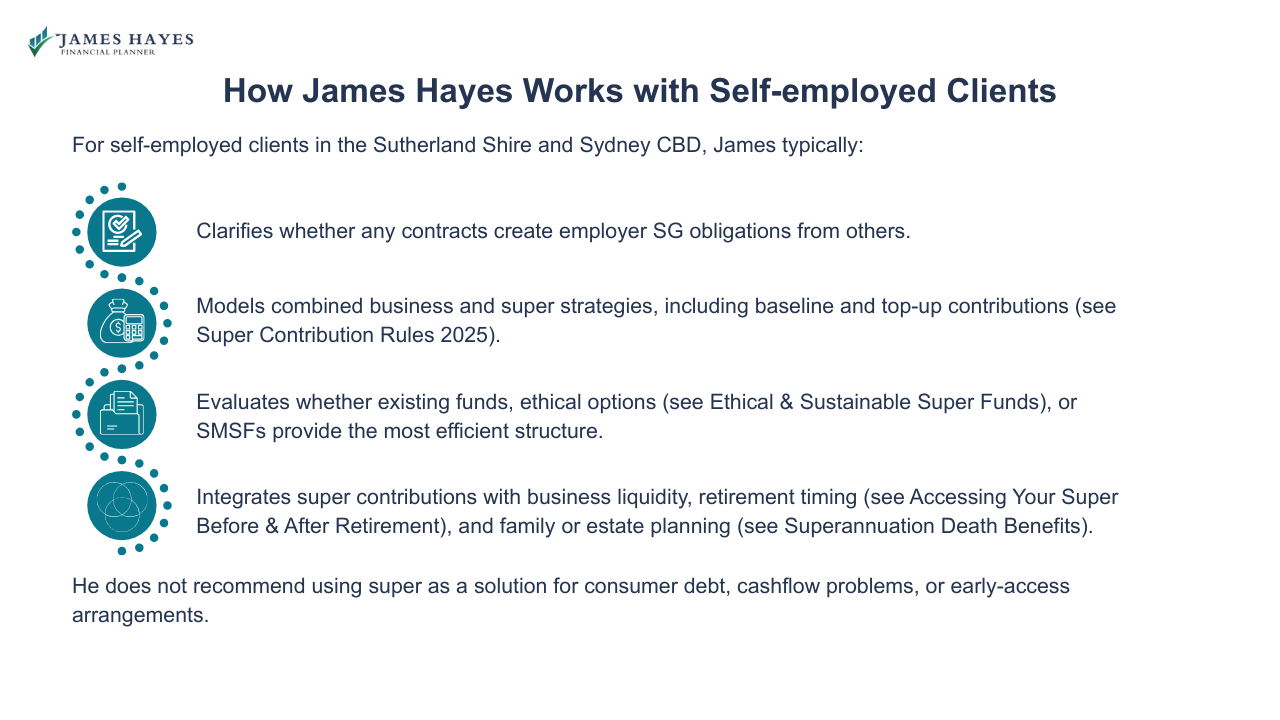
For self-employed clients in the Sutherland Shire and Sydney CBD, James typically:
Clarifies whether any contracts create employer SG obligations from others.
Models combined business and super strategies, including baseline and top-up contributions (see Super Contribution Rules 2025).
Evaluates whether existing funds, ethical options (see Ethical & Sustainable Super Funds), or SMSFs provide the most efficient structure.
Integrates super contributions with business liquidity, retirement timing (see Accessing Your Super Before & After Retirement), and family or estate planning (see Superannuation Death Benefits).
He does not recommend using super as a solution for consumer debt, cashflow problems, or early-access arrangements.
FAQs
-
No, you are not required to pay Super Guarantee for yourself if you are a genuine sole trader or partner. However, you can choose to make personal contributions and usually claim a tax deduction up to the concessional cap. If you are a contractor mainly paid for labour, SG may still apply from the payer.
-
There is no mandated amount. A common starting point is to mirror the Super Guarantee rate (12% of your business income or drawings) and review annually. From there, you can use top-up or catch-up concessional contributions within caps, based on cashflow and tax projections, especially in more profitable years.
-
If you are self-employed or substantially self-funded, most personal contributions can be claimed as concessional contributions, provided you lodge a valid notice of intent with your fund and receive acknowledgment. The amount then counts towards the concessional cap and is taxed at 15% in the fund, subject to Division 293.
-
Possibly, if the property qualifies as business real property, the SMSF is appropriate for your circumstances, and the property is leased to your business on market terms. The arrangement must satisfy SMSF investment rules, including the sole purpose test, related-party and in-house asset limits, and borrowing rules if an LRBA is used.
-
Often, yes. Super provides tax concessions and legal separation from business risk, while reinvesting in the business can increase concentration risk. Many self-employed people adopt a minimum contribution rule (such as 10–12% of income), then assess further reinvestment separately. The optimal balance depends on risk tolerance, business prospects, and retirement goals.
-
Super in complying funds is generally separate from business assets. If the business fails, creditors usually cannot access your super, although contributions made with the intent to defeat creditors may be challenged. Your super remains invested according to fund rules and is accessed under standard retirement conditions and tax rules, not business insolvency rules.
-
You usually only need one primary super fund for personal and, if relevant, company contributions. The more important distinctions are investment option, fees, insurance, and whether an SMSF is appropriate. Multiple funds may be necessary only to preserve specific insurances or defined benefit features, which should be reviewed carefully before consolidating.
-
At least annually, and whenever there are significant business or personal changes, including income volatility, new debt, major investments, or approaching retirement. Reviews should cover contributions versus caps, tax outcomes, investment performance relative to objectives, insurance adequacy, and whether structural changes such as SMSFs or rollovers remain appropriate.
Superannuation & SMSFs Knowledge Bundle
- What is Superannuation and How Does It Work?
- How to Grow Your Super Balance
- Super Contribution Rules 2025
- Tax Benefits of Super Contributions
- Accessing Your Super (Before & After Retirement)
- Superannuation Death Benefits
- Self-Managed Super Funds (SMSFs) Explained
- Setting Up an SMSF
- SMSF Investment Rules 2025
- SMSF Compliance & Administration
- Rolling Over Super Funds
- Ethical & Sustainable Super Funds
- Super and Divorce / Relationship Splits
- Women & Super Gap Awareness
Disclaimer
The information in this article is provided as a general guide only. It does not constitute personal financial advice and should not be relied upon as such. Readers should seek advice from a licensed financial adviser before making any financial decisions. James Hayes and his associated entities accept no responsibility or liability for any loss, damage, or action taken in reliance on the information contained in this article. Links to third-party websites are provided for reference purposes only. We do not endorse or guarantee the accuracy of their content.