
Ethical & Sustainable Super Funds
Summary
Ethical and sustainable super funds invest using environmental, social, and governance (ESG) criteria alongside financial analysis. Approaches include exclusions, ESG integration, and impact investing. In Australia, you assess them by checking disclosures, holdings, certification, performance, and fees, while being alert to greenwashing and ensuring they still meet your retirement objectives.
Table of Contents
- Introduction
- What Is an Ethical or Sustainable Super Fund?
- ASIC, APRA, and Greenwashing
- Exclusions, ESG Integration, and Impact
- How Ethical and Sustainable Super Options Are Disclosed
- Ethical Super Performance, Risk, and Fees
- How to Assess Whether an Ethical Super Option Is Credible
- Ethical and Sustainable Investing Within Existing Super Funds
- Ethical and Sustainable Strategies Inside SMSFs
- Ethical Super Considerations by Age and Life Stage
- Switching to Ethical Options or Funds
- Managing Greenwashing Risk as a Member
- How James Hayes Incorporates Ethical & Sustainable Super Preferences
- FAQs
- Superannuation & SMSFs Knowledge Bundle
Introduction
Ethical and sustainable super options are now standard in many large super funds, and increasingly used in SMSFs. For households in the Sutherland Shire and Sydney CBD, the main questions are whether these options are credible, how they perform, and how they fit into an existing retirement strategy.
This article explains:
What “ethical”, “responsible”, and “sustainable” super funds mean in practice
The Australian regulatory environment, including greenwashing enforcement
Approaches used by funds – exclusions, ESG integration, and impact
How to evaluate options, including performance, fees, and transparency
How to factor ethical investing into both platform super and SMSFs
It sits alongside:
What is Superannuation and How Does It Work? (system structure and tax)
How to Grow Your Super Balance (contribution and investment strategy)
Self-Managed Super Funds (SMSFs) Explained, SMSF Investment Rules 2025, and SMSF Compliance & Administration (SMSF governance)
Women & Super Gap Awareness and Super and Divorce / Relationship Splits (structural equity and splitting)
James Hayes is an ASIC-licensed financial planner based in Caringbah, working with clients across the Sutherland Shire and Sydney CBD on super, retirement planning, and SMSFs. He does not assist with Centrelink Jobseeker support, debt consolidation using super, or early access schemes.
What Is an Ethical or Sustainable Super Fund?
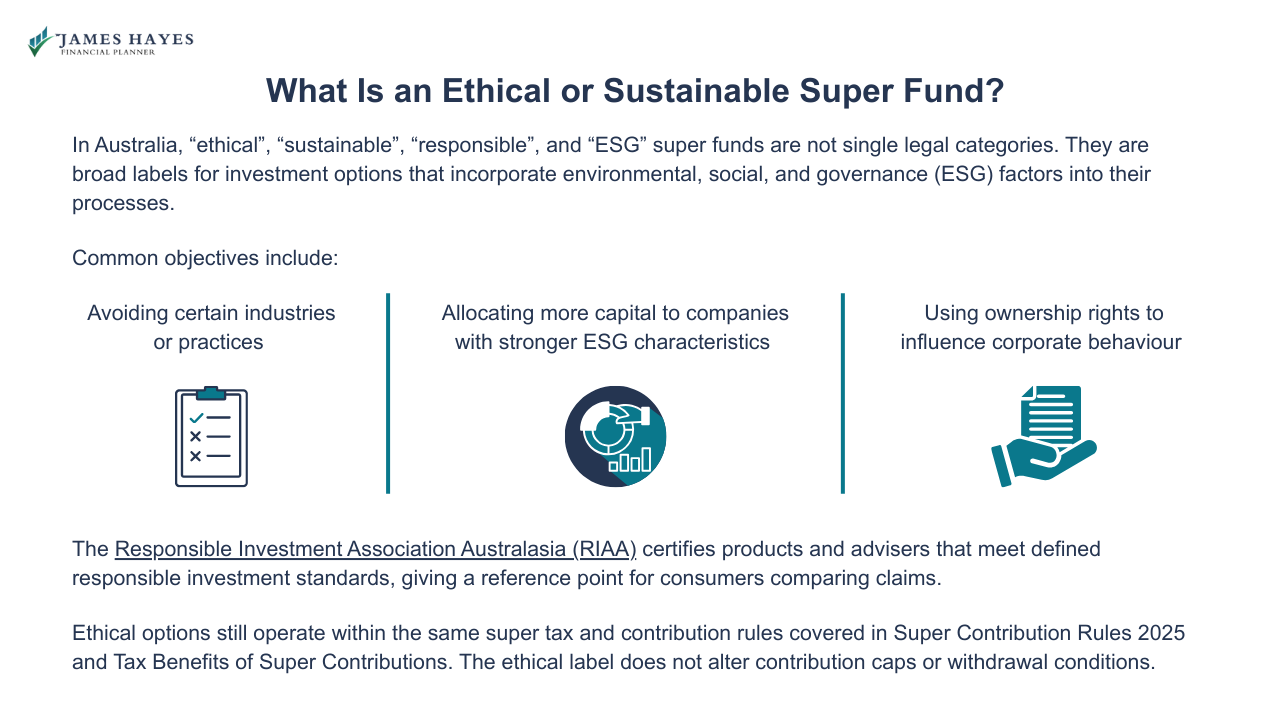
In Australia, “ethical”, “sustainable”, “responsible”, and “ESG” super funds are not single legal categories. They are broad labels for investment options that incorporate environmental, social, and governance (ESG) factors into their processes.
Common objectives include:
Avoiding certain industries or practices
Allocating more capital to companies with stronger ESG characteristics
Using ownership rights to influence corporate behaviour
The Responsible Investment Association Australasia (RIAA) certifies products and advisers that meet defined responsible investment standards, giving a reference point for consumers comparing claims.
Ethical options still operate within the same super tax and contribution rules covered in Super Contribution Rules 2025 and Tax Benefits of Super Contributions. The ethical label does not alter contribution caps or withdrawal conditions.
If you’re comparing ethical options across a few funds, use the Super Fund Comparison & Rollover Workbook — it gives you a clean structure to compare fees, performance, insurance, and ESG disclosures side by side.
ASIC, APRA, and Greenwashing
Ethical super funds operate inside the same regulatory framework as other funds, but there is additional supervisory focus on sustainability-related claims.
ASIC has issued INFO 271 – How to avoid greenwashing when offering or promoting sustainability-related products, which defines greenwashing and sets expectations for disclosure clarity, evidence, and consistency between marketing and actual holdings.
Regulatory action has increased:
ASIC’s 2023–24 report on greenwashing interventions recorded 47 regulatory interventions between April 2023 and June 2024, including civil penalty actions, infringement notices, and corrective disclosures targeting misleading sustainability claims in super and managed funds.
In 2024, the Federal Court fined Mercer Superannuation A$11.3 million for misleading ESG claims about its “Sustainable Plus” options, which still held high carbon emitters, alcohol producers, and gambling companies.
In 2024, Active Super was found to have made misleading claims about excluding gambling, coal, and oil sands while retaining holdings in those sectors.
APRA’s CPG 229 Climate Change Financial Risks guides super trustees on managing climate-related financial risks as part of standard risk management and governance, emphasising that climate risks are treated like other financial risks that may affect returns.
For investors, this means ethical super options are subject to both general super law and specific expectations around clarity and accuracy of ESG claims.
Exclusions, ESG integration, and Impact
Different super funds use different approaches, and many combine several methods within a single option. Understanding these approaches helps you interpret product disclosures and marketing.
Broad approaches include:
Negative screening (exclusions): Excluding certain sectors or companies (for example, tobacco, fossil fuels, controversial weapons, or gambling) from the investable universe.
Positive screening / best-in-class: Favouring companies with stronger ESG scores within each sector.
ESG integration: Systematically including ESG factors in research and valuation, alongside financial metrics.
Thematic or impact investing: Targeting specific themes such as renewable energy, clean transport, or social infrastructure, often with explicit impact metrics.
Active ownership / stewardship: Using voting and engagement strategies to influence company behaviour and disclosures.
RIAA’s certification program classifies some options as “Sustainable” or “Sustainable Plus”, based on screening and impact criteria, and maintains a public list of certified super products.
When comparing options, you should not assume that all “ethical” or “sustainable” labels mean the same thing. The detail of the screens and integration process matters.
How Ethical and Sustainable Super Options Are Disclosed
Ethical and sustainable options must still meet general disclosure requirements for super funds, including:
Product Disclosure Statements (PDS) describing investment strategy, risks, and fees.
Target Market Determinations (TMDs) outlining who the product is designed for.
Product dashboards for MySuper options, which show returns, risks, and fees in a standard format.
Many funds also publish:
ESG policies and stewardship reports
Lists of holdings, sometimes with sustainability ratings
Statements about exclusions and positive tilts
However, the Mercer and Active Super cases show that public claims and actual holdings can diverge if processes are weak. This is why ASIC’s guidance focuses on ensuring that labels, marketing, and disclosures match the underlying portfolio and processes.
When evaluating a fund, it is sensible to review both the PDS and the sustainability materials, and to cross-check any “no exposure” claims against holdings lists where they are available.
Ethical Super Performance, Risk, and Fees
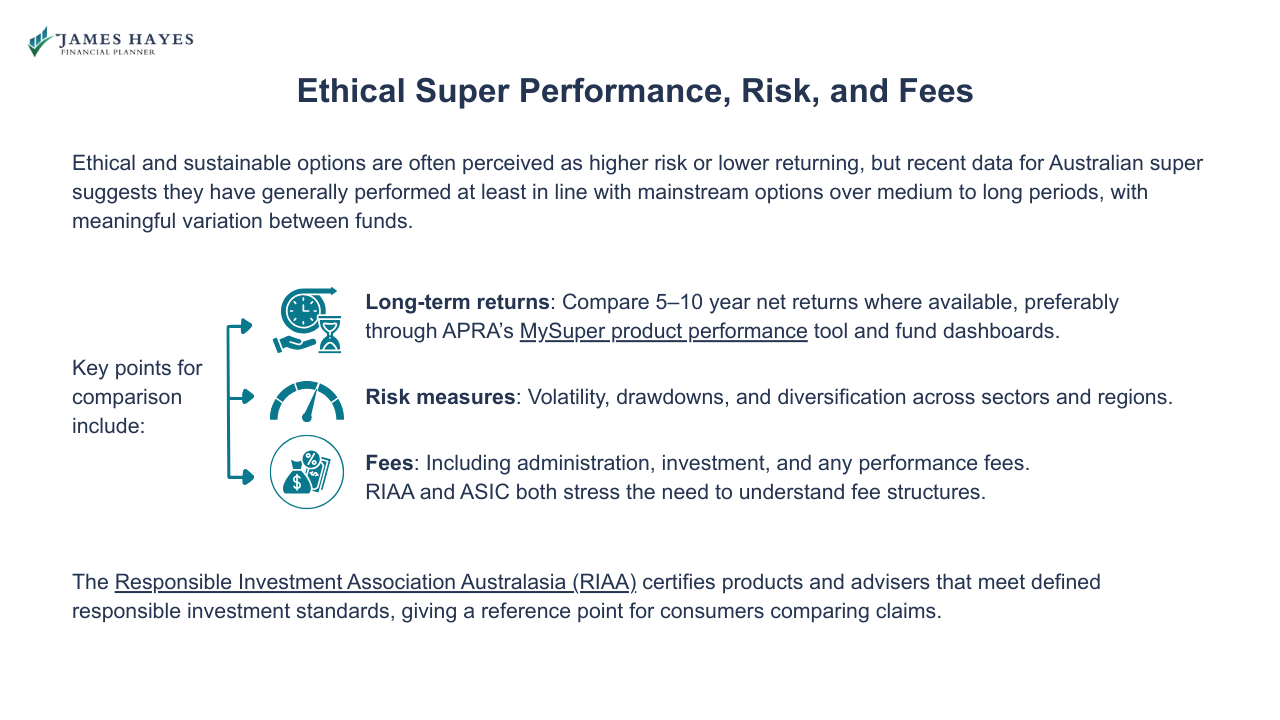
Ethical and sustainable options are often perceived as higher risk or lower returning, but recent data for Australian super suggests they have generally performed at least in line with mainstream options over medium to long periods, with meaningful variation between funds.
Key points for comparison include:
Long-term returns: Compare 5–10 year net returns where available, preferably through APRA’s MySuper product performance tool and fund dashboards.
Risk measures: Volatility, drawdowns, and diversification across sectors and regions.
Fees: Including administration, investment, and any performance fees. RIAA and ASIC both stress the need to understand fee structures.
The investment strategy work in How to Grow Your Super Balance applies equally to ethical options: portfolio design, risk tolerance, and time horizon remain central.
How to Assess Whether an Ethical Super Option Is Credible
A structured checklist is useful when reviewing ethical or sustainable super options, whether inside an existing fund or when considering a rollover.
Factors to review include:
Clarity of objectives and screens: Are excluded sectors and positive screens clearly defined and applied consistently?
Certification and external frameworks: Is the option certified under RIAA’s Responsible Investment Certification Program, or aligned with recognised frameworks such as TCFD or the UN Principles for Responsible Investment?
Holdings transparency: Does the fund publish holdings, and do they align with its stated exclusions and themes?
Stewardship reporting: Are engagement activities and voting records disclosed and aligned with the policy?
Performance and fees: As above, using dashboards and APRA data.
ASIC’s INFO 271 includes questions that product issuers must consider to avoid greenwashing. These can be repurposed by investors as a due-diligence checklist.
If a fund’s marketing statements are general, but underlying holdings reveal exposure to activities it claims to avoid, that is a potential warning sign, as recent enforcement outcomes illustrate.
Want a simple way to compare ethical options properly? The Super Fund Comparison & Rollover Workbook lets you line up fees, returns, policies, and ESG settings in one place.
Free eBook: Super Fund Comparison & Rollover Workbook
〰️
Free eBook: Super Fund Comparison & Rollover Workbook 〰️
Ethical and Sustainable Investing Within Existing Super Funds
For many Australians, the most straightforward way to implement ethical preferences is to select an ethical or sustainable option within an existing large fund, rather than changing providers.
Most large industry and retail funds now:
Offer at least one pre-mixed “sustainable” or “socially responsible” option, sometimes certified by RIAA.
Integrate ESG into their standard investment processes, even for core MySuper balanced options.
In practice, the process is:
Review existing investment options in your fund (growth, balanced, conservative, sustainable).
Compare each option’s PDS, sustainability disclosures, and performance.
Confirm that switching options does not cancel insurance or change fee tiers in unexpected ways.
This is often coordinated with contribution strategy, investment risk settings, and retirement planning discussed in How to Grow Your Super Balance and Accessing Your Super (Before & After Retirement).
Ethical and Sustainable Strategies Inside SMSFs
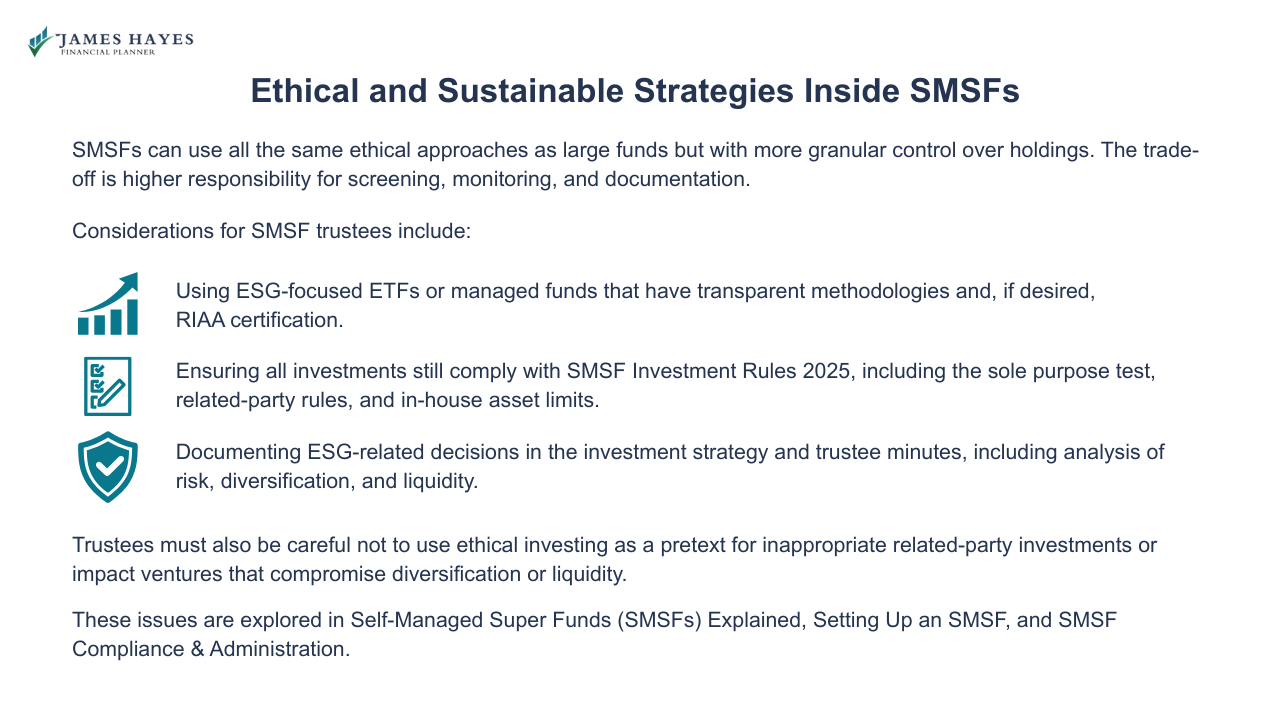
SMSFs can use all the same ethical approaches as large funds but with more granular control over holdings. The trade-off is higher responsibility for screening, monitoring, and documentation.
Considerations for SMSF trustees include:
Using ESG-focused ETFs or managed funds that have transparent methodologies and, if desired, RIAA certification.
Ensuring all investments still comply with SMSF Investment Rules 2025, including the sole purpose test, related-party rules, and in-house asset limits.
Documenting ESG-related decisions in the investment strategy and trustee minutes, including analysis of risk, diversification, and liquidity.
Trustees must also be careful not to use ethical investing as a pretext for inappropriate related-party investments or impact ventures that compromise diversification or liquidity.
These issues are explored in Self-Managed Super Funds (SMSFs) Explained, Setting Up an SMSF, and SMSF Compliance & Administration.
If you’re weighing an SMSF against ethical industry funds, the Super Fund Comparison & Rollover Workbook gives you a clear comparison page to work from.
Ethical Super Considerations by Age and Life Stage
Ethical and sustainable preferences do not replace standard portfolio design principles, which differ between 35–50-year-olds and 55–65-year-olds.
For 35–50 year olds:
Time horizons are often 15–30+ years, which supports higher growth allocations and potentially more concentrated thematic or impact exposures, subject to risk analysis.
Rollover and consolidation decisions often interact with career changes, self-employment, and family formation, linking to Super for the Self-Employed and Women & Super Gap Awareness.
For 55–65 year olds:
Sequence-of-returns risk and liquidity for pensions become central.
Ethical options need to be assessed for volatility, diversification, and income characteristics alongside sustainability criteria.
Pension design and withdrawal planning sit within Accessing Your Super (Before & After Retirement) and Superannuation Death Benefits.
In both groups, ethical preferences are one part of an overall super strategy, not a stand-alone objective.
Switching to Ethical Options or Funds
Switching to ethical super can involve either:
Moving into an ethical option within your current fund, or
Rolling over to a different fund that provides more suitable ethical options.
The mechanics of rollovers, timing, and data requirements are explained in Rolling Over Super Funds. In summary:
Use myGov or the receiving fund’s processes to initiate a rollover. This is treated as a transfer, not a contribution.
Confirm the impact on insurance, death-benefit nominations, and fees before closing old accounts.
For SMSFs, ensure the SMSF is fully established and SuperStream-ready before requesting rollovers.
James does not use rollovers as a way to access super early or to consolidate consumer debts.
Managing Greenwashing Risk as a Member
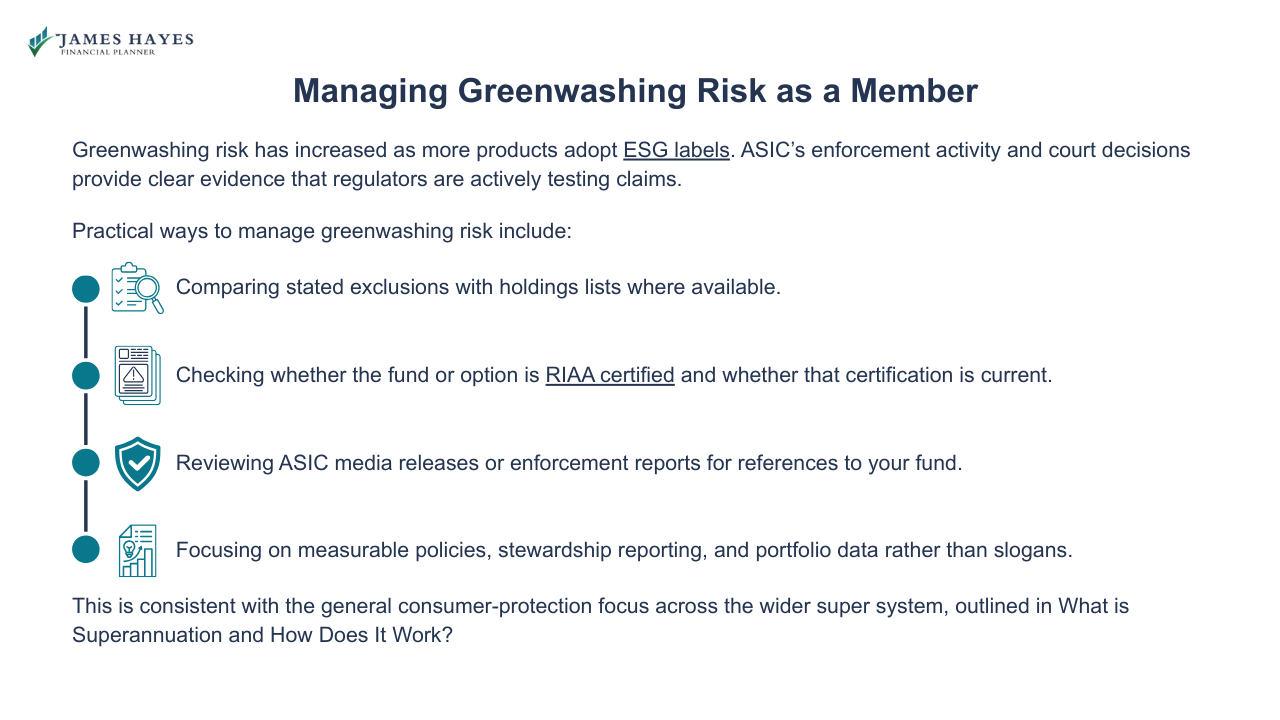
Greenwashing risk has increased as more products adopt ESG labels. ASIC’s enforcement activity and court decisions provide clear evidence that regulators are actively testing claims.
Practical ways to manage greenwashing risk include:
Comparing stated exclusions with holdings lists where available.
Checking whether the fund or option is RIAA certified and whether that certification is current.
Reviewing ASIC media releases or enforcement reports for references to your fund.
Focusing on measurable policies, stewardship reporting, and portfolio data rather than slogans.
This is consistent with the general consumer-protection focus across the wider super system, outlined in What is Superannuation and How Does It Work?
Unsure how each fund approaches ESG? The Super Fund Comparison & Rollover Workbook’s ESG section helps you compare policies, exclusions, certifications, and how transparent each fund is about its holdings.
How James Hayes Incorporates Ethical and Sustainable Super Preferences
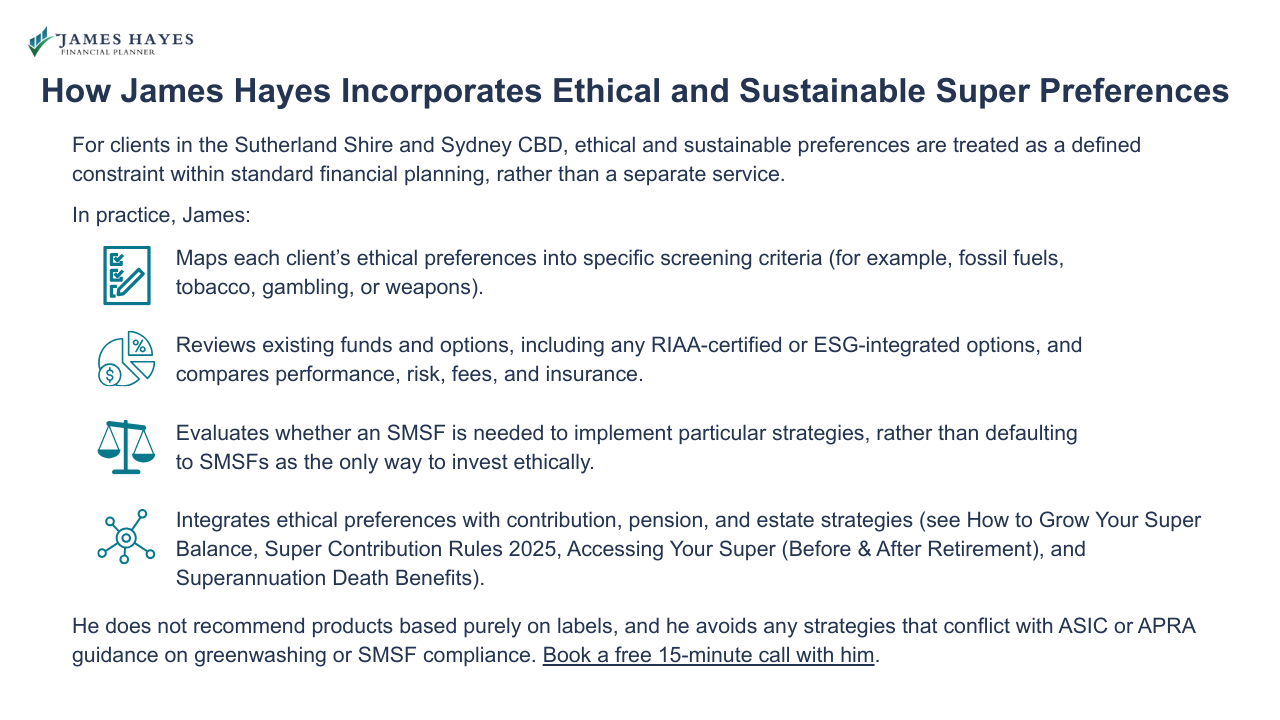
For clients in the Sutherland Shire and Sydney CBD, ethical and sustainable preferences are treated as a defined constraint within standard financial planning, rather than a separate service.
In practice, James:
Maps each client’s ethical preferences into specific screening criteria (for example, fossil fuels, tobacco, gambling, or weapons).
Reviews existing funds and options, including any RIAA-certified or ESG-integrated options, and compares performance, risk, fees, and insurance.
Evaluates whether an SMSF is needed to implement particular strategies, rather than defaulting to SMSFs as the only way to invest ethically.
Integrates ethical preferences with contribution, pension, and estate strategies (see How to Grow Your Super Balance, Super Contribution Rules 2025, Accessing Your Super (Before & After Retirement), and Superannuation Death Benefits).
He does not recommend products based purely on labels, and he avoids any strategies that conflict with ASIC or APRA guidance on greenwashing or SMSF compliance.
FAQs
-
An ethical or sustainable super fund uses environmental, social, and governance (ESG) criteria in investment decisions, in addition to financial analysis. Approaches include exclusions, ESG integration, and impact themes. In Australia, products are still subject to standard super and disclosure rules, and some are independently certified under programs such as RIAA’s Responsible Investment Certification.
-
Not necessarily. Recent Australian data shows many sustainable options have performed broadly in line with, or sometimes ahead of, mainstream options over selected periods, while others trail. Performance depends on asset allocation, implementation, and fees, not just ESG labels. Long-term return, volatility, and diversification still need careful comparison, using dashboards and APRA data.
-
Check whether stated exclusions and themes match published holdings, whether the option is independently certified by bodies such as RIAA, and whether ESG policies, engagement reports, and voting records are detailed and consistent. ASIC’s greenwashing guidance emphasises that claims must be clear, specific, and supported by evidence, not general slogans.
-
Often yes. Many industry and retail funds offer sustainable or socially responsible options alongside standard choices, and many integrate ESG across all portfolios. You can usually switch options within the fund, after reviewing PDS, sustainability disclosures, fees, and insurance implications. This avoids rollovers unless a different fund is required for specific features.
-
In an SMSF, trustees can select ESG-focused ETFs, managed funds, or direct holdings consistent with their ethical criteria. They must still meet SMSF investment rules, including the sole purpose test, related-party limits, and diversification considerations. ESG preferences should be reflected in the investment strategy and trustee minutes, with appropriate documentation and monitoring.
-
Ethical funds are subject to the same super, disclosure, and conduct rules as other funds, but ASIC has issued specific guidance (INFO 271) on avoiding greenwashing in sustainability-related products. APRA’s CPG 229 also guides trustees on managing climate-related financial risks. Regulations focus on accurate disclosure, risk management, and avoiding misleading ESG claims.
-
Before rolling over, assess the new fund’s investment approach, ESG criteria, performance, and fees, along with insurance cover and death-benefit nominations. Confirm that ethical claims are supported by holdings and certification where relevant. You should also confirm rollover processes, SuperStream requirements, and the impact on existing defined benefit or legacy features, if any.
-
Review ethical super choices when your preferences change, when there are significant product changes or regulatory findings, and as part of your regular super review, often annually or biennially. This includes checking performance, fees, holdings, and updated ESG policies, alongside broader retirement planning, contribution strategies, and estate considerations across your overall financial position.
Superannuation & SMSFs Knowledge Bundle
- What is Superannuation and How Does It Work?
- How to Grow Your Super Balance
- Super Contribution Rules 2025
- Tax Benefits of Super Contributions
- Accessing Your Super (Before & After Retirement)
- Superannuation Death Benefits
- Self-Managed Super Funds (SMSFs) Explained
- Setting Up an SMSF
- SMSF Investment Rules 2025
- SMSF Compliance & Administration
- Rolling Over Super Funds
- Super for the Self-Employed
- Super and Divorce / Relationship Splits
- Women & Super Gap Awareness
Disclaimer
The information in this article is provided as a general guide only. It does not constitute personal financial advice and should not be relied upon as such. Readers should seek advice from a licensed financial adviser before making any financial decisions. James Hayes and his associated entities accept no responsibility or liability for any loss, damage, or action taken in reliance on the information contained in this article. Links to third-party websites are provided for reference purposes only. We do not endorse or guarantee the accuracy of their content.