
Deceased Estates & Capital Gains Tax in Australia: Key Rules
Summary
CGT is not paid when a person dies because section 128-10 of the Income Tax Assessment Act 1997 disregards capital gains and losses at death. CGT is worked out later when the executor or beneficiary sells an inherited asset. The main residence rules in Section 118-195 can remove CGT on an inherited home if conditions are met.
Table of Contents
- Introduction
- How Does CGT Work When Someone Dies?
- When Is CGT Worked Out?
- Cost Base Rules for Inherited Assets
- Inherited Homes and the Main Residence Exemption
- Special Situations That Change CGT Outcomes
- Record Keeping for Executors and Beneficiaries
- Mistakes That Create Avoidable CGT
- When to Get Advice
- Conclusion
- FAQs
- Inheritance & Estate Planning Knowledge Bundle
Introduction
When an estate includes property, shares, or managed funds, capital gains tax can become the biggest tax item after death. The tax calculation is linked to when an inherited asset is sold or transferred, and who does it.
This guide explains the CGT rules that apply to deceased estates in Australia, with an emphasis on the decisions executors and beneficiaries make most often.
How Does CGT Work When Someone Dies?
Australian tax law treats death as a handover point, not a sale.
Capital Gains and Losses at Death Are Disregarded
Section 128-10 of the Income Tax Assessment Act 1997 states that when you die, a capital gain or capital loss from a CGT event for a CGT asset you owned just before death is disregarded. This is why families do not receive a CGT bill simply because someone has died.
CGT Exceptions
There is a specific exception where CGT event K3 can apply. Section 104-215 of the Income Tax Assessment Act 1997 states that CGT event K3 happens if a CGT asset passes to a beneficiary who, at the time it passes, is an exempt entity, the trustee of a complying superannuation entity, or a foreign resident. If your estate has any foreign resident beneficiaries, it is worth flagging this early, before assets are transferred.
When Is CGT Worked Out?
CGT is worked out when a later CGT event happens, most often a sale. Section 104-10 of the Income Tax Assessment Act 1997 explains CGT event A1 happens if you dispose of a CGT asset, and disposal includes a change of ownership from you to another entity.
Who Pays the CGT Bill?
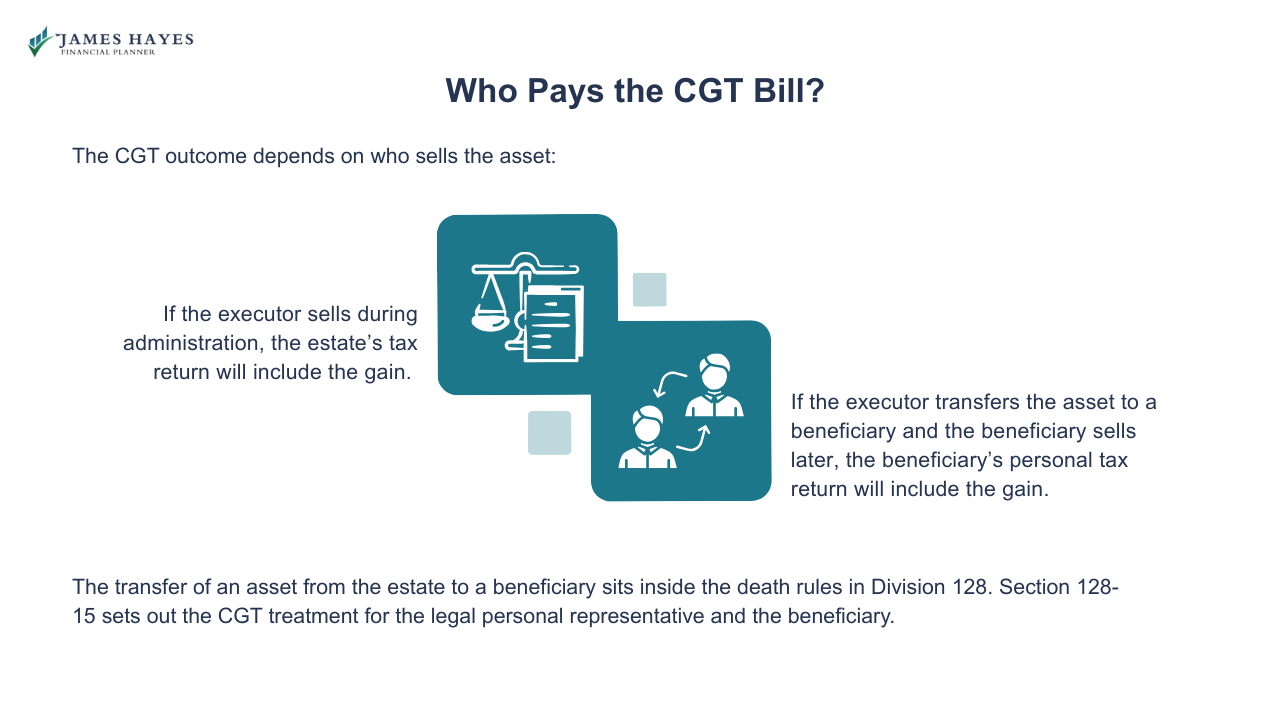
The CGT outcome depends on who sells the asset:
If the executor sells during administration, the estate’s tax return will include the gain.
If the executor transfers the asset to a beneficiary and the beneficiary sells later, the beneficiary’s personal tax return will include the gain.
The transfer of an asset from the estate to a beneficiary sits inside the death rules in Division 128. Section 128-15 sets out the CGT treatment for the legal personal representative and the beneficiary.
Cost Base Rules for Inherited Assets
A CGT calculation is built on the cost base, then adjusted by any exemptions or discounts. The ATO sets out how to work out the cost base of inherited assets and confirms that, in some circumstances, legal costs incurred by the legal personal representative can form part of the cost base of the estate’s assets.
Date-of-Death Valuations
Executors and beneficiaries often need date-of-death values to support cost base and exemption calculations. If records are incomplete, getting a formal valuation early can reduce later disputes about the numbers used.
Jointly Owned Property
If a CGT asset is owned by joint tenants and one of them dies, Section 128-50 of the Income Tax Assessment Act 1997 states the surviving joint tenant is taken to have acquired the deceased’s interest on the day of death.
Inherited Homes and the Main Residence Exemption
Inherited homes are where CGT outcomes vary the most, because the main residence rules are fact-driven. Section 118-195 of the Income Tax Assessment Act 1997 contains the rules that can allow you to disregard a capital gain or loss for a dwelling acquired from a deceased estate in the circumstances set out in the section’s table.
2-Year Sale Period and Extensions
Many estates focus on the two-year period linked to the deceased estate main residence exemption. The ATO explains when it will consider an extension to the two-year ownership period and that extensions are not automatic.
Partial Exemptions
If Section 118-195 does not apply, Section 118-200 of the Income Tax Assessment Act 1997 provides the rules for a partial exemption (or no exemption) for deceased estate dwellings.
Absence Rule
Section 118-145 of the Income Tax Assessment Act 1997 allows a person to choose to keep treating a dwelling as their main residence after they stop living in it, and sets a six-year maximum while it is used to produce assessable income.
Special Situations That Change CGT Outcomes
A few scenarios need extra care because the default assumptions break quickly.
Foreign Resident Issues
The ATO’s foreign resident main residence guidance states that if a person is a foreign resident for tax purposes when they die, the foreign resident main residence rules also apply to legal personal representatives and beneficiaries of the deceased estate. If any beneficiary lives overseas, confirm tax residency early. Do not assume citizenship and residency are the same thing.
Assets Passing Under a Deed of Arrangement
If an estate is resolved by deed (for example, after a claim), Section 128-20 of the Income Tax Assessment Act 1997 sets out when an asset is taken to pass to a beneficiary, including where an asset becomes owned under a deed of arrangement that settles an estate participation claim.
Non-Arm’s-Length Transfers Outside Standard Estate Administration
Where a disposal happens outside normal sale conditions, the market value substitution rule can apply. Section 116-30 of the Income Tax Assessment Act 1997 sets out when capital proceeds are replaced with market value, including where parties did not deal at arm’s length. This is more common in gifting and restructure scenarios than in a clean executor sale, but it is still relevant if assets move in unusual ways.
Free eBook: Inherited Property CGT Decision Tree + 2-Year Sale Tracker (Instant Download)
〰️
Free eBook: Inherited Property CGT Decision Tree + 2-Year Sale Tracker (Instant Download) 〰️
Recordkeeping for Executors and Beneficiaries
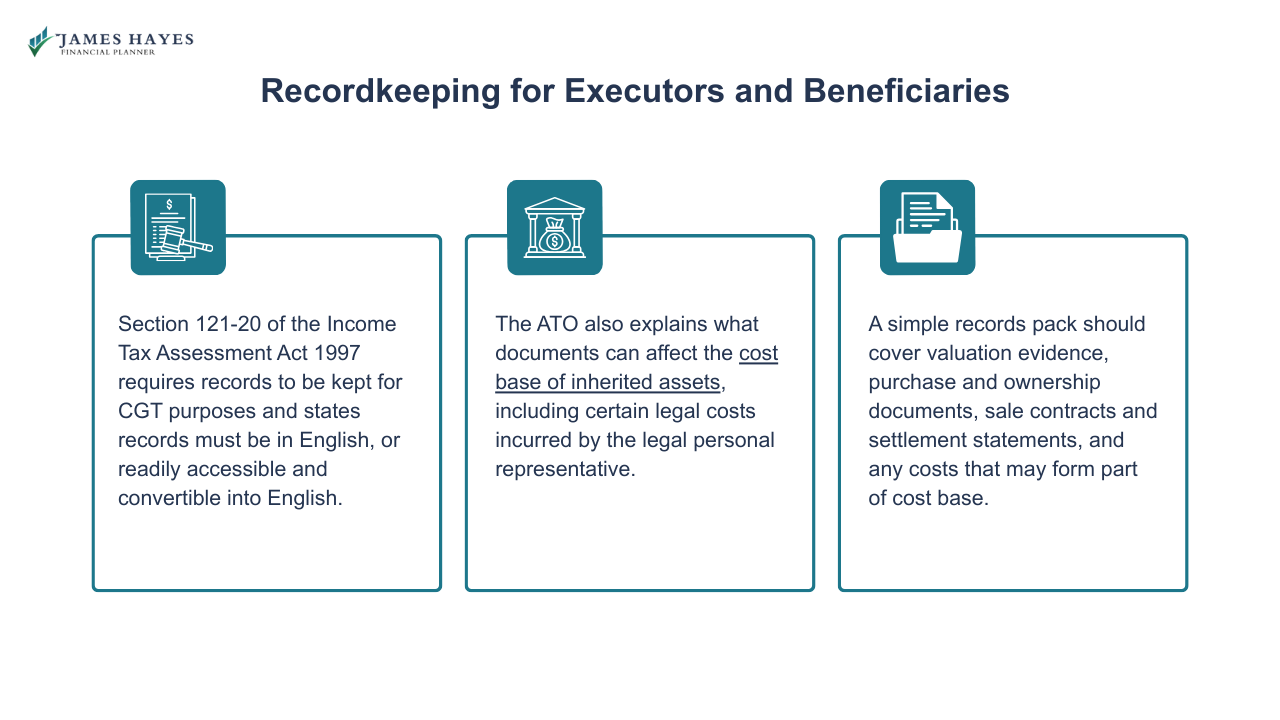
Section 121-20 of the Income Tax Assessment Act 1997 requires records to be kept for CGT purposes and states records must be in English, or readily accessible and convertible into English.
The ATO also explains what documents can affect the cost base of inherited assets, including certain legal costs incurred by the legal personal representative.
A simple records pack should cover valuation evidence, purchase and ownership documents, sale contracts and settlement statements, and any costs that may form part of cost base.
Mistakes That Create Avoidable CGT
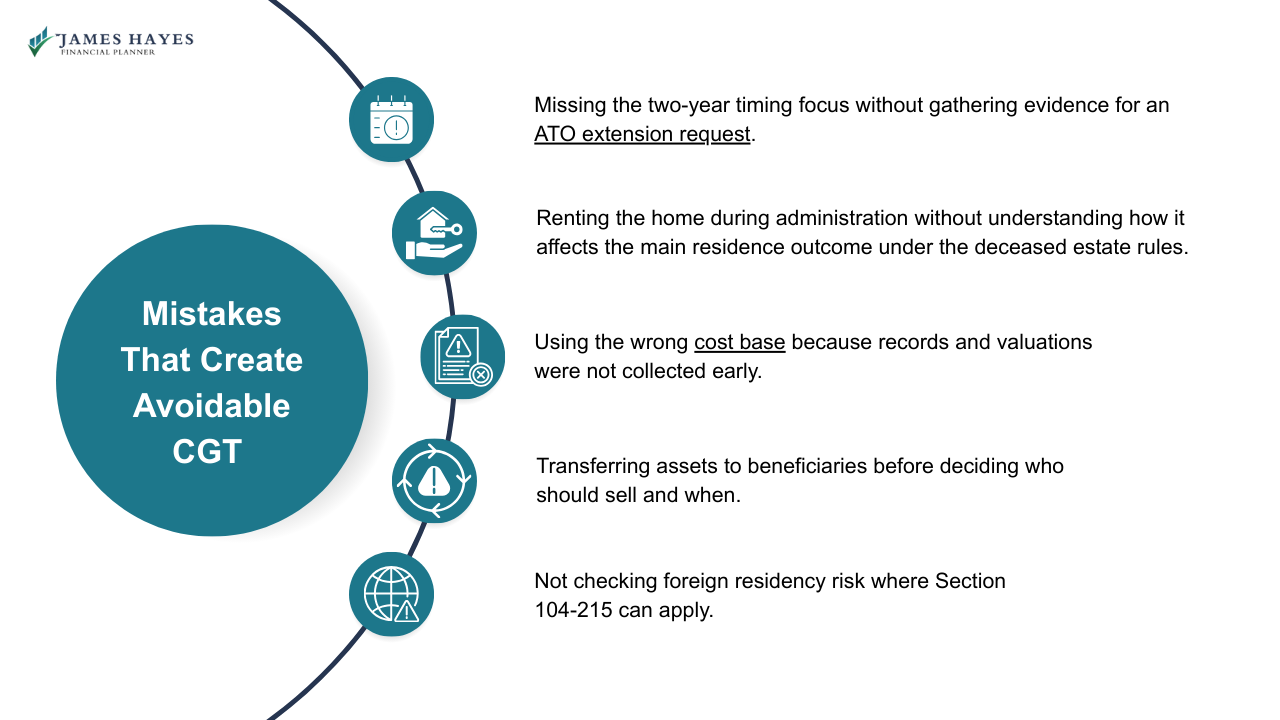
The most frequent issues are:
Missing the two-year timing focus without gathering evidence for an ATO extension request.
Renting the home during administration without understanding how it affects the main residence outcome under the deceased estate rules.
Using the wrong cost base because records and valuations were not collected early.
Transferring assets to beneficiaries before deciding who should sell and when.
Not checking foreign residency risk where Section 104-215 can apply.
When to Get Advice
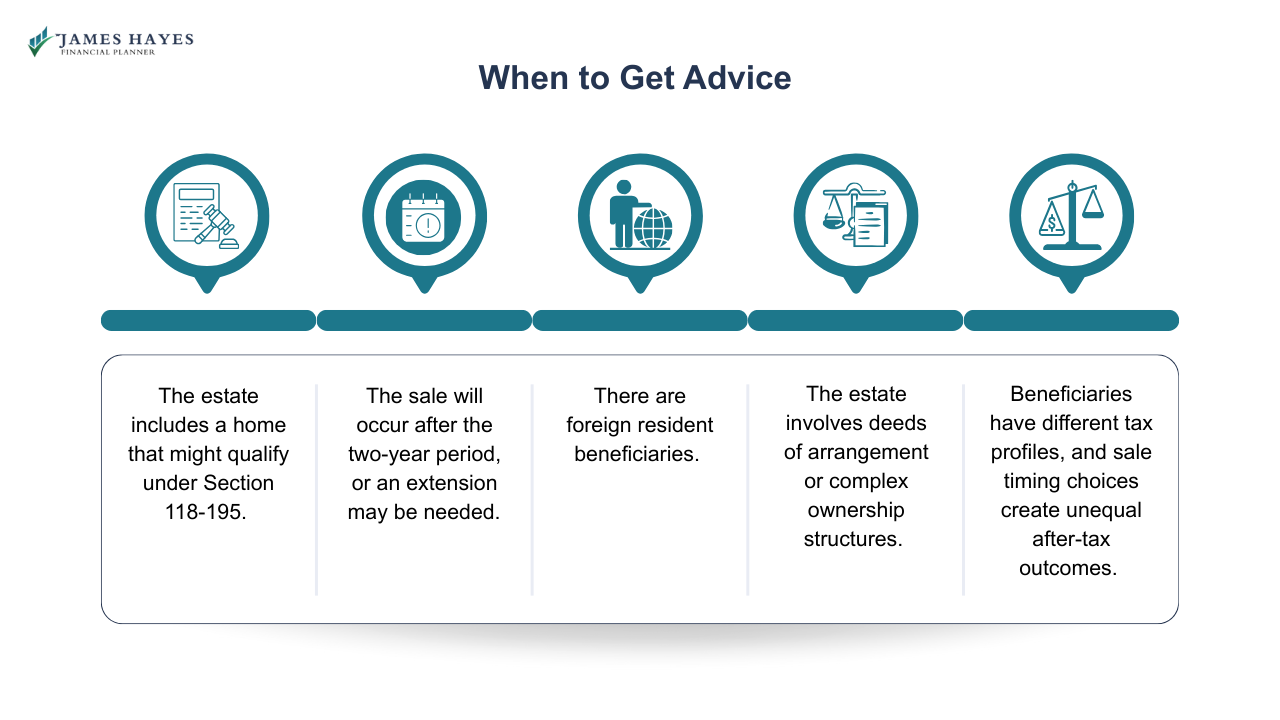
Advice is most useful before the sale contract is signed or before assets are transferred out of the estate. It is worth getting coordinated input from a tax agent and solicitor when:
The estate includes a home that might qualify under Section 118-195.
The sale will occur after the two-year period, or an extension may be needed.
There are foreign resident beneficiaries.
The estate involves deeds of arrangement or complex ownership structures.
Beneficiaries have different tax profiles, and sale timing choices create unequal after-tax outcomes.
Conclusion
Death does not create a CGT bill on its own because Section 128-10 of the Income Tax Assessment Act 1997 disregards gains and losses at death. CGT is worked out later, most often when an executor or beneficiary sells an inherited asset under Section 104-10. For inherited homes, Section 118-195 and the ATO’s two-year guidance drive the outcome.
James Hayes is an ASIC-licensed financial adviser based in Caringbah who works with wealth builders, pre-retirees, and retirees across the Sutherland Shire and Greater Sydney. He can model after-tax outcomes from different sale timings and reinvestment options, then coordinate with your accountant and solicitor on implementation. Book your free 15-minute call today.
FAQs
-
No. Section 128-10 of the Income Tax Assessment Act 1997 says a capital gain or loss at death is disregarded. CGT is calculated later if the executor or beneficiary disposes of an inherited asset. One exception is CGT event K3 in section 104-215, which can apply when an asset passes to certain beneficiaries.
-
The two-year rule is linked to the deceased estate main residence exemption in Section 118-195 of the Income Tax Assessment Act 1997. Meeting the conditions can allow the capital gain to be disregarded. The ATO explains it can extend the two-year period in limited circumstances, and evidence is required to support the request.
-
Yes. The ATO publishes guidance on extensions to the two-year ownership period for inherited property. It focuses on circumstances that prevented earlier disposal and expects supporting records. Extensions are not automatic, so executors should keep clear documentation such as probate timing, sale attempts, and reasons settlement could not occur sooner.
-
The CGT result depends on who disposes of the asset. A sale by the executor is dealt with in the estate’s tax position. If the executor transfers the asset to a beneficiary and the beneficiary sells later, the beneficiary deals with CGT in their own return. Section 128-15 sets the transfer rules for estates and beneficiaries.
-
Section 121-20 of the Income Tax Assessment Act 1997 requires CGT records to be kept and states they must be in English or convertible to English. The ATO also explains that certain legal costs incurred by the legal personal representative can form part of cost base. Keep valuations, acquisition records, contracts, settlement statements, and invoices.
-
Foreign residency can change main residence CGT outcomes. The ATO states that if a person is a foreign resident for tax purposes when they die, the foreign resident main residence rules apply to legal personal representatives and beneficiaries of the deceased estate. Separately, Section 104-215 sets out CGT event K3, which can apply when assets pass to a foreign resident beneficiary.
Inheritance & Estate Planning Knowledge Bundle
Disclaimer
The information in this article is provided as a general guide only. It does not constitute personal financial advice and should not be relied upon as such. Readers should seek advice from a licensed financial adviser before making any financial decisions. James Hayes and his associated entities accept no responsibility or liability for any loss, damage, or action taken in reliance on the information contained in this article. Links to third-party websites are provided for reference purposes only. We do not endorse or guarantee the accuracy of their content.