
Why You Need Financial Advice After Receiving an Inheritance
Summary
Financial advice after an inheritance helps you make clear decisions before money is spent or assets are sold. It covers tax (CGT, super death benefits), legal timing (probate and distribution), Centrelink assessment, investment risk, insurance, and long-term planning. It also helps set a sustainable spending level and reduce costly mistakes.
Table of Contents
- Introduction
- To Make Sense of What You Now Own
- To Understand Probate, Estate Distribution, and Timing
- To Navigate Tax Without Expensive Surprises
- To Stay on Top of ATO Reporting During Estate Administration
- To Stop Impulsive Spending and Set a Sustainable Lifestyle Level
- To Protect and Grow the Inheritance with the Right Investment Structure
- To Rebuild Your Portfolio Around the New Assets
- To Handle Centrelink and Social Security Effects
- To Make Inheriting Property or a Business Financially Viable
- To Set Up Protective Structures Where Appropriate
- To Reduce Conflict and Keep Decisions Documented
- To Use Super Strategies If They Fit Your Situation
- To Close Gaps in Household Retirement Outcomes
- To Update Your Own Will, Powers of Attorney, and Insurance
- To Get a Second Set of Eyes
- Conclusion
- FAQs
- Inheritance & Estate Planning Knowledge Bundle
Introduction
An inheritance is great news, but the responsibilities that attend it are less exciting: paperwork, deadlines, and decisions that cannot be reversed. What exactly are you supposed to do when you receive a windfall? A financial adviser’s role is to pull the moving parts into one plan, then coordinate with your accountant and estate lawyer where needed. This article explains the benefits of financial advice in the aftermath of receiving an inheritance.
To Make Sense of What You Now Own
Inheritance is not always a single cash deposit. It can include property, listed investments, superannuation benefits, business interests, loans owed to the estate, or shared ownership with other beneficiaries.
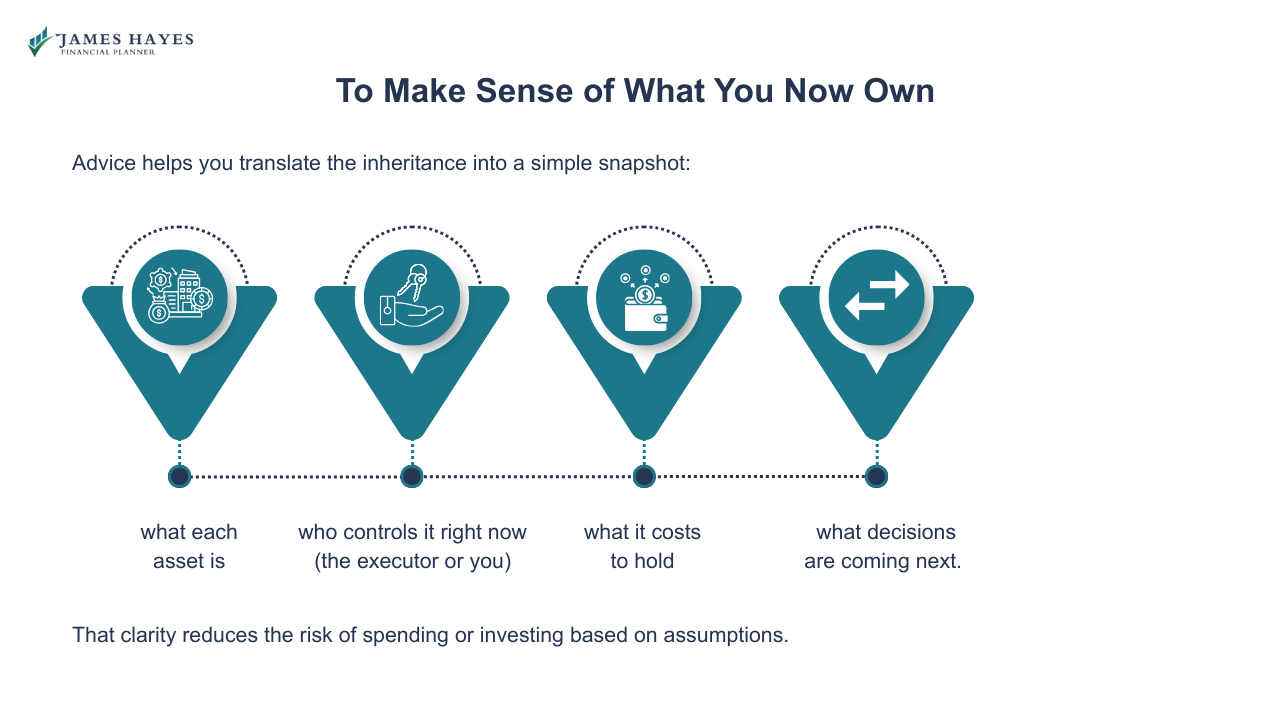
Advice helps you translate the inheritance into a simple snapshot:
what each asset is,
who controls it right now (the executor or you),
what it costs to hold, and
what decisions are coming next
That clarity reduces the risk of spending or investing based on assumptions.
To Understand Probate, Estate Distribution, and Timing
The Supreme Court of NSW explains that a grant of probate authorises an executor to manage the estate according to the will, including collecting assets, paying debts, and distributing assets to beneficiaries.
A financial adviser can work alongside the executor’s timeline so your plans match what can happen, and when. This is also where disputes and delays change the sequence of decisions, including property sales and distributions.
To Navigate Tax Without Expensive Surprises
Tax often arrives later, usually after an asset sale, an income stream starts, or the estate lodges a return. Advice helps you map the tax items early, then choose the least damaging order of steps.
To Reduce CGT Risk on Inherited Property and Investments
Inherited property and share portfolios regularly create CGT issues when sold. For an inherited home, the ATO explains extensions to the two-year ownership period, and links this to Practical Compliance Guideline PCG 2019/5.
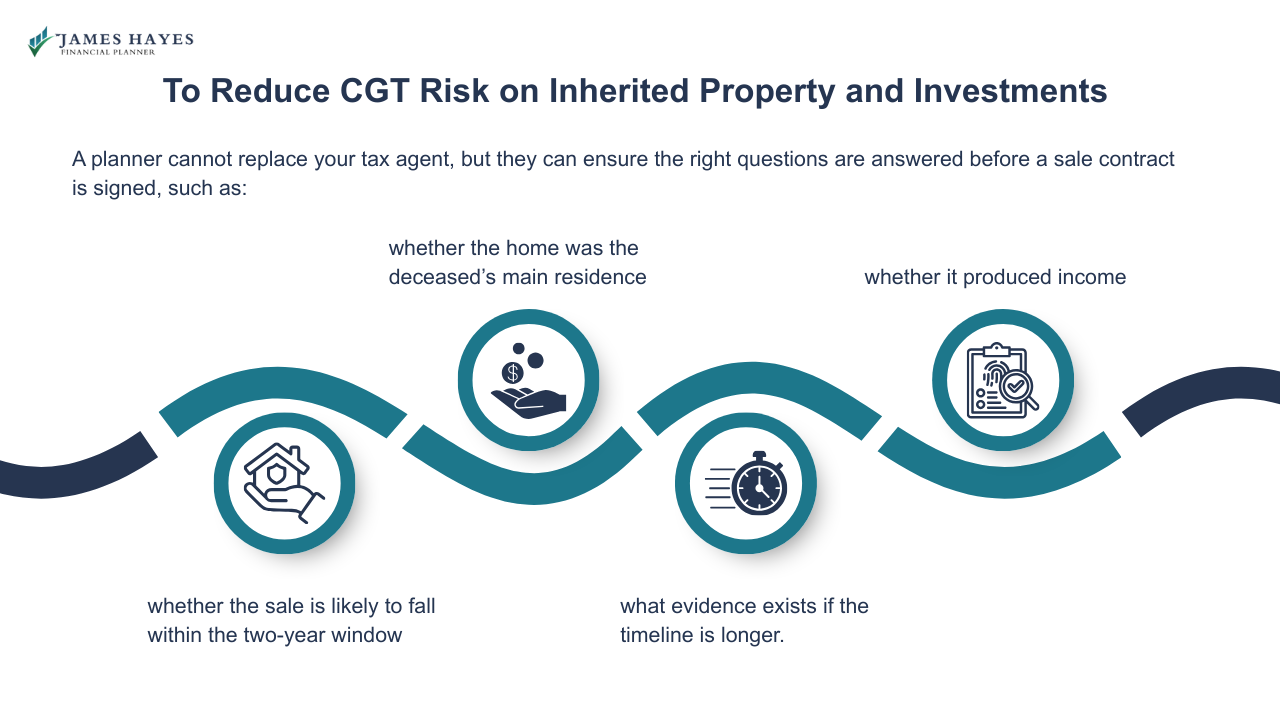
A planner cannot replace your tax agent, but they can ensure the right questions are answered before a sale contract is signed, such as:
whether the home was the deceased’s main residence,
whether it produced income,
whether the sale is likely to fall within the two-year window, and
what evidence exists if the timeline is longer
To Stay on Top of ATO Reporting During Estate Administration
When an estate earns income (rent, dividends, interest) during administration, tax reporting can apply.
The ATO explains trust tax returns for deceased estates, including that the estate is treated as a trust for tax purposes, and returns may need to be lodged each year until the estate is finalised.
Financial advice helps you keep records aligned with what the accountant will need: dates, valuations, cost base documents, and income statements.
To Choose the Most Tax-Effective Handling of Super Death Benefits
Superannuation death benefits can be tax-free or taxable depending on who receives them and how they are paid.
The ATO states that where beneficiaries are not dependants, tax is applied to the taxable component at 15% for the taxed element and 30% for any untaxed element, while any tax-free component is not taxed.
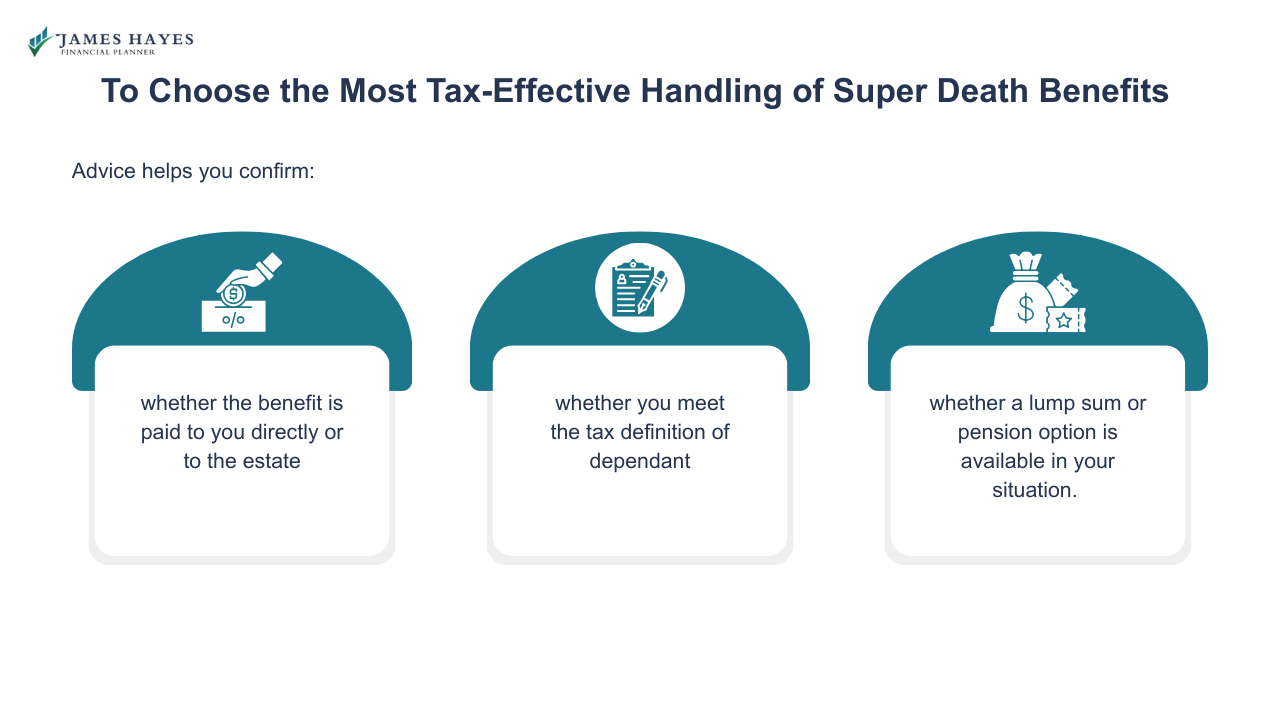
Advice helps you confirm:
whether the benefit is paid to you directly or to the estate,
whether you meet the tax definition of dependant, and
whether a lump sum or pension option is available in your situation
To Stop Impulsive Spending and Set a Sustainable Lifestyle Level
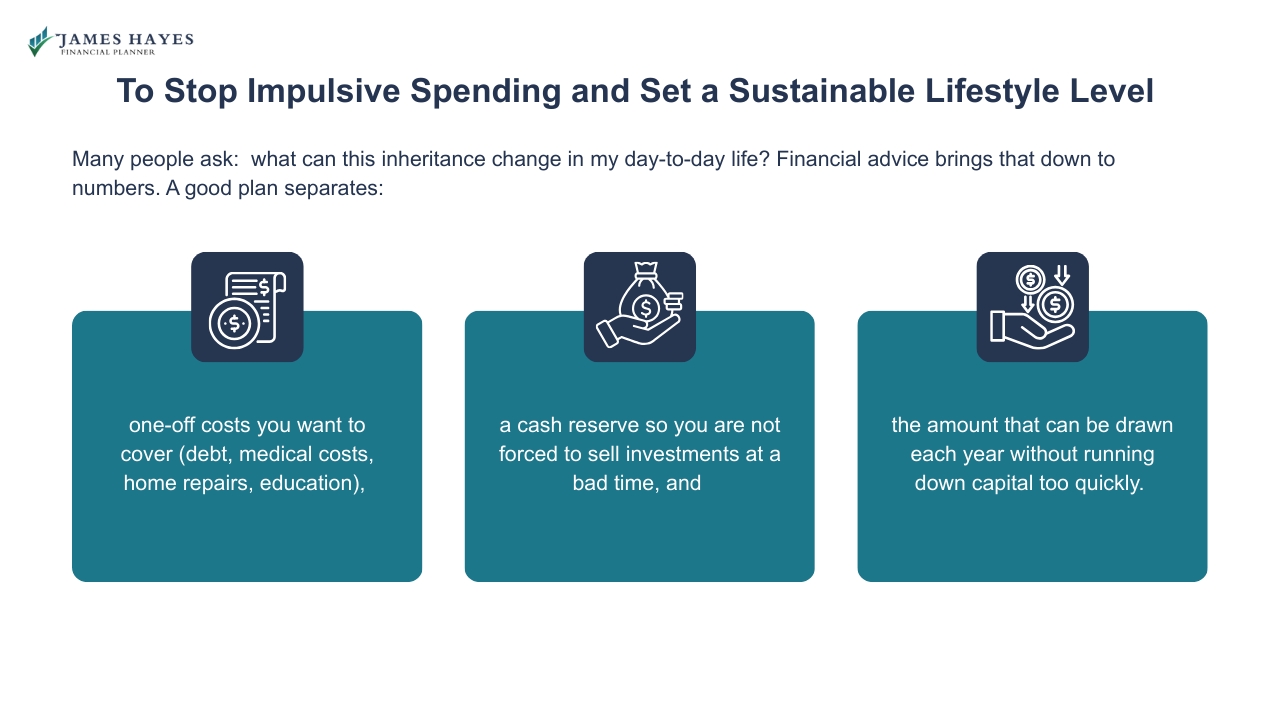
Many people ask: what can this inheritance change in my day-to-day life? Financial advice brings that down to numbers. A good plan separates:
one-off costs you want to cover (debt, medical costs, home repairs, education),
a cash reserve so you are not forced to sell investments at a bad time, and
the amount that can be drawn each year without running down capital too quickly.
Inflation is built into this work. Spending that looks fine today can become a problem when costs rise over time.
Free eBook: Inheritance First 30 Days Checklist + Document List (Instant Download)
〰️
Free eBook: Inheritance First 30 Days Checklist + Document List (Instant Download) 〰️
To Protect and Grow the Inheritance with the Right Investment Structure
Inheritance can tilt your balance sheet sharply. A person with a diversified portfolio can suddenly be heavily concentrated in one Sydney property. Another person can move from mostly super to a large taxable investment account.
Advice helps you set an asset allocation that suits:
your timeframe (short, medium, long),
how much variability you can tolerate, and
how much income you need from the portfolio.
It also helps you choose where assets should reside (personal name, super, family trust, or other structures), with your accountant and lawyer involved where legal or tax structuring is required.
To Rebuild Your Portfolio Around the New Assets
If you already had investments, the inheritance can leave you overweight in one asset class.
Portfolio review includes:
whether existing investments should be sold, held, or topped up,
whether the new assets duplicate risk you already had, and
whether rebalancing is required to keep risk aligned with your plan.
This is also where bracket creep can become a real issue. More rent, dividends, and interest can push taxable income higher. Your accountant can confirm the tax effect. A financial adviser can make sure the investment plan reflects after-tax outcomes, not just pre-tax returns.
To Handle Centrelink and Social Security Effects
For retirees, an inheritance often changes Age Pension outcomes. Services Australia explains deeming, which is used to work out income from financial assets, and then applied under the income test for the Age Pension.
Services Australia also explains that lump sums can count in the income test and may affect a payment.
Gifting is another area where many people get caught. Services Australia explains how much you can gift, and that gifting over the free area can affect payments, with the excess counted under the assets test and deemed under the income test for five years.
Financial advice helps retirees choose a strategy (debt reduction, home improvements, investing, gifting, or helping family) with Centrelink rules checked before money moves.
To Make Inheriting Property or a Business Financially Viable
Some inheritances arrive with ongoing commitments and costs.
For real estate, advice helps you compare:
net income after rates, insurance, repairs, and agent fees,
the cash required for maintenance and vacancies,
whether holding the asset increases concentration risk, and
what a sale would look like after tax and costs.
For a family business, the review starts with:
cash flow and liabilities,
leases and guarantees,
staffing risk, and
whether you have the time and capability to run it, or whether management must be hired.
This also ties into succession planning if multiple family members are involved, or if ownership and control are split.
To Set Up Protective Structures Where Appropriate
Inheritance planning includes asset protection, especially where there are creditor risks, relationship risks, or beneficiaries with different needs.
Where a will includes a testamentary trust, advice helps beneficiaries understand how distributions, investments, and responsibilities work.
For a beneficiary with a severe disability, a Special Disability Trust can be relevant. Services Australia explains that Special Disability Trust funds are intended to meet reasonable care and accommodation needs for the principal beneficiary.
To Reduce Conflict and Keep Decisions Documented
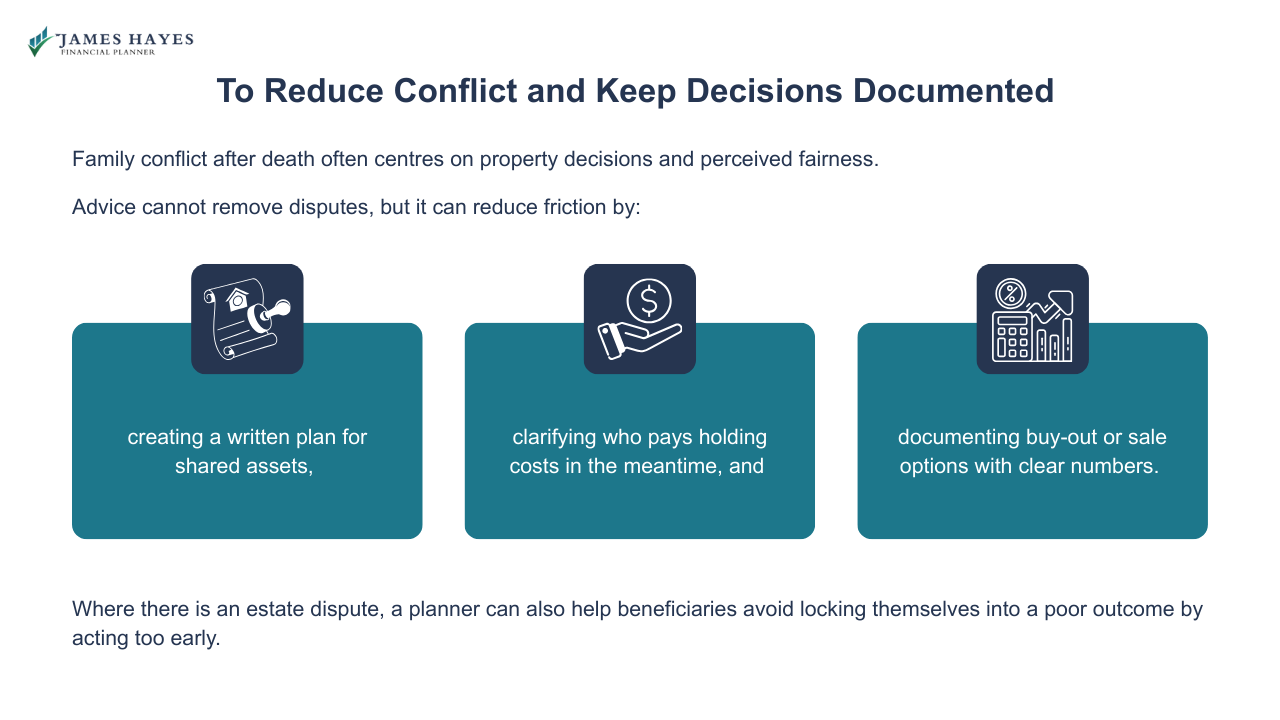
Family conflict after death often centres on property decisions and perceived fairness.
Advice cannot remove disputes, but it can reduce friction by:
creating a written plan for shared assets,
clarifying who pays holding costs in the meantime, and
documenting buy-out or sale options with clear numbers.
Where there is an estate dispute, a planner can also help beneficiaries avoid locking themselves into a poor outcome by acting too early.
To Use Super Strategies If They Fit Your Situation
Some people use inheritance to strengthen retirement funding through super contributions.
The ATO explains that from 1 July 2025 the bring-forward amount depends on total super balance thresholds, with examples showing up to three times the annual non-concessional cap where eligible. The ATO also explains carry-forward concessional contributions where total super balance is under $500,000, using unused concessional cap amounts from up to the previous five years.
To Close Gaps in Household Retirement Outcomes
In many households, inheritance becomes a chance to fix long-term imbalance.
WGEA reports a 21.1% gender pay gap in its 2024–25 scorecard. ASFA states that leading up to retirement age, women’s median super balance is around 25% lower than men’s.
Advice helps families decide whether part of the inheritance should strengthen the weaker retirement position in the household, including super contributions where eligible.
To Update Your Own Will, Powers of Attorney, and Insurance
Inheritance changes your balance sheet, and that can affect:
who you want as executor,
who should act under powers of attorney, and
how your super nominations should be set.
Insurance also needs review. A larger asset base can reduce the need for some covers, while family commitments and debts can still justify life, trauma, or income protection.
To Get a Second Set of Eyes
A coordinated approach reduces gaps between legal steps, tax reporting, and investment decisions.
ASIC explains that the best interests duty and related obligations are designed to ensure retail clients receive advice that meets their objectives, financial situation, and needs, and that advisers act in the client’s best interests when providing advice.
A good process also connects you with the right specialists when required, commonly an accountant for tax and an estate lawyer for legal structure and disputes.
Conclusion
People seek advice after an inheritance because the decisions are connected. Spending affects tax. Tax affects whether you sell or hold assets. Holding assets affects Centrelink, cash flow, and risk. Advice brings those pieces into one plan, then keeps the plan aligned while the estate is settled.
James Hayes supports clients across the Sutherland Shire and Sydney CBD with inheritance planning, portfolio reviews, super strategy, and coordination with accountants and estate lawyers.
FAQs
-
Often, yes. Advice will give you a clear picture of spending limits, tax on interest, debt repayment priorities, super contribution options, and whether Centrelink entitlements may change. It also helps you avoid moving the money into investments that do not match your timeframe or risk tolerance, and it helps document your plan.
-
CGT often comes up when inherited property or shares are sold, and super death benefit tax can apply depending on who receives the benefit. The ATO also explains that deceased estates may need trust tax returns while administration continues, particularly where income is earned before assets are distributed.
-
A planner can track what you control and when, then align your plan to the executor’s timeline. The Supreme Court of NSW explains that probate authorises the executor to collect assets, pay debts, and distribute to beneficiaries. Advice also helps you prepare records for your accountant and make informed choices before assets are sold or transferred.
-
It may. Services Australia uses deeming to work out income from financial assets for the Age Pension income test, and lump sums can affect payments. Gifting can also reduce entitlements if you give away more than the gifting free area, with the excess assessed for five years. Advice helps you plan changes before money moves.
-
Possibly. The ATO explains bring-forward non-concessional contributions based on total super balance thresholds, and carry-forward concessional contributions where total super balance is under $500,000 and unused cap amounts are available from up to five prior years. Advice helps confirm eligibility and ensures contributions fit your retirement timeline.
-
Property and businesses bring holding costs, cash flow demands, tax consequences on sale, and concentration risk. A second opinion helps you compare scenarios such as selling, retaining, or transferring, then quantify the ongoing costs and risk. It also helps create a written agreement when there are multiple beneficiaries sharing decisions and expenses.
Inheritance & Estate Planning Knowledge Bundle
Disclaimer
The information in this article is provided as a general guide only. It does not constitute personal financial advice and should not be relied upon as such. Readers should seek advice from a licensed financial adviser before making any financial decisions. James Hayes and his associated entities accept no responsibility or liability for any loss, damage, or action taken in reliance on the information contained in this article. Links to third-party websites are provided for reference purposes only. We do not endorse or guarantee the accuracy of their content.