
Ethical Will and Legacy Planning
Summary
An ethical will is a personal document that records values, context, and messages you want family to understand. It does not distribute assets and it does not override your legal will. Use it to explain the intent behind decisions, document family history, and outline priorities for future generations. Store it clearly and keep it separate from legal documents.
Table of Contents
- Introduction
- What Is an Ethical Will?
- What to Include in an Ethical Will
- Is an Ethical Will a Legal Document?
- Role of Ethical Wills in Legacy Planning
- How to Write an Ethical Will
- When and How to Share an Ethical Will
- Mistakes to Avoid with Ethical Wills
- How Do Ethical Wills Fit Into Your Legacy Plan?
- When to Seek Professional Guidance for Ethical Wills
- Conclusion
- FAQs
- Inheritance & Estate Planning Knowledge Bundle
Introduction
Estate planning deals with the legal control of assets, but legacy planning is broader and includes the information people use to interpret decisions after you are gone. An ethical will belongs in that second category.
This article explains what an ethical will is, what it can include, how it differs from legal documents, and how to create and share one without causing confusion.
What Is an Ethical Will?
An ethical will is a non-legal document written for family or other chosen recipients. It is used to communicate values, principles, and personal context. It can be written as a letter, a structured document, a recorded video, or an audio message.
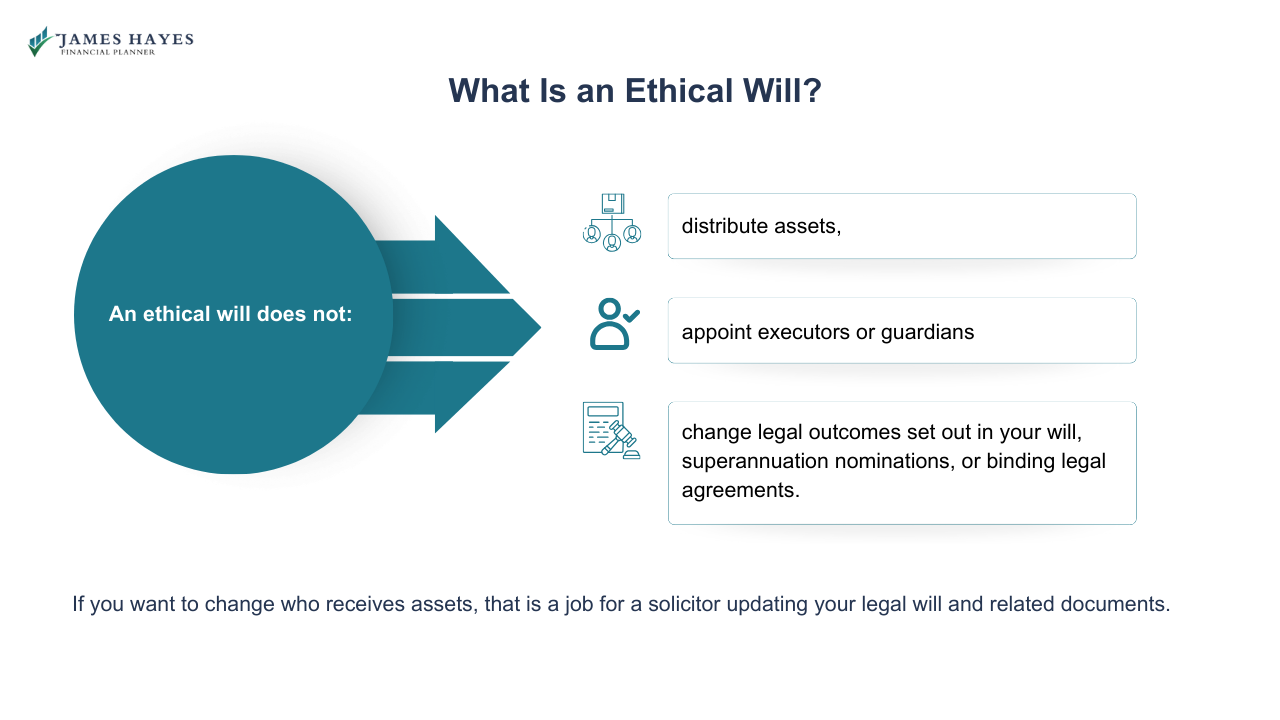
An ethical will does not:
distribute assets,
appoint executors or guardians, or
change legal outcomes set out in your will, superannuation nominations, or binding legal agreements.
If you want to change who receives assets, that is a job for a solicitor updating your legal will and related documents.
What to Include in an Ethical Will
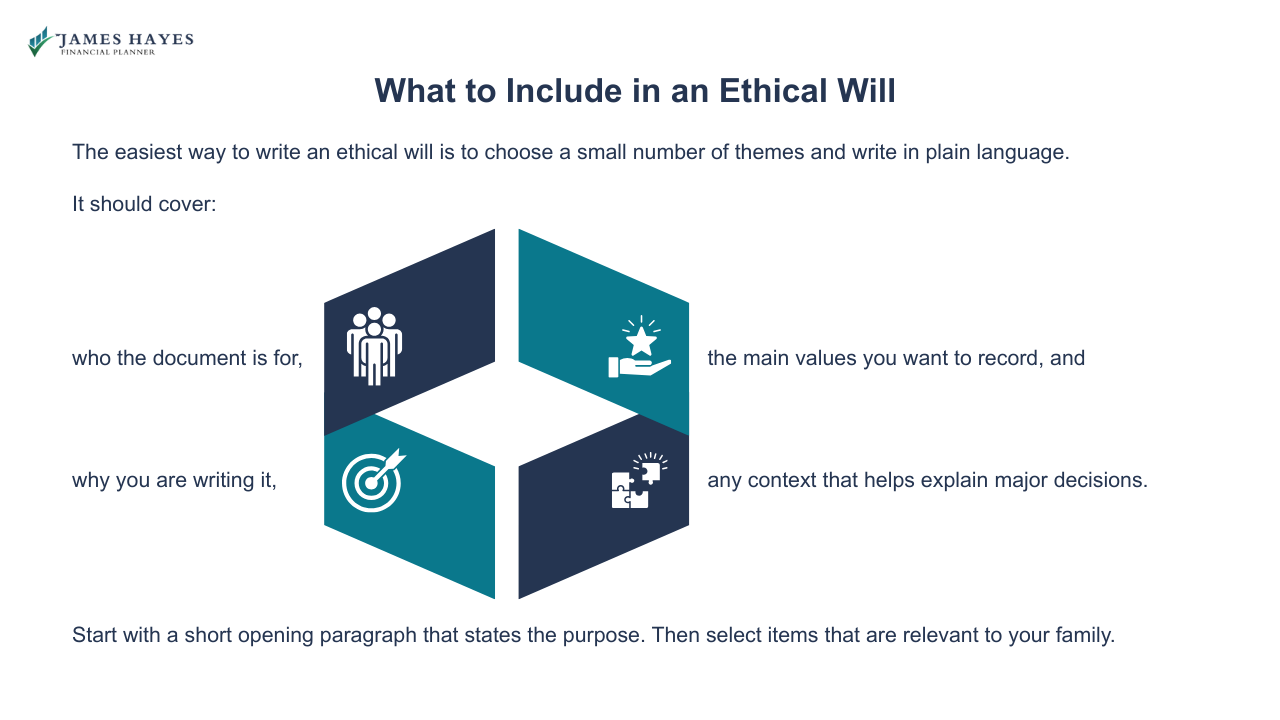
The easiest way to write an ethical will is to choose a small number of themes and write in plain language.
It should cover:
who the document is for,
why you are writing it,
the main values you want to record, and
any context that helps explain major decisions.
Start with a short opening paragraph that states the purpose. Then select items that are relevant to your family.
Common inclusions:
Guiding values: Principles that influenced decisions, work, family life, and priorities.
Family context: Brief background that explains major events, turning points, migration history, or business origins.
Decision context: Why certain choices were made, especially where outcomes may look uneven on paper.
Messages to individuals: Short sections addressed to specific people, written with a consistent tone.
Views on money and responsibility: How you think wealth should be used, managed, and discussed.
Community and giving priorities: Charitable intent and the reasons behind it (the legal instructions still reside in the will).
Digital information: Where to find important non-financial information (do not put passwords in the document).
Is an Ethical Will a Legal Document?
A legal will is a formal document governed by succession law. In NSW, section 6 of the Succession Act 2006 sets execution requirements, including being in writing, signed, and witnessed by two or more witnesses present at the same time.
An ethical will is separate as it is personal guidance, not a legal instrument.
Ethical Will vs Legal Will
Consult the comparison below for the differences between a legal will and an ethical will.
| Feature | Ethical Will | Legal Will |
|---|---|---|
| Legal status | Not legally binding | Legally binding if validly executed |
| Main purpose | Record values, context, and messages | Distribute assets, appoint roles, set instructions |
| Format | Flexible | Must meet legal requirements |
| Risk if unclear | Confusion or mixed expectations | Invalidity, disputes, or unintended distribution |
If you include asset instructions inside an ethical will, you increase the risk of misunderstanding. Keep legal directions in the legal will only.
Role of Ethical Wills in Legacy Planning
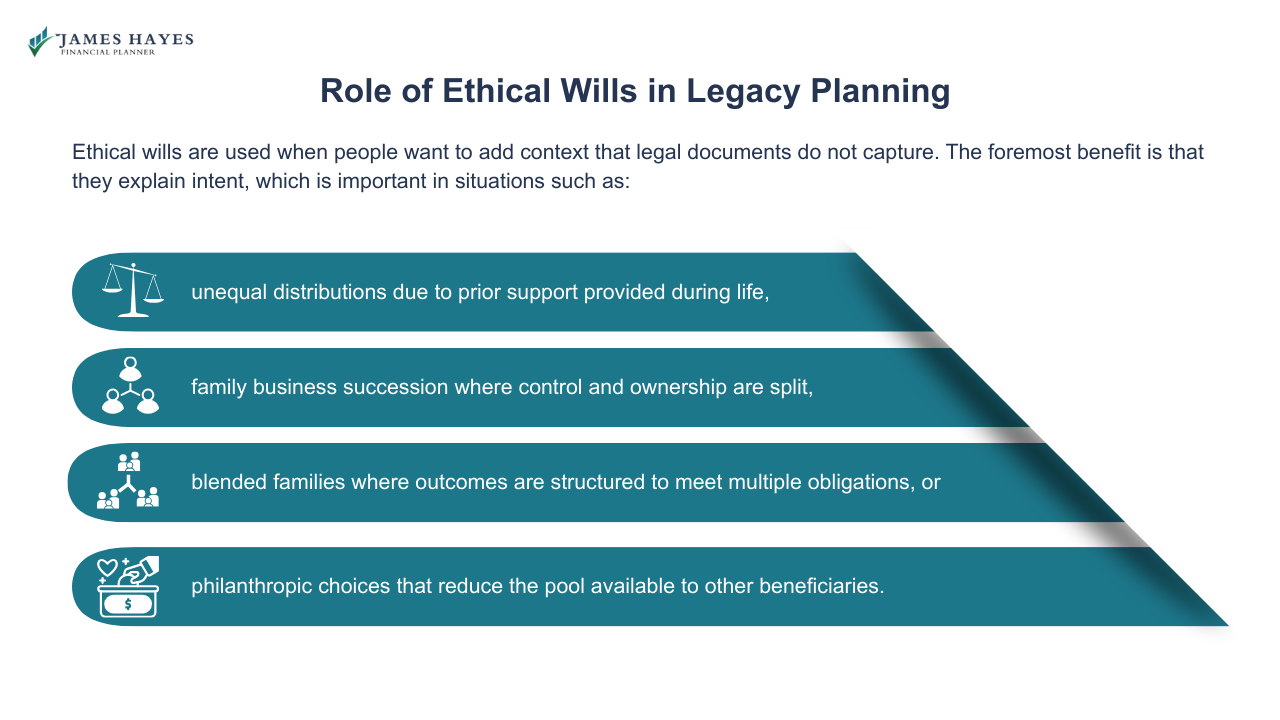
Ethical wills are used when people want to add context that legal documents do not capture. The foremost benefit is that they explain intent, which is important in situations such as:
unequal distributions due to prior support provided during life,
family business succession where control and ownership are split,
blended families where outcomes are structured to meet multiple obligations, or
philanthropic choices that reduce the pool available to other beneficiaries.
An ethical will does not remove dispute risk on its own. It can reduce misunderstanding if it is written clearly and stored properly.
Free eBook: Ethical Will Template + Writing Prompts (Instant Download)
〰️
Free eBook: Ethical Will Template + Writing Prompts (Instant Download) 〰️
How to Write an Ethical Will
You will need a clear structure, a consistent tone, and a clean separation from legal documents.
Step 1: Decide Who Will Read It
Write a one-line list of intended recipients.
Examples:
“For my children and grandchildren.”
“For my spouse and children.”
“For my business successor and my family.”
Step 2: Choose Three to Five Themes
Pick a small number of themes and stay inside them. This keeps the document short and readable.
Common theme sets include:
values and priorities,
decision context,
money and responsibility,
family history, and
community and giving.
Step 3: Write a Clear Disclaimer at the Top
Add a direct statement that the document is not a legal will and is not intended to change your legal will.
For example: “This is an ethical will. It is a personal statement and does not replace or alter my legal will or any binding nominations.”
Step 4: Write in Short Sections
Keep paragraphs short. Use headings. Use names where appropriate. Remove repetition. A good length is two to six pages.
Step 5: Date It and Version It
Add:
the date,
a version number (Version 1, Version 2), and
a note that newer versions replace older ones.
This helps if you update it after life events.
When and How to Share an Ethical Will
Sharing decisions affect how the message is received and how it is used. Some people share the ethical will while they are alive. Others prefer it to be read after their demise. Either option can work if storage and access are clear.
Storage Options That Reduce Confusion
Keep the ethical will:
with your estate planning file in a clearly labelled section, or
in a secure digital vault with access instructions held by a trusted person.
If you store it with legal documents, label it clearly as “Ethical Will – Not A Legal Document”.
Mistakes to Avoid with Ethical Wills
Problems come from mixing legal instructions with personal guidance or writing in a way that creates uncertainty.
Avoid these mistakes:
Using the ethical will to change asset outcomes: Put all asset directions in the legal will.
Including contradictory statements: If your legal will says one thing and your ethical will implies another, confusion follows.
Writing in broad statements only: A few specific points are clearer than pages of general commentary.
Publishing sensitive information: Do not include bank passwords, super logins, or PINs.
Forgetting to update it: Review after major changes such as marriage, separation, business sale, relocation, or major changes in assets.
How Do Ethical Wills Fit Into Your Legacy Plan?
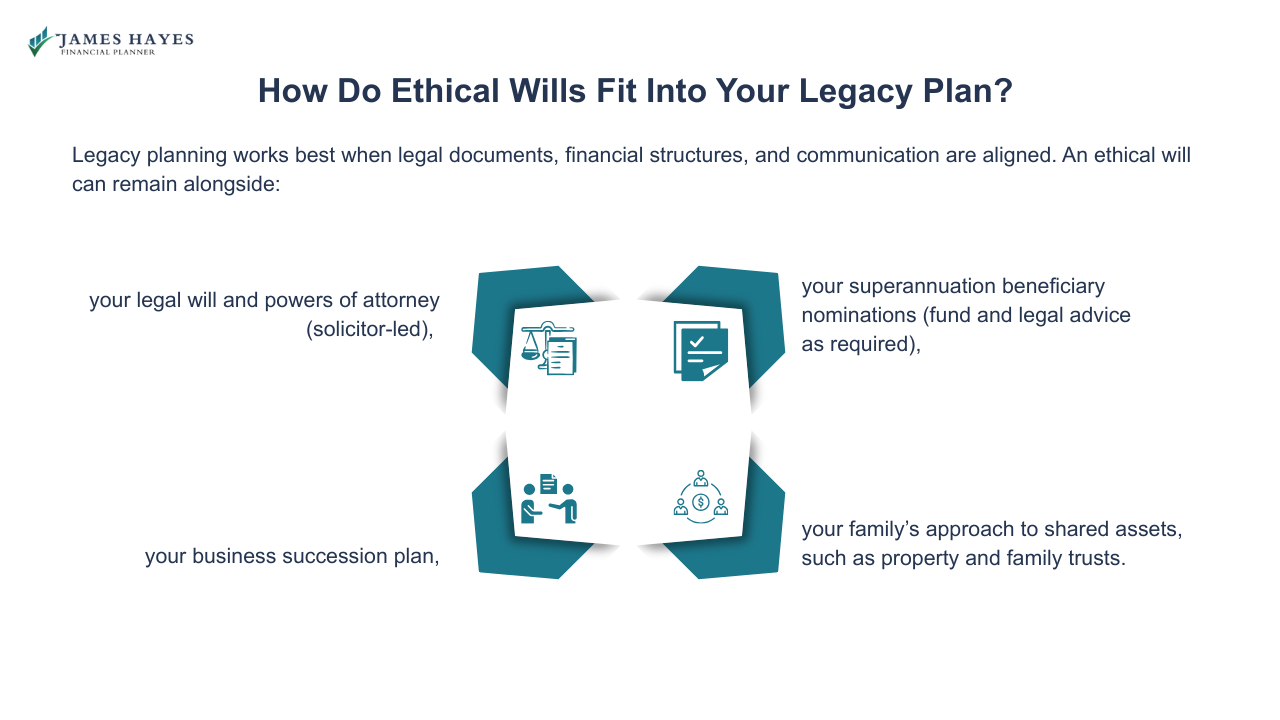
Legacy planning works best when legal documents, financial structures, and communication are aligned. An ethical will can remain alongside:
your legal will and powers of attorney (solicitor-led),
your superannuation beneficiary nominations (fund and legal advice as required),
your business succession plan, and
your family’s approach to shared assets, such as property and family trusts.
If your estate plan involves complex structures, an ethical will can explain the logic in plain language without altering the legal settings.
When to Seek Professional Guidance for Ethical Wills
You can write an ethical will yourself. Professional guidance is required when you want it to align with formal planning and avoid mixups.
A solicitor is the right professional for legal wills and estate documents, including execution requirements under the Succession Act 2006 (NSW).
A financial adviser can help you align legacy intentions with financial strategy and implementation. ASIC explains that obligations vary depending on whether advice is personal or general, and financial advice must be provided within regulatory requirements.
Conclusion
An ethical will is a clear way to record values, context, and intent without changing legal outcomes. The best ethical wills are short, specific, separate from legal documents, and easy to locate.
James Hayes is a financial planner in Caringbah, working with clients across the Sutherland Shire and Sydney CBD. He can help you map legacy goals into a financial plan, and coordinate with your solicitor and accountant so the ethical will supports, rather than conflicts with, the legal estate plan. Book a free 15-minute call with him.
FAQs
-
No. An ethical will is not a legal document and it does not distribute assets or appoint executors. A legal will must meet execution requirements, including signing and witnessing rules under Section 6 of the Succession Act 2006 (NSW). Use an ethical will to add context, not to control asset outcomes.
-
Both approaches are acceptable. A single ethical will can cover shared themes, values, and family context. Separate messages can be useful for individual topics, such as business succession, different life stages, or private acknowledgements. If you do both, keep the tone consistent, label your documents clearly, and store them together.
-
No execution formalities apply because an ethical will is not a legal will. Signing and dating it is still useful for context and version control. If you update it, add a new date and version number, and store the latest version where it can be found without confusion.
-
It can help explain the reason behind decisions, such as prior gifts, different levels of support, or business succession choices. It does not prevent legal claims and it does not override the legal will. Keep explanations factual, avoid asset instructions, and ensure your legal will and structures reflect the intended outcome.
-
Yes. A video may be ideal if you can keep it structured and concise. Use the same approach as a written document: state the purpose, cover a small set of themes, and keep it separate from legal instructions. Store the file securely, test that it can be accessed, and note where it is stored in your estate file.
-
Write it once you have clear values you want to record and people you want to address. Common triggers include becoming a parent, building a business, receiving an inheritance, planning retirement, or updating legal estate documents. Review it after major life events, and keep the latest version easy to locate.
Inheritance & Estate Planning Knowledge Bundle
- Inheritance & Estate Planning Explained
- Understanding Inheritance Tax in Australia
- Superannuation Death Benefits
- Tax Implications for Beneficiaries
- Wills, Executors & Probate
- Gifting vs Inheriting
- Blended Families & Estate Disputes
- Deceased Estates & Capital Gains
- Financial Planning After Inheritance
Disclaimer
The information in this article is provided as a general guide only. It does not constitute personal financial advice and should not be relied upon as such. Readers should seek advice from a licensed financial adviser before making any financial decisions. James Hayes and his associated entities accept no responsibility or liability for any loss, damage, or action taken in reliance on the information contained in this article. Links to third-party websites are provided for reference purposes only. We do not endorse or guarantee the accuracy of their content.