
Summary
AFP® and CFP® are professional designations administered by the FAAA. AFP® confirms approved membership for practising advisers. CFP® is an advanced certification with global recognition, added exams, and experience. Both marks have strict usage rules, appear next to the individual’s name, and require current membership to remain valid.
Table of Contents
- Introduction
- A Quick Definition
- What is Financial Planner AFP®?
- What is CFP® (CERTIFIED FINANCIAL PLANNER®)?
- Who Awards These Marks?
- Pathways and Eligibility
- Ongoing Obligations and What Happens If Membership Lapses
- How The Marks Must Appear on a Website or Brochure
- Where The Marks Can and Cannot Appear Online
- How to Verify an Adviser’s Designation
- Quick Comparison Table
- Why These Designations Matter When You Choose an Adviser
- FAQs
- Financial Planner Knowledge Bundle
Introduction
Clients see designations as a shorthand for trust. Advisers see designations as proof of standards, community, and ongoing learning. Two marks you will see on Australian websites are Financial Planner AFP® and CFP®. This guide explains exactly what each designation means, who awards them, how advisers earn and keep them, and how clients should read these credentials on a profile page.
A Quick Definition
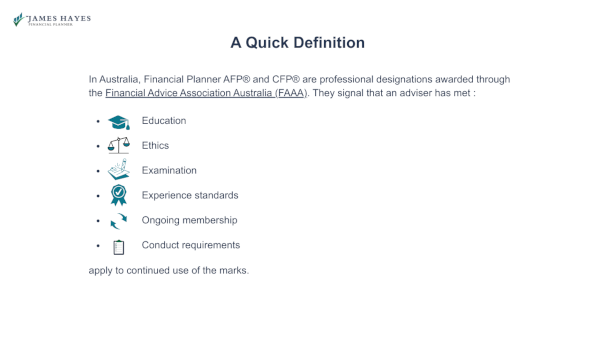
In Australia, Financial Planner AFP® and CFP® are professional designations awarded through the Financial Advice Association Australia (FAAA). They signal that an adviser has met education, ethics, examination, and experience standards, and that ongoing membership and conduct requirements apply to continued use of the marks.
What is Financial Planner AFP®?
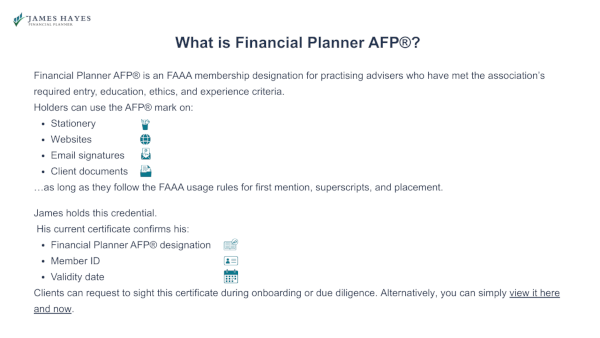
Financial Planner AFP® is an FAAA membership designation for practising advisers who meet entry, education, ethics, and experience criteria set by the association. Holders may use the AFP® mark in approved ways on stationery, websites, email signatures, and client documents, with specific usage rules for first mention and superscripts.
James holds this credential. His current certificate confirms the Financial Planner AFP® designation, his member ID, and the validity date. Clients can request to sight this certificate during onboarding or due diligence. Alternatively, you can simply view it here and now.
What is CFP® (CERTIFIED FINANCIAL PLANNER®)?
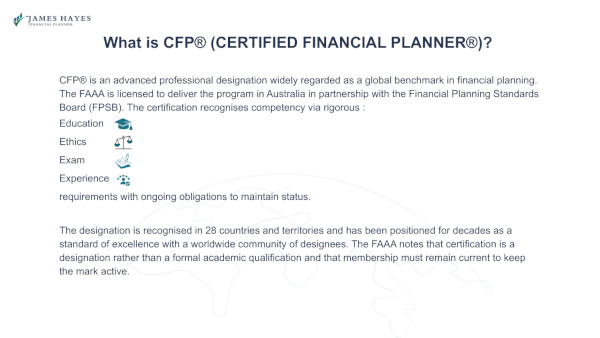
CFP® is an advanced professional designation widely regarded as a global benchmark in financial planning. The FAAA is licensed to deliver the program in Australia in partnership with the Financial Planning Standards Board (FPSB). The certification recognises competency via rigorous education, ethics, exam, and experience requirements, with ongoing obligations to maintain status.
The designation is recognised in 28 countries and territories and has been positioned for decades as a standard of excellence with a worldwide community of designees. The FAAA notes that certification is a designation rather than a formal academic qualification and that membership must remain current to keep the mark active.
Who Awards These Marks?
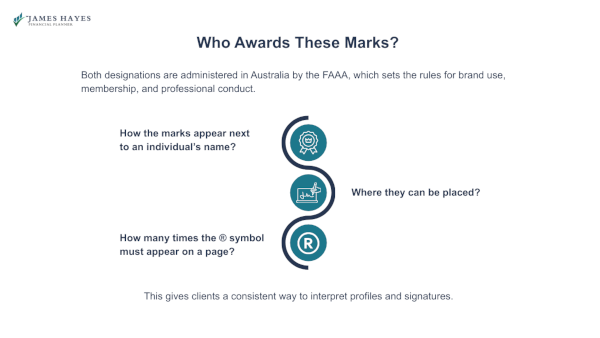
Both designations are administered in Australia by the FAAA, which sets the rules for brand use, membership, and professional conduct. The rules cover how the marks appear next to an individual’s name, where they can be placed, and how many times the ® symbol must appear on a page. This gives clients a consistent way to interpret profiles and signatures.
Pathways and Eligibility

While AFP® indicates membership at an approved professional level, CFP® requires completion of the CFP certification program or an approved pathway plus documented experience and ethics compliance. Degree requirements, bridging units, experienced provider routes, and membership status determine when a candidate may enrol in the CFP certification unit.
If you are reviewing adviser bios, here is a simple way to read the pathways:
AFP®: Confirms the adviser meets FAAA entry and conduct standards for the Financial Planner AFP® membership category.
CFP®: Confirms the adviser has completed advanced certification requirements set and licensed by the FAAA in Australia, with ongoing obligations to maintain the credential.
Ongoing Obligations and What Happens If Membership Lapses
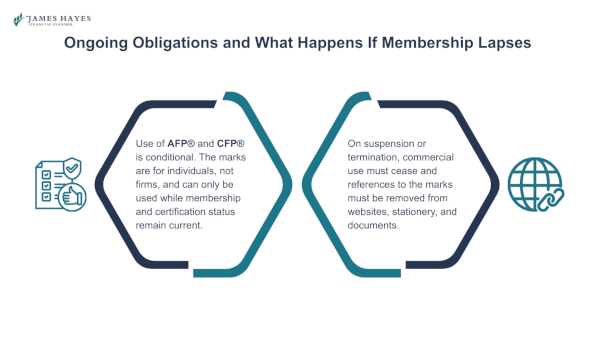
Use of AFP® and CFP® is conditional. The marks are for individuals, not firms, and can only be used while membership and certification status remain current. On suspension or termination, commercial use must cease and references to the marks must be removed from websites, stationery, and documents.
How The Marks Must Appear on a Website or Brochure
The FAAA sets detailed presentation rules so consumers see accurate, consistent information. The highlights below help you sanity-check any adviser profile you are reading.
Rules for AFP® usage:
First use on a page should read Financial Planner AFP® or AFP® with the ® in superscript. Subsequent uses on the same page do not need the symbol.
The mark is used as a descriptive adjective next to a person’s name, for example: James Hayes, Financial Planner AFP®. It is not used as a noun or verb.
The mark should be paired with approved nouns such as professional, practitioner, designation, credential, certification, or mark.
It must appear in capitals when used as AFP®, and without full stops.
There is no AFP logo; the approved usage is the text mark next to the adviser’s name.
Rules for CFP® usage you may see on other adviser sites:
First use should include CFP® or CERTIFIED FINANCIAL PLANNER® with the ® in superscript, followed by an approved noun such as professional or practitioner.
The mark sits with the individual, not the firm logo, and must not be pluralised or turned into a possessive form.
The CFP flame logo has strict artwork, colour, clear-space, and size rules and must be sourced from FAAA artwork files.
Where The Marks Can and Cannot Appear Online
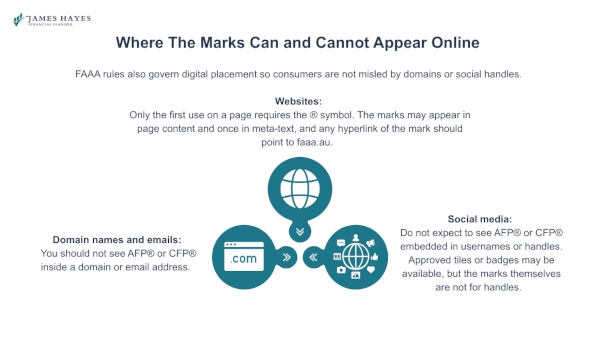
FAAA rules also govern digital placement so consumers are not misled by domains or social handles.
Websites: Only the first use on a page requires the ® symbol. The marks may appear in page content and once in meta-text, and any hyperlink of the mark should point to faaa.au.
Domain names and emails: You should not see AFP® or CFP® inside a domain or email address.
Social media: Do not expect to see AFP® or CFP® embedded in usernames or handles. Approved tiles or badges may be available, but the marks themselves are not for handles.
How to Verify an Adviser’s Designation

Verification is quick and worthwhile. Use the steps below when comparing planners in the Sutherland Shire, the Sydney CBD, or elsewhere.
Ask to see the current certificate for AFP® or CFP® status. For James, the Financial Planner AFP® certificate shows his name, member ID, and validity.
Check profile usage: look for first-use ®, positioning next to the individual’s name, and approved nouns.
Confirm membership is active: the right to use each mark depends on current membership and compliance with FAAA rules.
Quick Comparison Table
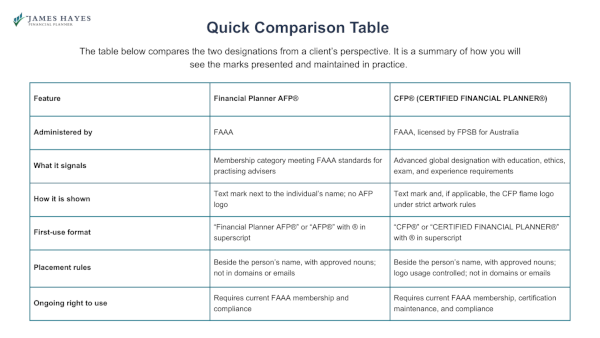
The table below compares the two designations from a client’s perspective. It is a summary of how you will see the marks presented and maintained in practice.
| Feature | Financial Planner AFP® | CFP® (CERTIFIED FINANCIAL PLANNER®) |
|---|---|---|
| Administered by | FAAA | FAAA, licensed by FPSB for Australia |
| What it signals | Membership category meeting FAAA standards for practising advisers | Advanced global designation with education, ethics, exam, and experience requirements |
| How it is shown | Text mark next to the individual’s name; no AFP logo | Text mark and, if applicable, the CFP flame logo under strict artwork rules |
| First-use format | “Financial Planner AFP®” or “AFP®” with ® in superscript | “CFP®” or “CERTIFIED FINANCIAL PLANNER®” with ® in superscript |
| Placement rules | Beside the person’s name, with approved nouns; not in domains or emails | Beside the person’s name, with approved nouns; logo usage controlled; not in domains or emails |
| Ongoing right to use | Requires current FAAA membership and compliance | Requires current FAAA membership, certification maintenance, and compliance |
Why These Designations Matter When You Choose an Adviser
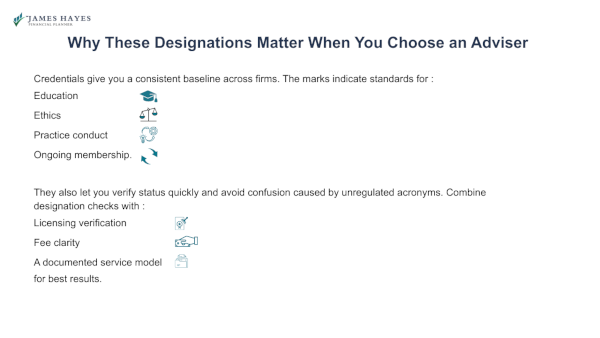
Credentials give you a consistent baseline across firms. The marks indicate standards for education, ethics, practice conduct, and ongoing membership. They also let you verify status quickly and avoid confusion caused by unregulated acronyms. Combine designation checks with licensing verification, fee clarity, and a documented service model for best results.
FAQs
-
AFP® is a professional designation tied to FAAA membership, not an academic qualification. I use it next to my name with the ® on first mention, and I maintain eligibility each year under the association’s rules for ethics, education, experience, and conduct. Clients can request my current certificate anytime.
-
CFP® is an advanced designation with additional certification requirements, global recognition, and strict brand rules. The program is delivered in Australia by the FAAA under licence from FPSB. If you see CFP®, it should sit beside an individual’s name, with the ® on first use and approved wording.
-
No. The marks cannot appear in domain names, email addresses, or social handles. They may appear in page content, next to the individual’s name, and once in meta-text per page, following the first-use ® rule. This prevents misuse and keeps credentials easy to verify online.
-
Ask to see the current Financial Planner AFP® certificate, check first-use formatting with the ® on his website, and confirm membership is active. My certificate lists my name, member ID, and validity date, and I maintain the designation in line with FAAA rules each year.
Financial Planner Knowledge Bundle
- What Exactly Does a Financial Planner Do?
- Financial Advice vs Financial Planning
- Independent vs Institution-Linked Financial Advisers
- What Does Financial Advice Cost in NSW?
- How to Choose the Right Financial Adviser in Australia
- When to Get Financial Advice in Australia
- What Areas Do Financial Planners Cover?
- Online Financial Planning Services
- Financial Planning Process Explained
- Common Mistakes When Choosing Financial Advisers
- Certified Financial Planner (AFP®/CFP®) Explained
- Financial Adviser Regulation & Licensing (ASIC/AFSL) Explained
- Local Financial Planning Services in Sutherland Shire
Disclaimer
The information in this article is provided as a general guide only. It does not constitute personal financial advice and should not be relied upon as such. Readers should seek advice from a licensed financial adviser before making any financial decisions. James Hayes and his associated entities accept no responsibility or liability for any loss, damage, or action taken in reliance on the information contained in this article. Links to third-party websites are provided for reference purposes only. We do not endorse or guarantee the accuracy of their content.