
First Home Buying
How to Save for First Home Deposit – Advice from Financial Adviser
Written & Reviewed by James Hayes ·

Summary
Deposit size, genuine savings rules and your marginal tax rate all shape where your money should be while you save. A high-interest account, an offset account and the First Home Super Saver Scheme each suit different timelines and risk levels, and most first home buyers use more than one at once.
Financial health and savings checklist. Download Free Checklist.
Introduction
Saving for a first house isn’t just about the amount you set aside each month. It’s about where that money is, how it’s taxed, and whether it counts as genuine savings when a lender reviews your file. Two buyers saving $1,000 a month can end up in very different positions after two years, depending on these three factors alone.
This post builds on our first article, Are You Financially Ready to Buy Your First Home? (read this first), by working through the practical side of saving:
- How much you need
- Where to keep it
- How to speed it up
- What to do if your deposit is smaller than you’d like
For a savings plan built around your income and timeline, James does offer financial advice for first home buying in case you are interested.

How Much Deposit Do You Need?
The deposit figure changes depending on which path you take, so it helps to work from a real property price rather than a percentage alone.
On an $800,000 property, a 5% deposit under the First Home Guarantee (opens in a new tab) comes to $40,000, while a traditional 20% deposit comes to $160,000. Most lenders also require genuine savings of at least 5% of the purchase price, held for a minimum of three months, regardless of which deposit size you’re aiming for.
On top of the deposit, budget for stamp duty (NSW first home buyers pay none up to $800,000, with a sliding concession to $1,000,000), conveyancing fees of roughly $1,500 to $2,500, and a building and pest inspection at $400 to $800. Your total savings target is the deposit plus these costs, not the deposit figure alone.
Can You Buy A Home With a 5% Deposit?
Yes, and for many first home buyers it’s now the faster path to ownership.
The First Home Guarantee (opens in a new tab), run by Housing Australia (opens in a new tab), lets eligible buyers purchase with a 5% deposit while the government guarantees the remaining gap up to 15% of the property’s value. This removes the need to pay Lenders Mortgage Insurance (opens in a new tab), which can otherwise add roughly $15,000 to $35,000 to a loan for a buyer with a sub-20% deposit outside the scheme.
Since October 2025, the scheme has no income cap and no annual place limit, and the Sydney property price cap is $1,500,000. The trade-off is a larger loan balance and higher total interest paid over the life of the loan compared with a 20% deposit, since you’re borrowing 95% of the purchase price instead of 80%.
Is a 20% Deposit Still Worth Saving?
For some buyers, yes, but the calculation has changed now that the 5% path avoids LMI entirely.
A 20% deposit still delivers the smallest possible loan balance and the lowest total interest paid, and it removes any dependency on a government scheme’s eligibility rules or price caps. It also gives you more room if your target property is above the First Home Guarantee’s cap for your area. The cost is years of extra saving because reaching $160,000 on an $800,000 property takes roughly four times as long as reaching $40,000 at the same monthly savings rate, before accounting for house price growth in the meantime.
For buyers who qualify for the First Home Guarantee and don’t need extra borrowing headroom, saving the full 20% is rarely the faster or cheaper route once LMI is out of the equation.
What Counts as Genuine Savings?
Lenders don’t just want to see money in your account. They want to see how it got there.
Genuine savings generally means funds that have been held in your name, in a bank account, term deposit or similar, for at least three consecutive months, rather than deposited immediately before you apply. Regular savings account balances, term deposits, shares held for three months or longer, and First Home Super Saver Scheme (opens in a new tab) contributions all typically qualify. A cash gift from family, an inheritance, or a builder’s deposit can also count, but usually only once it’s been in your account for three months or more.
This requirement applies most strictly once you’re borrowing above 80% of the property’s value, which covers most first home buyers using a 5% or 10% deposit.
How Much Income Should Go Towards Deposit?
There’s no single figure that works for everyone, but a starting range helps set a realistic pace.
First home buyers should aim to direct 15% to 25% of their net income towards deposit savings, adjusted up or down depending on their timeline and other financial commitments. Someone targeting a three-year timeline on a tight deposit goal will need to save at the higher end of that range or extend the timeline.
It’s worth setting this figure as a fixed transfer on payday rather than a leftover amount at the end of the month, since a fixed transfer tends to produce a steadier monthly result than saving whatever’s left after spending.
How to Balance Saving with Other Financial Goals
A deposit goal doesn’t need to come at the expense of everything else, but it does need a clear order of priority.
Keep your employer’s compulsory superannuation contributions running as normal, since these aren’t part of your deposit savings and shouldn’t be redirected.
If you’re carrying high-interest debt such as credit card balances or buy-now-pay-later plans, clearing these usually delivers a better return than what any savings account pays, so it’s worth prioritising ahead of extra deposit contributions.
Keep a small separate buffer for emergencies, rather than treating your entire deposit balance as available for unexpected costs, since dipping into it can set your timeline back by months.
Voluntary super contributions through the First Home Super Saver Scheme can run alongside your regular savings account rather than replacing it, since the two work differently on tax.
We cover exactly how that scheme works, including the contribution caps and application steps, in the next post in this series.
Where Should You Save Your Deposit?
The right account depends on how soon you plan to buy and whether you already hold a mortgage.
A high-interest savings account is the standard choice for most first home buyers, with the top ongoing rates in Australia currently between 5% and 5.75% p.a., though these usually require a minimum monthly deposit or no withdrawals to unlock the full rate. Term deposits suit money you’re confident you won’t need to touch for a fixed period, since early withdrawal usually costs you the bonus interest.
If you already own a property with a mortgage, such as an investment property, an offset account can outperform a savings account after tax, since it reduces the interest you pay on your loan rather than generating taxable interest income.
Whichever account you choose, keeping deposit savings separate from everyday spending money makes it easier to track progress and avoid accidentally spending it.
Savings vs Investments For Deposit?
For most first home buyers saving over a two- to five-year timeline, investing deposit savings in shares or ETFs adds a risk that doesn’t suit the goal.
Share markets can and do fall over any given two- to five-year period, and a downturn in the months before you’re ready to buy could shrink your deposit right when you need it. A savings account or term deposit doesn’t offer the same growth potential, but it also doesn’t carry that risk of loss right before settlement. Investing can make more sense if your timeline is longer, five years or more, and you’re comfortable adjusting your purchase timing if markets move against you.
For most buyers with a firm target date, keeping deposit savings in cash and directing any investment risk toward longer-term goals, like super, is the more reliable approach.
How to Build Deposit Faster
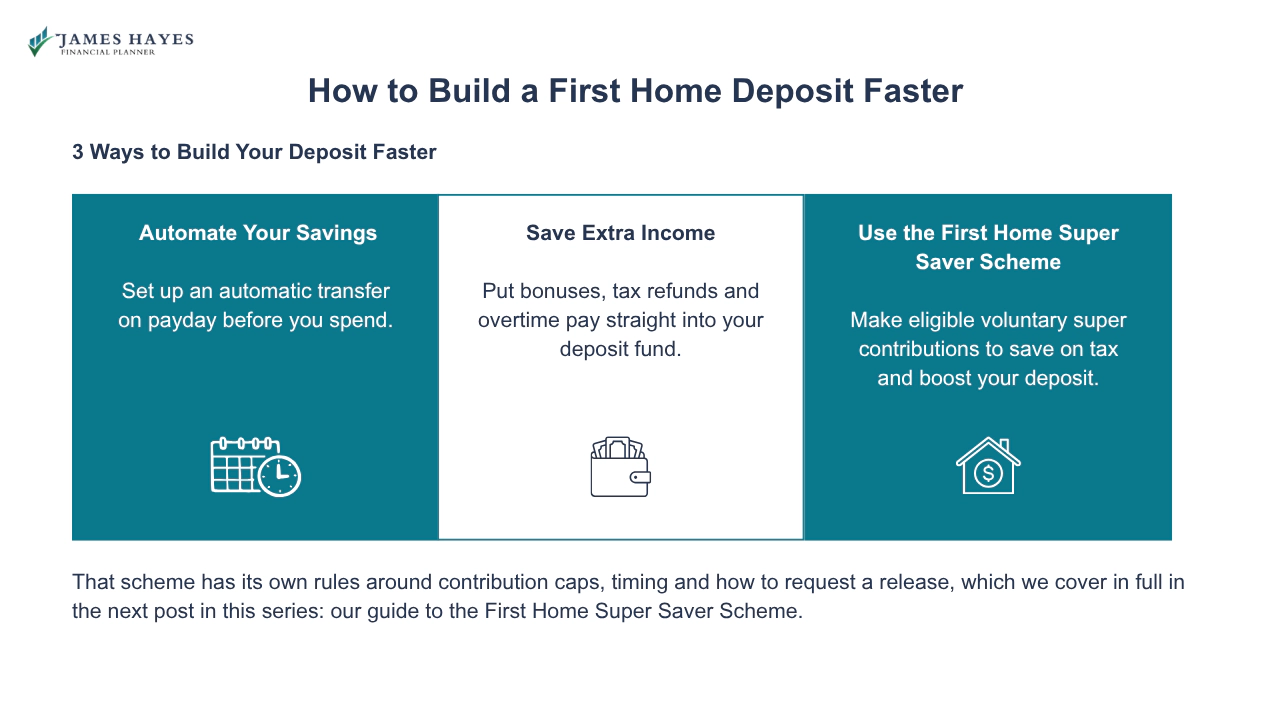
Three changes make the biggest difference to how quickly a deposit builds, beyond simply saving more each month.
- Automate a fixed transfer to your savings account on payday, before you have a chance to spend it, rather than saving whatever’s left at the end of the month.
- Direct any bonuses, tax refunds or overtime pay straight into your deposit account instead of treating it as spending money, since irregular income adds up faster than it feels like it does.
- Use the First Home Super Saver Scheme to direct voluntary super contributions toward your deposit, since these are taxed at 15% inside super rather than your marginal income tax rate, which can be a meaningful saving over a few years for anyone on a 32.5% or 37% tax bracket.
That scheme has its own rules around contribution caps, timing and how to request a release, which we cover in full in the next post in this series: our guide to the First Home Super Saver Scheme.
What Happens If You Have a Small Deposit but Strong Income?
A smaller deposit doesn’t rule out buying, provided your income can support the loan. Lenders assess borrowing capacity primarily on income, expenses, and existing debt, not deposit size alone, which means a buyer with a strong, stable income and a 5% deposit can often still be approved under the First Home Guarantee. The trade-off is a larger loan balance and higher total interest over the life of the loan, since you’re borrowing a larger share of the purchase price.
It’s worth working through both scenarios, buying now with a smaller deposit versus waiting to save more, against your own income and the property prices in your target area, since the better financial outcome depends on how quickly prices are moving relative to your savings rate.
Get a First Home Savings Plan Built Around Your Numbers
Every first home buyer’s savings account, income allocation and timeline look different once real numbers are involved. James Hayes, is an AFP®-accredited financial planner (opens in a new tab) based in Caringbah, works through deposit targets, genuine savings rules and account structures with first home buyers across the Sutherland Shire, Inner West and Greater Sydney. Book a free 15-minute call (opens in a new tab) to build a plan around your income and timeline.