
First Home Buying
Are You Financially Ready to Buy Your First Home?
Written & Reviewed by James Hayes ·

Summary
Financial readiness for a first home rests on four figures: genuine savings held for three months, borrowing capacity tested at your rate plus 3%, eligibility for schemes like the First Home Guarantee, and total upfront costs beyond the deposit. Most buyers underestimate at least one before they start inspecting properties.
First home buyer financial planning guide. Download Free Guide.
Introduction
Buying your first home, starts well before an open home inspection. A first home buyer today needs 11.2 years on average to save a 20% deposit, according to the federal government’s 2026 State of the Housing System report (opens in a new tab), up from nine years in 2015. That single figure explains why financial readiness needs to mean something more concrete than a gut feeling.
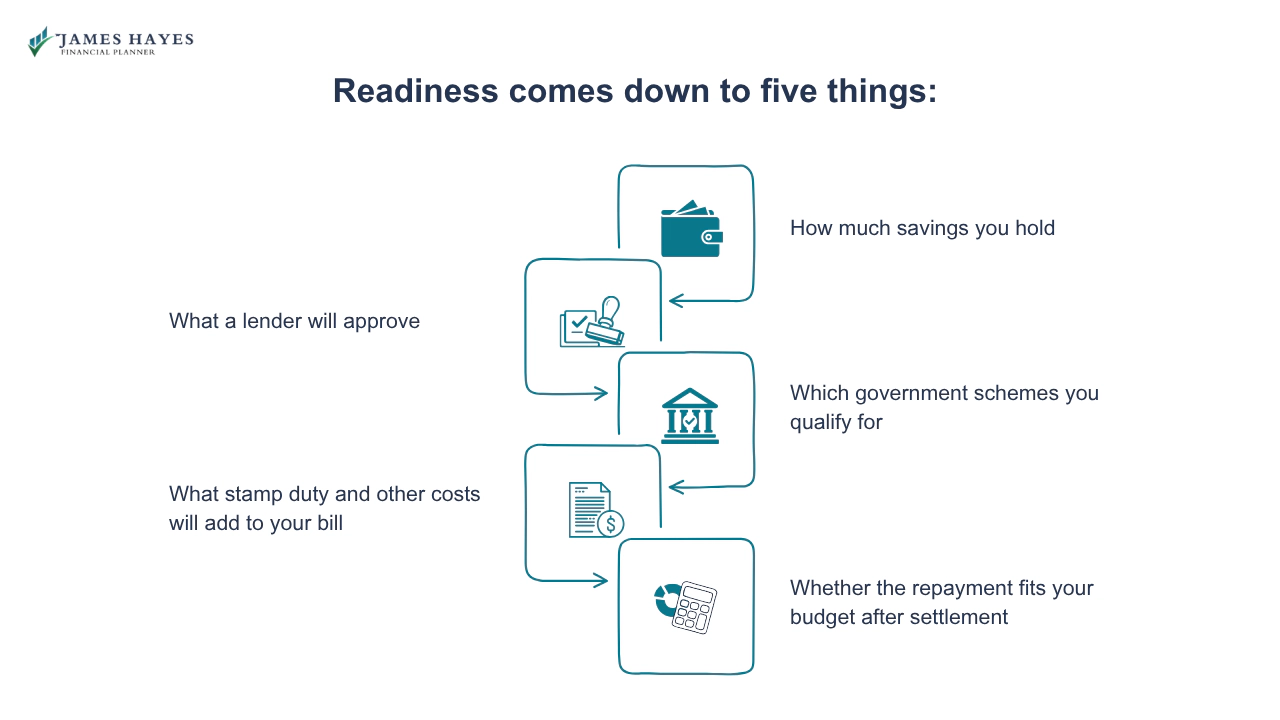
Readiness comes down to five things:
- How much savings you hold
- What a lender will approve
- Which government schemes you qualify for
- What stamp duty and other costs will add to your bill
- Whether the repayment fits your budget after settlement
This guide works through each one in the order most first home buyers need them. For a plan built around your income, deposit and target suburb, I do offer first home buying financial advice that turns these checks into a savings and borrowing plan.

Where Should You Start?
First home buyers start by browsing listings. That’s backwards. The property search should start after three checks, not before.
First, pull your full financial position together:
- Net income after tax
- Every existing debt (HECS-HELP, car loans, buy-now-pay-later balances, credit cards)
- Free credit report from Equifax, illion or Experian
Second, check the price caps and eligibility rules for your target area at firsthomebuyers.gov.au (opens in a new tab). You may also wish to check the cap for the city or regional where you wish to purchase under the First Home Guarantee scheme.
Third, get a borrowing capacity estimate or formal pre-approval before you start attending inspections, because your servicing limit, not the price you’d like to pay, sets your real ceiling.
Doing these three things in order stops you from falling for a property that a lender won’t approve or missing a scheme deadline because you found out about it too late.
How to Know If You’re Financially Ready
Readiness isn’t about having enough saved in a vague sense. You’re likely ready if:
- Your deposit has been in a savings account, term deposit or FHSSS-eligible super contribution for at least three months (this is what lenders call genuine savings)
- Your employment has been stable for six months or more.
- Your existing debts are manageable enough that a lender’s serviceability calculator, which tests your ability to repay at your loan rate plus a 3-percentage-point buffer, still approves the amount you need.
- You can keep three to six months of living expenses in reserve after settlement.
- You’ve checked your credit file for errors or missed payments that could reduce your approved amount.
If two or more of these aren’t true yet, that’s not a reason to stop. You’ll know what to fix first.
What Financial Goals Should You Set?
A savings account without a target number rarely hits one. Before you buy, set five goals you can track.
- Set a deposit target as a dollar figure, not a percentage. For example, $40,000 for a 5% deposit on an $800,000 property under the First Home Guarantee, or $160,000 for a traditional 20% deposit.
- Set a genuine savings goal of at least 5% of your target purchase price, held for three consecutive months, since most lenders require this above an 80% loan-to-value ratio.
- Set a debt-reduction goal that clears buy-now-pay-later balances and brings credit card limits down, because lenders assess your full credit limit, not your balance, when calculating serviceability.
- Set a buffer goal of three to six months of living expenses to hold in reserve after settlement.
- Set a timeline goal, whether that’s 18 months or three years, so your monthly savings rate has a target to hit and does not drift.
How Much Do You Need to Save?
The number depends on which deposit path you’re taking, and the gap between them is large.
Under the First Home Guarantee (opens in a new tab), eligible buyers can purchase with a 5% deposit and no Lenders Mortgage Insurance (opens in a new tab), since the government guarantees the remaining gap up to 15% of the property’s value. On an $800,000 Sutherland Shire home, that’s $40,000. Buy the same property with a traditional 20% deposit and no guarantee, and you’d need $160,000, though you’d also avoid LMI, which can otherwise add anywhere from roughly $15,000 to $35,000 to your loan for a sub-20% deposit outside the scheme.
Genuine savings rules apply on top of the deposit figure itself. Most lenders want to see at least 5% of the purchase price held in a bank account, term deposit or similar for a minimum of three months, rather than dropped in as a recent gift.
Add stamp duty to the total. NSW first home buyers pay no stamp duty on properties up to $800,000 (opens in a new tab), with a sliding concessional rate applying between $800,000 and $1,000,000. On an $870,000 purchase, that concession brings duty down from a standard $33,337 to roughly $13,715.
Add legal and inspection costs, and your total need-to-save figure is your deposit plus these upfront costs, not the deposit alone.
How Long Should You Save?
The national average of 11.2 years to save a 20% deposit assumes no scheme support and a fixed savings rate. Most first home buyers can speed up the timeline using three levers.
First, the First Home Guarantee’s 5% deposit path cuts the target dollar figure by roughly three-quarters compared with a 20% deposit, which is the single biggest timeline lever available.
Second, the First Home Super Saver Scheme (opens in a new tab) lets you direct up to $15,000 of voluntary super contributions per financial year, up to a $50,000 lifetime cap per person ($100,000 for a couple who are both eligible), into your deposit. Contributions are taxed at 15% inside super rather than your marginal income tax rate, and released amounts carry a 30% tax offset. For someone on a 32.5% or 37% marginal rate, that difference compounds over several years of saving.
Third, automating a fixed transfer to a separate high-interest savings account on payday, rather than saving what’s left over, tends to produce a more consistent monthly rate than ad hoc saving.
How Much Can You Afford to Spend on Your First Home?
Affordability is set by your lender’s assessment rate, not today’s advertised rate.
APRA requires every regulated lender to test your ability to repay at your actual loan rate plus a 3-percentage-point buffer. If you’re offered a 6% variable rate, the bank checks whether you could still make repayments at around 9%. This buffer reduces borrowing capacity by 15% to 20% compared with an assessment at the real rate, which is why a borrowing estimate from a lender’s website calculator often overstates what you’ll be approved for. Existing debts cut into this further. HECS-HELP balances, car loans, and even unused credit card limits are counted against your capacity, because lenders assess the full limit rather than your current balance.
As a starting guide, many lenders and planners use a rule of thumb that mortgage repayments should stay under roughly 30% of net household income, leaving room for the rest of your budget. This is a guide, not a hard rule. Your own comfortable ceiling depends on your other financial goals, including how much you’re still contributing to super and any other debts you’re carrying.
What Should Your First Home Budget Include?
A first home budget has two parts:
- Upfront costs
- Ongoing costs
Upfront costs include:
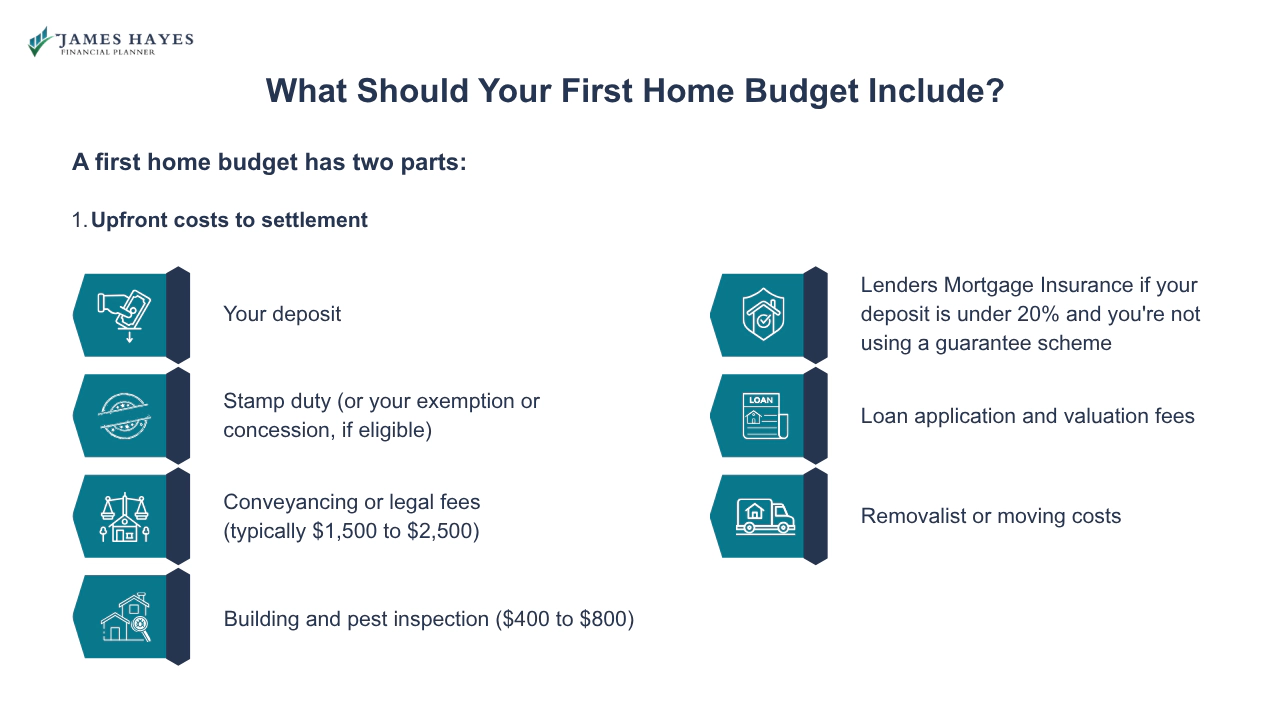
- Your deposit
- Stamp duty (or your exemption or concession, if eligible)
- Conveyancing or legal fees (typically $1,500 to $2,500)
- Building and pest inspection ($400 to $800)
- Lenders Mortgage Insurance if your deposit is under 20% and you’re not using a guarantee scheme
- Loan application and valuation fees
- Removalist or moving costs
Ongoing costs include:
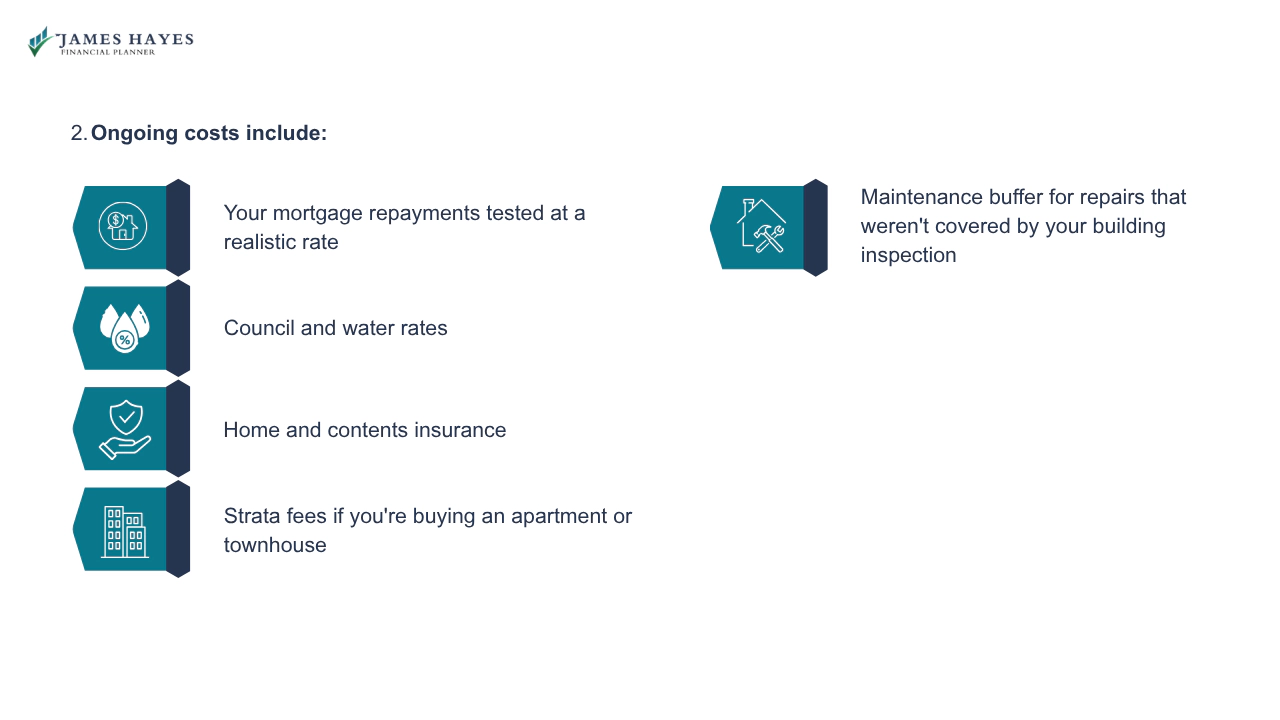
- Your mortgage repayments tested at a realistic rate
- Council and water rates
- Home and contents insurance
- Strata fees if you’re buying an apartment or townhouse
- Maintenance buffer for repairs that weren’t covered by your building inspection
Missing either half of this list is the most common budgeting mistake first home buyers make. The deposit gets planned in detail, while stamp duty, LMI and ongoing rates get treated as an afterthought.
How to Set a Realistic Buying Budget
Build your budget from your take-home pay downward, not from the property price upward.
Start with net income after tax, then subtract fixed living costs, existing debt repayments, and your ongoing savings goal, including super. What’s left is your genuine capacity for a mortgage repayment.
Run that repayment figure through your own version of the APRA stress test. Calculate what the repayment would look like at your quoted rate plus 3%, not just at today’s rate, so you’re not caught out if rates move during the life of the loan.
Leave a working buffer of at least 5% to 10% of the repayment amount for the ongoing costs listed above, rather than assuming your borrowing capacity figure from the bank is the amount you should spend.
First Home Buyer Financial Checklist
Getting your paperwork and finances in order ahead of time shortens the path from finding a property to exchanging contracts. The checklist below covers the three areas that most commonly delay a first home buyer’s approval.
Documents to Gather
Have 100 points of identification ready, along with your two most recent payslips, three months of bank statements across all accounts, your most recent tax return or Notice of Assessment, and statements for every existing debt, including HECS-HELP, car loans and credit cards.
Finances to Tidy Up
Make sure your genuine savings have remained untouched for at least three months, reduce or close unused credit card limits, clear buy-now-pay-later balances, and check your credit file for errors before a lender does.
Scheme Applications to Lodge
If you’re using the First Home Super Saver Scheme (opens in a new tab), request your FHSS determination from the ATO before you sign a purchase contract. Signing first forfeits your eligibility for that purchase.
If you’re applying for the First Home Guarantee (opens in a new tab), confirm your spot with a participating lender before making an offer, since not every lender takes part.
If you’re eligible for a stamp duty exemption or the First Home Owner Grant (opens in a new tab), have that paperwork ready to lodge at the same time as your loan application.
Should You Buy a Home Now or Keep Saving?
This is the decision every first home buyer eventually must make, and there’s no single right answer, only a set of trade-offs worth weighing against your numbers.
Buying now with a 5% deposit under the First Home Guarantee avoids Lenders Mortgage Insurance entirely and removes the years it would otherwise take to reach a 20% deposit. The trade-off is a larger loan balance from day one, and more of your repayment going toward interest in the early years.
Waiting and saving a larger deposit reduces your loan size and monthly repayment but exposes you to the risk that prices in your target suburb rise faster than your savings rate, and to years of paying rent that builds no equity in the meantime. The 3% APRA buffer and current price caps also mean your borrowing capacity today may not be your borrowing capacity next year, in either direction.
The right call depends on your income stability, how close you already are to a workable deposit, and current price caps and rates in your area. The next post in this series breaks down exactly how to build a deposit-saving strategy once you’ve made that call.
Get a Clear Answer About First Home Buying Finances
Reading about deposit thresholds and buffers is different from knowing where you personally stand. James Hayes, is an AFP®-accredited financial planner (opens in a new tab) based in Caringbah, works through genuine savings, borrowing capacity, and scheme eligibility with first home buyers across the Sutherland Shire and Greater Sydney. Book a free 15-minute call (opens in a new tab) to find out exactly how close you are to being ready.