

The First Home Super Saver Scheme lets you release up to $50,000 of voluntary super contributions, taxed at 15% going in rather than your marginal rate. Release amounts, contribution ordering, and strict timing rules around requesting a determination and signing a contract all affect how much you get and when.
Introduction
The First Home Super Saver Scheme (opens in a new tab) lets first home buyers use their superannuation fund as a tax-effective deposit account. It’s run by the Australian Taxation Office (opens in a new tab), and it can speed up a deposit timeline, but the contribution limits, release calculations, and timing rules catch out buyers who apply for it without understanding what it is and how it works.
If you’d like a plan that fits your income, super balance, and target timeline, James Hayes’s First Home Buyers Advice service can work through whether the scheme suits your situation.
How Does It Work?
The scheme lets you make voluntary contributions into your super (opens in a new tab), on top of your employer’s compulsory contributions, and later withdraw those contributions plus deemed earnings to help buy your first home.
You can contribute through salary sacrifice (concessional contributions, taxed at 15% in your super fund) or after-tax personal contributions (non-concessional contributions). When you’re ready to buy, you apply to the ATO for a determination that tells you your maximum release amount (opens in a new tab), then request the release itself. Your super fund sends the money to the ATO, which withholds tax and pays the balance to you.
Couples, friends, or siblings buying together can each use their own FHSS savings toward the same property, which means a couple can potentially combine two separate releases.
Who Is Eligible?
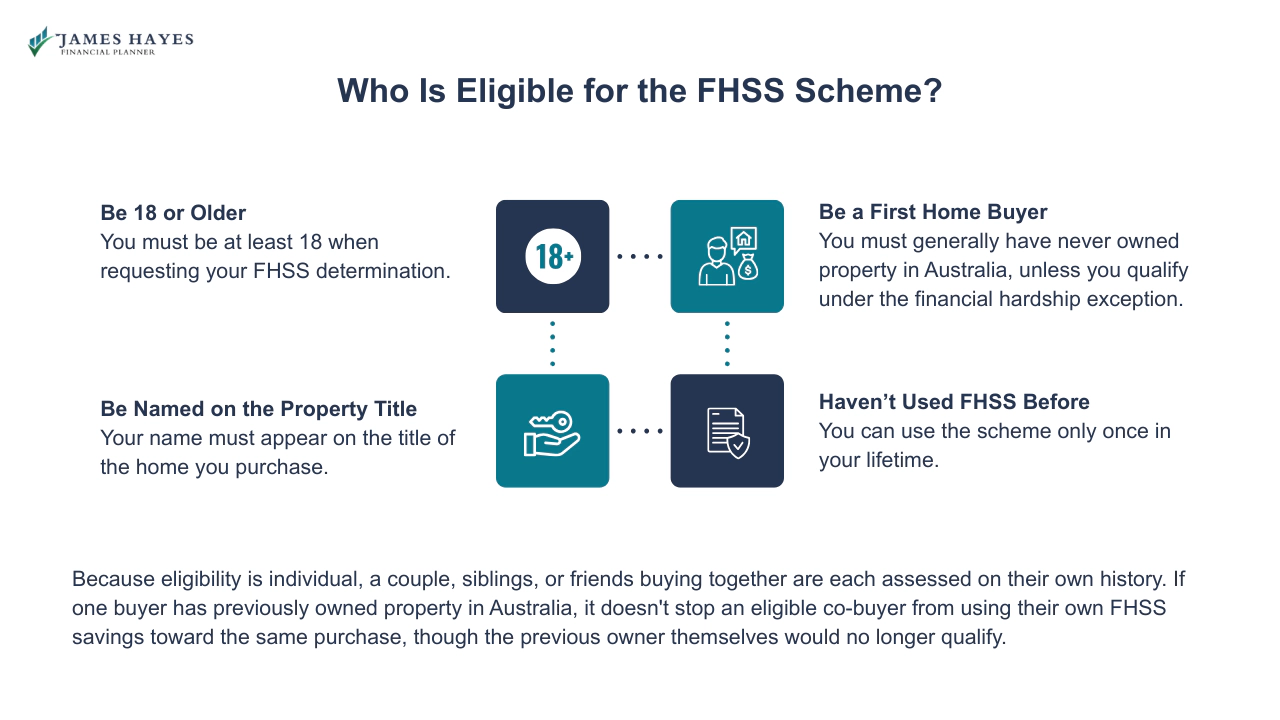
The ATO assesses FHSS eligibility (opens in a new tab) on an individual basis, which means every condition below applies to you personally rather than to your household or co-buyer.
- You must be 18 or older when you request your FHSS determination, though contributions made before you turned 18 can still count toward your release amount.
- You must be a genuine first home buyer who has never owned property in Australia, including an investment property, vacant land, commercial property, a lease of land, or a company title interest in land. An exception applies if the ATO determines you’ve experienced FHSS financial hardship after previously losing a property (opens in a new tab).
- Your name must appear on the title of the property you buy, since being listed on utility bills or a lease isn’t enough to satisfy this condition.
- You also can’t have a completed release request from an earlier FHSS determination, since the scheme is a once-in-a-lifetime entitlement per person.
Because eligibility is individual, a couple, siblings, or friends buying together are each assessed on their own history. If one buyer has previously owned property in Australia, it doesn’t stop an eligible co-buyer from using their own FHSS savings toward the same purchase, though the previous owner themselves would no longer qualify.
How Much Can You Save Through It?
The scheme caps both your annual eligible contributions and your total lifetime release amount, so it helps to know both figures before you start planning around it.
You can count up to $15,000 of voluntary contributions per financial year (opens in a new tab) toward the scheme, and $50,000 in total across all years since 1 July 2017.
Your release amount isn’t simply your contributions back. It includes 100% of your non-concessional (after-tax) contributions, 85% of your concessional (salary sacrifice) contributions, and deemed earnings calculated by the ATO using the shortfall interest charge rate. The 15% cut on concessional contributions reflects the tax your super fund already paid on them.
For example, someone who salary sacrifices $15,000 a year for three years has made $45,000 in concessional contributions, but their release amount would be based on 85% of that figure, plus associated earnings, not the full $45,000.
What Are the Benefits and Limitations?
The scheme’s main advantage is tax, not growth. Contributions are taxed at 15% inside super rather than your marginal income tax rate, which can be 32.5%, 37%, or 45% depending on your income.
On release, the ATO applies a withholding rate based on your expected marginal tax rate plus the Medicare levy, minus a 30% offset, or 17% if your rate can’t be estimated. This structure means the scheme suits people with room in their budget for extra voluntary contributions and a marginal tax rate above 15%. It suits fewer people at the $50,000 lifetime cap once weighed against a full 20% deposit target, since the cap covers only part of most first home budgets.
The scheme also locks your money inside super until you’re ready to buy, which limits flexibility if your plans change, and it can only be used once in a lifetime per person.
First Home Super Saver Scheme vs Saving a Deposit in a Bank Account
Both paths can run at the same time, but they behave differently on tax and access.
A high-interest savings account currently pays 5% to 5.75% p.a. at the most competitive providers, taxed at your full marginal rate as ordinary income. Contributions to the FHSS scheme are taxed at 15% going in, and the released amount carries a 30% tax offset, which for most income levels works out ahead of a savings account after tax.
The trade-off is access. Savings account funds can be withdrawn any time, while FHSS contributions are locked inside super until you formally request a release under the scheme’s rules.
Most first home buyers use both, directing a portion of their savings rate through voluntary super contributions and keeping a separate savings account for the deposit money they might need sooner or for costs the scheme doesn’t cover, such as stamp duty and legal fees.
Should You Use Super to Help Fund Your First Home Deposit?
Whether the scheme suits you depends on your marginal tax rate, your timeline, and how much flexibility you need in your savings.
It’s worth using if you’re on a marginal tax rate above 15%, have room in your budget to direct extra income into super without straining your day-to-day finances, and expect to buy more than a year or two away, since the timing rules require an ATO determination before you sign a contract.
It’s less suited to buyers who need every dollar of their deposit accessible at short notice, or who are close to exchanging on a property already, since setting up salary sacrifice arrangements and building a meaningful balance takes time.
When Should You Start Using the FHSS?
Starting early is more advantageous with this scheme than with a standard savings account, because the tax benefit compounds with every extra year of contributions.
The $15,000 annual cap means it takes at least four financial years of maximum contributions to reach the top of the scheme’s own limits before earnings. Starting contributions as soon as you commit to buying a first home, rather than waiting until you’re close to a purchase, gives you more time to build toward the cap and more time for deemed earnings to accrue.
If you’re within a year of buying, it’s still worth checking your figures, but the tax advantage on a smaller balance built over a shorter period will be more modest.
How to Use It to Build Your Deposit
Setting up the scheme correctly, and in the right order, prevents most of the problems that trip up first-time applicants.
- Set up a salary sacrifice arrangement with your employer or arrange to make personal deductible contributions directly to your super fund, and confirm your fund accepts voluntary contributions for this purpose.
- Track your contributions against the $15,000 annual and $50,000 lifetime caps as you go, since exceeding them doesn’t increase your release amount and can create other tax complications.
- When you’re ready to buy, request an FHSS determination from the ATO before you sign any contract to purchase or build, since ownership transferring to you (which generally happens at settlement) ends your eligibility to request one.
- Once you have your determination, submit your release request. The ATO typically takes 15 to 20 business days to pay released funds after your super fund processes the request.
Government grants, stamp duty concessions, and the First Home Guarantee (opens in a new tab) can all be used alongside the FHSS scheme, and stacking these correctly makes a difference to your total upfront costs. Our next post in this series covers how those schemes and grants work, and how to check what you’re eligible for in your state.
Common First Home Super Saver Scheme Mistakes to Avoid
A handful of timing and paperwork mistakes cause most of the problems first home buyers run into with this scheme.
- Signing a purchase contract before requesting your FHSS determination is the most common and costly mistake, since it forfeits your eligibility for that purchase entirely.
- Missing the post-release deadline is another. Once you’ve released funds, you generally have 12 months to sign a contract to buy or build (with a possible 12-month extension), or to recontribute the amount to your super fund. If you do neither, you’re liable for FHSS tax of 20% of your assessable released amount (opens in a new tab), on top of any income tax already withheld.
- Overcontributing beyond the $15,000 annual or $50,000 lifetime caps doesn’t increase your release amount, so any excess sits in super without the deposit benefit you were counting on.
- Off-the-plan buyers face a different version of the same timing issue because the ATO requires you to request your determination, request your release, and notify them within 90 days of the contract date, so leaving this to the last minute is a common way to miss out.
Work Out If the FHSS Is the Right Plan for You
Deciding how much to salary sacrifice, when to request your determination, and how to combine the scheme with other deposit savings depends on your income and timeline. James Hayes, an AFP®-accredited financial planner (opens in a new tab) based in Caringbah, works through these numbers with first home buyers across the Sutherland Shire and Greater Sydney. Book a free 15-minute call to check whether the First Home Super Saver Scheme fits your plan (opens in a new tab).