
First Home Buying
Government Schemes, Grants & Stamp Duty for First Home Buyers
Written & Reviewed by James Hayes ·

Summary
Federal schemes cut deposit size and remove Lenders Mortgage Insurance, state grants add a cash contribution for new homes, and stamp duty exemptions remove the largest upfront cost. Most first home buyers qualify for at least two of these at once, and buying in NSW can access a full stamp duty exemption up to $800,000.
NSW first home buyer eligibility checklist. Download Free Checklist.
Introduction
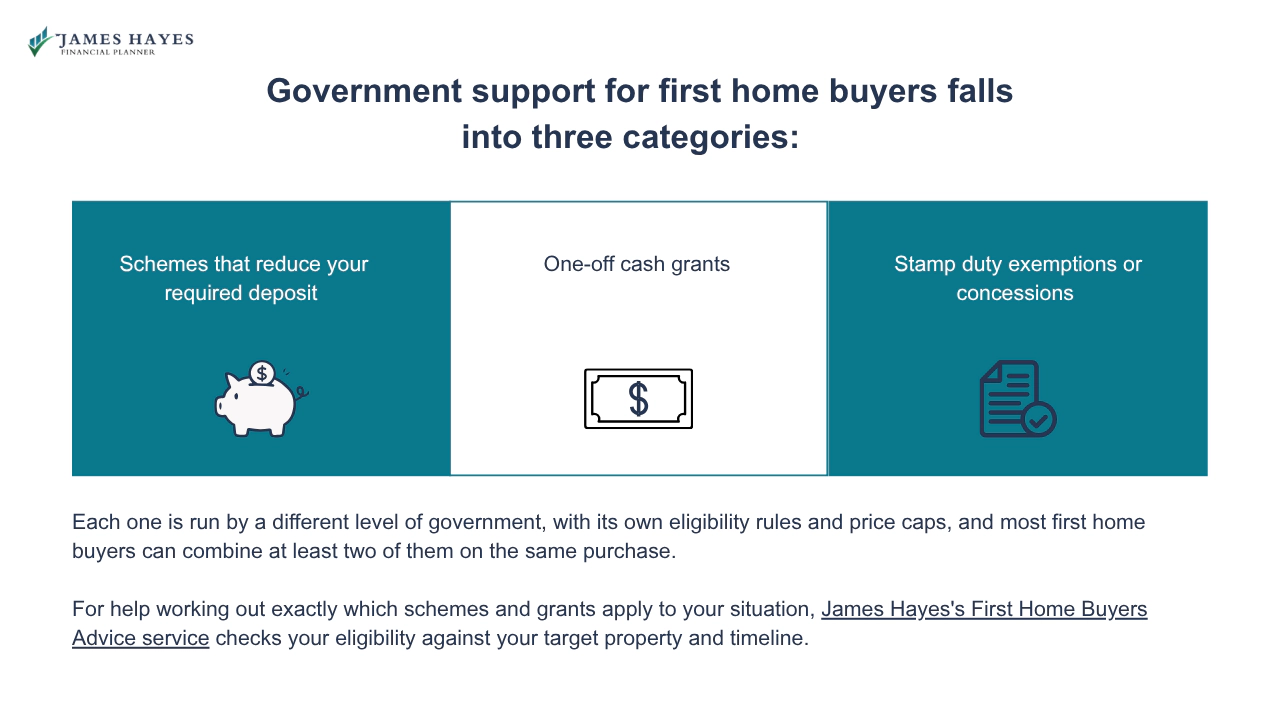
Government support for first home buyers falls into three categories:
- Schemes that reduce your required deposit
- One-off cash grants
- Stamp duty exemptions or concessions
Each one is run by a different level of government, with its own eligibility rules and price caps, and most first home buyers can combine at least two of them on the same purchase.
For help working out exactly which schemes and grants apply to your situation, I can help you checks your eligibility against your target property and timeline.

What First Home Buyer Government Schemes Are Available?
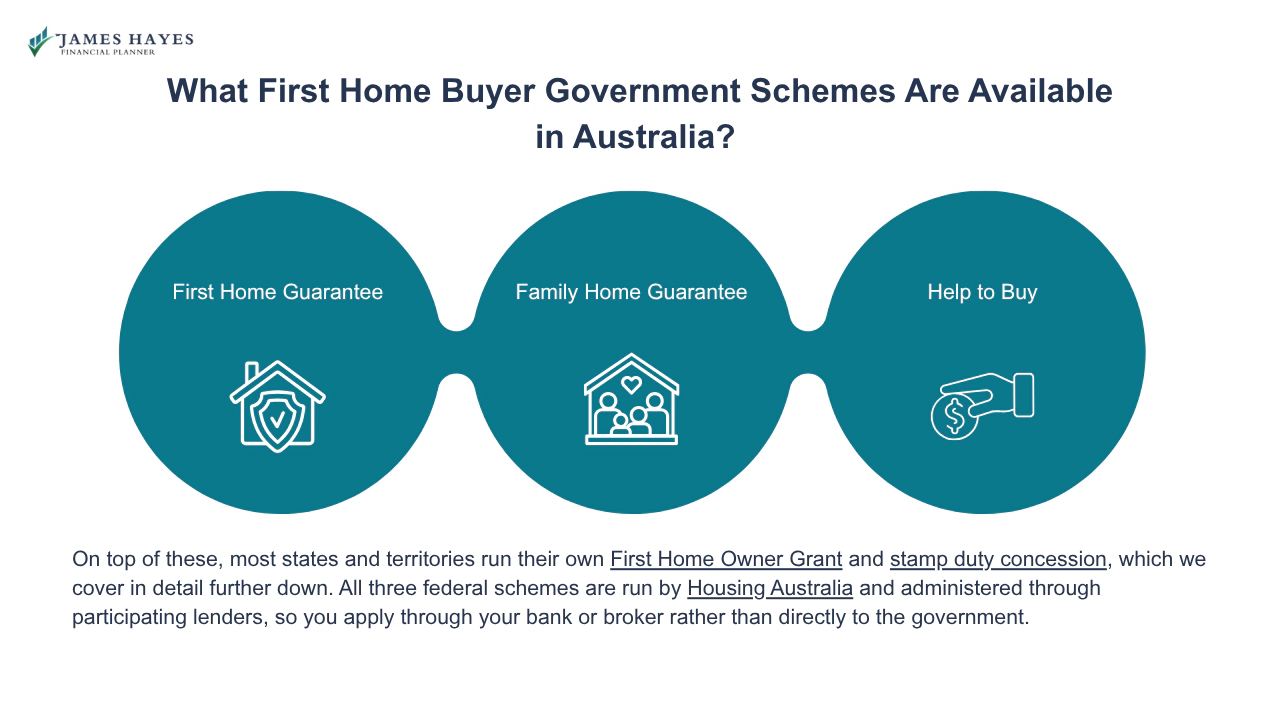
Three federal schemes currently support first home buyers, each targeting a different barrier to entry.
- First Home Guarantee: Lets eligible buyers purchase with a 5% deposit while the government guarantees the gap, removing the need for Lenders Mortgage Insurance. Learn more (opens in a new tab).
- Family Home Guarantee: The same guarantee structure, but for single parents or single legal guardians with at least one dependent, requiring only a 2% deposit. Learn more (opens in a new tab).
- Help to Buy: A shared equity scheme where the government contributes up to 30% of an existing home’s price or 40% of a new home’s price, in exchange for an equivalent equity stake, requiring a 2% deposit. Learn more (opens in a new tab).
On top of these, most states and territories run their own First Home Owner Grant (opens in a new tab) and stamp duty concession (opens in a new tab), which we cover in detail further down. All three federal schemes are run by Housing Australia (opens in a new tab) and administered through participating lenders, so you apply through your bank or broker rather than directly to the government.
How the Government’s Home Buyer Schemes Work
Each federal scheme uses a different mechanism to lower your entry cost, so it’s worth understanding how the money moves.
Under the First Home Guarantee and Family Home Guarantee, no cash changes hands. The government simply guarantees the lender against the portion of the loan above 80% of the property’s value, up to 15% for the First Home Guarantee or 18% for the Family Home Guarantee.
This guarantee is what lets the lender waive Lenders Mortgage Insurance (opens in a new tab), since the LMI’s usual purpose, covering the lender’s risk on a low-deposit loan, is met by the government guarantee instead.
Help to Buy works differently. It’s a shared equity arrangement where the government contributes actual cash toward your purchase price and takes a matching ownership stake. For example, on an $800,000 home, a 30% government contribution would be $240,000, with the government’s share sold or bought back proportionally when you sell or refinance.
Help to Buy applicants must earn no more than $103,000 individually or $165,000 jointly (these thresholds are wage-indexed annually), can’t already own property in Australia or overseas, and can’t combine Help to Buy with other government-backed deposit or equity schemes on the same purchase.
How the First Home Guarantee Can Help You Buy with a Smaller Deposit
For most first home buyers, the First Home Guarantee is the most relevant of the three federal schemes.
Since the scheme’s October 2025 expansion, there’s no income cap, no annual limit on the number of places, and the Sydney property price cap is $1,500,000. On an $800,000 property, a 5% deposit under the guarantee comes to $40,000, compared with $160,000 for a traditional 20% deposit. Avoiding LMI on a loan this size saves somewhere between $15,000 and $35,000, depending on the lender and loan amount. You apply through a participating lender rather than directly to Housing Australia, and once conditionally approved, you generally have 90 days to find a property and sign a contract of sale.
The trade-off is a larger loan balance and more interest paid over the life of the loan, since you’re borrowing 95% of the purchase price rather than 80%. It’s worth running both scenarios, a 5% deposit now versus a larger deposit later, against your own borrowing capacity before deciding.
What Grants and Concessions Are You Eligible For?
Grant eligibility and amounts vary by state, and most grants apply only to new homes rather than established ones.
For NSW buyers specifically, the First Home Owner Grant provides $10,000 toward a new home valued up to $600,000, or a new house-and-land package valued up to $750,000. This grant doesn’t apply to established homes, which rules it out for many Sutherland Shire purchases, since most properties in the area are existing houses or apartments rather than new builds.
Other states offer different amounts and thresholds. Queensland’s grant runs up to $30,000 for new homes under $750,000, Victoria and Western Australia both offer up to $10,000, and South Australia offers $15,000 with no property price cap.
If you’re building rather than buying established, it’s worth checking your state’s threshold before committing to a contract, since missing an eligibility condition by a small margin, such as a purchase price a few thousand dollars over the cap, forfeits the entire grant.
What Do You Need to Know About Stamp Duty Concessions?
Stamp duty is usually the largest single upfront cost after your deposit, so a concession or exemption has an outsized effect on how much cash you need at settlement.
Most states offer a full exemption below a set property value, followed by a sliding-scale concession up to a higher ceiling, after which standard rates apply. The exemption threshold, the concession ceiling, and whether established homes qualify (not just new builds) all vary by state, so a scheme that fully exempts one buyer might only partially help another a few suburbs away, if their state’s threshold sits lower.
Stamp duty is also payable upfront in cash, generally within three months of the contract date or at settlement, whichever comes first. It can’t be added to your home loan. This makes checking your eligibility before signing a contract just as important as knowing your deposit target.
First Home Buyer Assistance in NSW
NSW offers three separate forms of assistance, and buyers can potentially combine all three depending on the property.
Under the First Home Buyers Assistance Scheme, eligible buyers pay no stamp duty on a new or existing home valued up to $800,000, with a sliding concessional rate applying between $800,000 and $1,000,000. Vacant land carries its own thresholds: a full exemption up to $350,000 and a concession up to $450,000.
Separately, the $10,000 First Home Owner Grant applies only to new homes up to $600,000 or new house-and-land packages up to $750,000, as covered above.
NSW also runs the Shared Equity Home Buyer Helper (opens in a new tab), where the government can contribute up to 40% of a new home’s price or 30% of an existing home’s price in exchange for an equivalent equity share, allowing a deposit as low as 2%. This program (opens in a new tab) is income-tested and has its own eligibility criteria separate from the federal Help to Buy scheme.
To qualify for the stamp duty exemption and grant, you generally need to move into the property within 12 months of settlement and live there continuously for at least 12 months.
How Government Incentives Can Change the Cost of Buying
Combining schemes changes the total cash required at settlement more than any single scheme does on its own. A worked example makes the scale of this clear.
Take an established $750,000 home. Without any first home buyer support, standard NSW stamp duty on this property runs to roughly $28,000, and a buyer without access to a government-backed low-deposit scheme would typically need a 20% deposit ($150,000) to avoid LMI.
Applying NSW’s First Home Buyers Assistance Scheme brings that stamp duty bill to zero, since $750,000 is under the $800,000 exemption threshold. Applying the federal First Home Guarantee lets the same buyer purchase with a 5% deposit ($37,500) instead of 20%, while also avoiding an LMI cost that could otherwise run to $20,000 or more on a loan of this size.
Between the stamp duty exemption and the avoided LMI, this buyer’s combined saving is well above $45,000, even before accounting for the deposit reduction itself.
What First Home Buyer Benefits Could You Be Missing?
A handful of overlaps and lesser-known conditions cause eligible buyers to miss out on support they were otherwise entitled to.
- Combining the First Home Guarantee with a state grant or stamp duty concession. These work at different levels of government and generally can be used together, unlike Help to Buy, which can’t be combined with other government-backed deposit or equity schemes on the same purchase.
- First Home Super Saver Scheme alongside any of the above. Voluntary super contributions released under the FHSS scheme can be used toward your deposit regardless of which other schemes you’re using, since it’s a savings vehicle rather than a deposit guarantee. We covered how that scheme works, including its contribution caps and timing rules, in our previous post.
- New-build eligibility for grants you assumed didn’t apply. Substantially renovated homes, house-and-land packages, and off-the-plan purchases often qualify for the same grants as a fully new build, even though buyers frequently assume the grant only covers a home nobody has ever lived in.
- Price caps calculated on the wrong figure. Scheme and grant price caps are usually assessed against both the contract price and the lender’s valuation, whichever is lower, which can catch out buyers who assume their offer price is the only number that matters.
Knowing which schemes you’re eligible for is only half the picture. The other half is whether a lender will approve the loan you need once these schemes are factored in, which is what we cover in our next post on borrowing capacity and loan readiness.
Check Your Eligibility for FHB Government Schemes
Government schemes, grants and stamp duty concessions change depending on your income, your target property, and whether it’s new or established. James Hayes, an AFP®-accredited financial planner (opens in a new tab) based in Caringbah, works through exactly which of these apply to first home buyers across the Sutherland Shire and Greater Sydney. Book a free 15-minute call to check what you’re eligible for before you sign a contract.