
First Home Buying
Bank of Mum & Dad: Helping your children buy a house
Written & Reviewed by James Hayes ·

More than 60% of Australian first home buyers now receive financial help from parents, most often as a cash gift rather than a loan. Gifted deposits, family loans, and family guarantees work differently and carry different risks for the parent, so the right form of help depends on what they can afford to lose.
Introduction
More than 60% of Australian first home buyers (opens in a new tab) now receive some form of financial help from their parents, and the shape of that help has changed. The average parental gift toward a deposit reached $74,040 in 2025 (opens in a new tab), up from $69,907 in 2021, and three-quarters of parents giving that money no longer expect it back, compared with a third in 2021. Family assistance now ranges from a straightforward cash gift to a formal guarantee secured against a parent’s own property, and each option carries a different level of risk for the parent providing it.
If your family is considering how to help, or you’re weighing up whether to ask, James Hayes’s First Home Buyers Advice service can work through the options with both generations at once.
Financial Considerations in Family Assistance for First Home Buying
Before deciding how family help should work, it’s worth being clear on what problem it’s solving, since a gift, a loan, and a guarantee solve different problems.
A cash gift or loan speeds up how quickly a buyer reaches their deposit target, since it adds directly to the dollar figure they’re saving toward. A guarantee doesn’t add any cash at all. It uses a parent’s equity to bridge the gap between a buyer’s deposit and the 20% a lender would otherwise want, which can remove the need for Lenders Mortgage Insurance without any money changing hands.
The right form of assistance depends on how much the parent can afford to give away outright, whether they have significant equity in their own home rather than spare cash, and how comfortable both generations are with the risk each option carries.
Should Your Parents Help with Your First Home Deposit?
Whether to ask, and how much to ask for, depends on your parents’ own financial position as much as your deposit shortfall.
It’s worth having a direct conversation about what your parents can genuinely afford, rather than assuming their offer reflects their full financial picture. A gift or loan that leaves a parent short of their own retirement savings, or that would need to be recalled if their circumstances changed, creates a risk for their future rather than solving yours. If your parents are receiving or approaching the Age Pension, a gift above Centrelink’s thresholds can also affect their pension, which is worth checking before any amount is transferred.
Asking for a smaller, sustainable contribution, or for help through a guarantee rather than cash, is often a better outcome for the family than accepting the largest amount offered.
Gifted Deposits & Family Loans
A gifted deposit is the most common form of family assistance, but lenders treat it differently from money you’ve saved yourself, and the paperwork is important.
Most lenders require a signed gift letter or statutory declaration confirming the money is an unconditional, non-repayable gift, not a loan disguised as one. Even with a substantial gift, many lenders still want to see some portion of your deposit come from genuine savings, held in your account for at least three months, particularly if your gift covers less than 20% of the purchase price.
If your family is instead lending you the money with an expectation of repayment, this needs to be disclosed to the lender as a liability, since declaring a loan as a gift on a statutory declaration when there’s a private understanding it will be repaid is a false statement with serious consequences. A documented loan agreement, with clear terms, protects both parties if the arrangement isn’t a gift, and avoids exactly this problem.
Risks and Benefits of Using a Family Guarantee
A family guarantee lets a parent use equity in their own property as security for part of your loan, without handing over any cash or going on the title of the property you’re buying.
It lets you borrow with little or no cash deposit while avoiding LMI entirely, since the lender treats the guaranteed portion as additional security rather than unsecured risk. The risk is with the guarantor, not you.
If you default on the loan and the property sells for less than what’s owed, your parent can be held liable for the guaranteed portion, and in a worst-case scenario, the lender could pursue their property to recover it.
Most lenders require guarantors to obtain independent legal advice from a solicitor who isn’t acting for you, confirming they understand this liability before signing, and this step exists precisely because the risk is real rather than theoretical.
Parent Guarantee vs Gifted Deposit
The core difference is what’s at risk. A gift risks money the parent has already given away, while a guarantee risks equity in a property they still own and may still be living in.
With a gifted deposit, once the money has been transferred and the sale settles, the parent’s exposure ends there. They’ve given away a fixed amount and nothing more can be claimed from them.
With a guarantee, the parent’s liability continues for as long as the guarantee remains in place, typically three to seven years, and depends on how the buyer manages the loan rather than a decision the parent made once.
A gift also requires the parent to have spare cash or accessible savings, while a guarantee suits parents with substantial equity in their home but limited cash on hand, which is why many families end up choosing between the two based on which asset the parent actually has available.
What Happens If a Family Guarantee Is Used for a Home Loan?
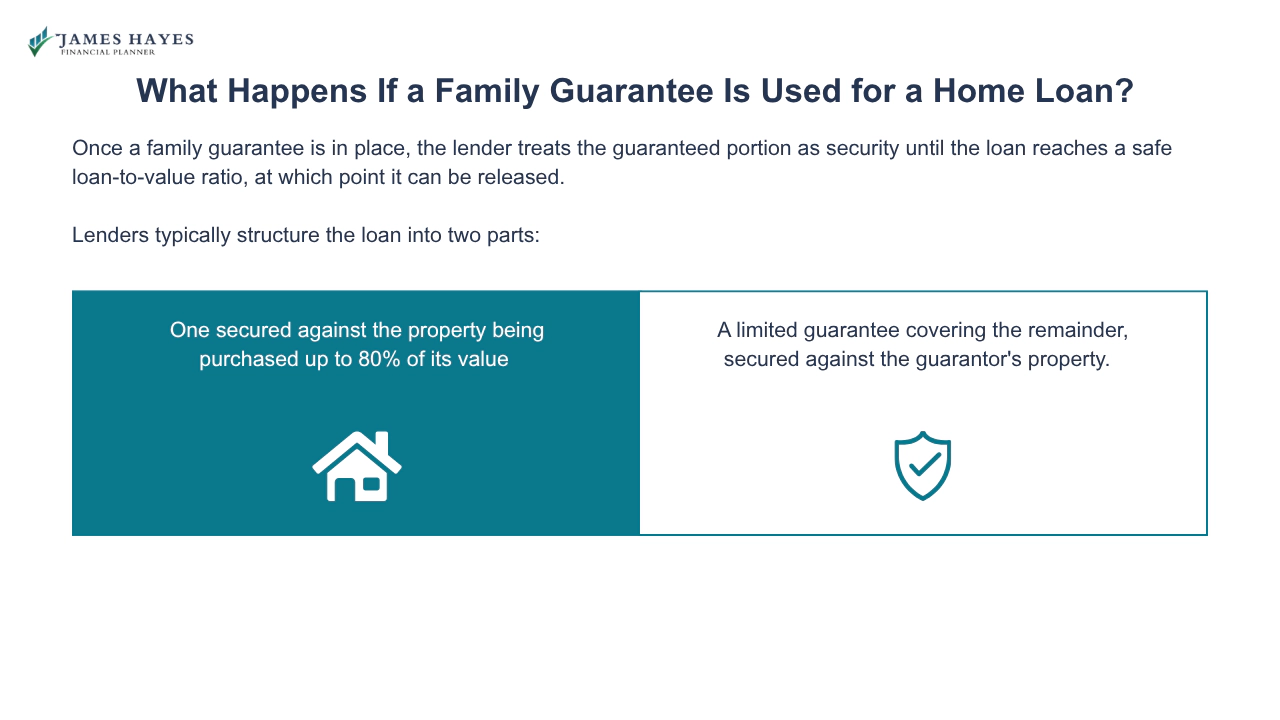
Once a family guarantee is in place, the lender treats the guaranteed portion as security until the loan reaches a safe loan-to-value ratio, at which point it can be released.
Lenders typically structure the loan into two parts:
- One secured against the property being purchased up to 80% of its value
- A limited guarantee covering the remainder, secured against the guarantor’s property.
As the buyer makes repayments and, in a rising market, as the property’s value grows, the loan balance falls as a percentage of the property’s value. Once it drops to around 80% or below, the buyer or guarantor can apply to the lender for a formal release, which requires a fresh valuation and lender approval rather than happening automatically. For most borrowers, this takes somewhere between three and seven years, and making extra repayments during that period can shorten the timeline.
Considerations for Parents Helping Their Children
For parents considering helping an adult child, the decision affects your own financial position for years, not just the day the money or guarantee is provided.
Before committing to a gift, loan, or guarantee, it’s worth reviewing your own retirement savings and cash flow needs, rather than treating the amount as separate from your broader financial plan. If you’re gifting cash and receiving or approaching the Age Pension, Centrelink allows gifts of up to $10,000 per financial year, or $30,000 over a rolling five-year period, before the excess is assessed as a deprived asset and counted against your pension for five years.
If you’re considering a guarantee instead of a gift, check how it might affect your own borrowing capacity if you plan to refinance, downsize, or purchase another property in the next few years, since lenders treat a guarantee as a contingent liability on your file.
If you have more than one child, it’s worth documenting the arrangement clearly and discussing it with your other children, since an undocumented gift to one child can create disputes over fairness later, particularly around inheritance.
How Parents Can Help Without Jeopardising Their Finances
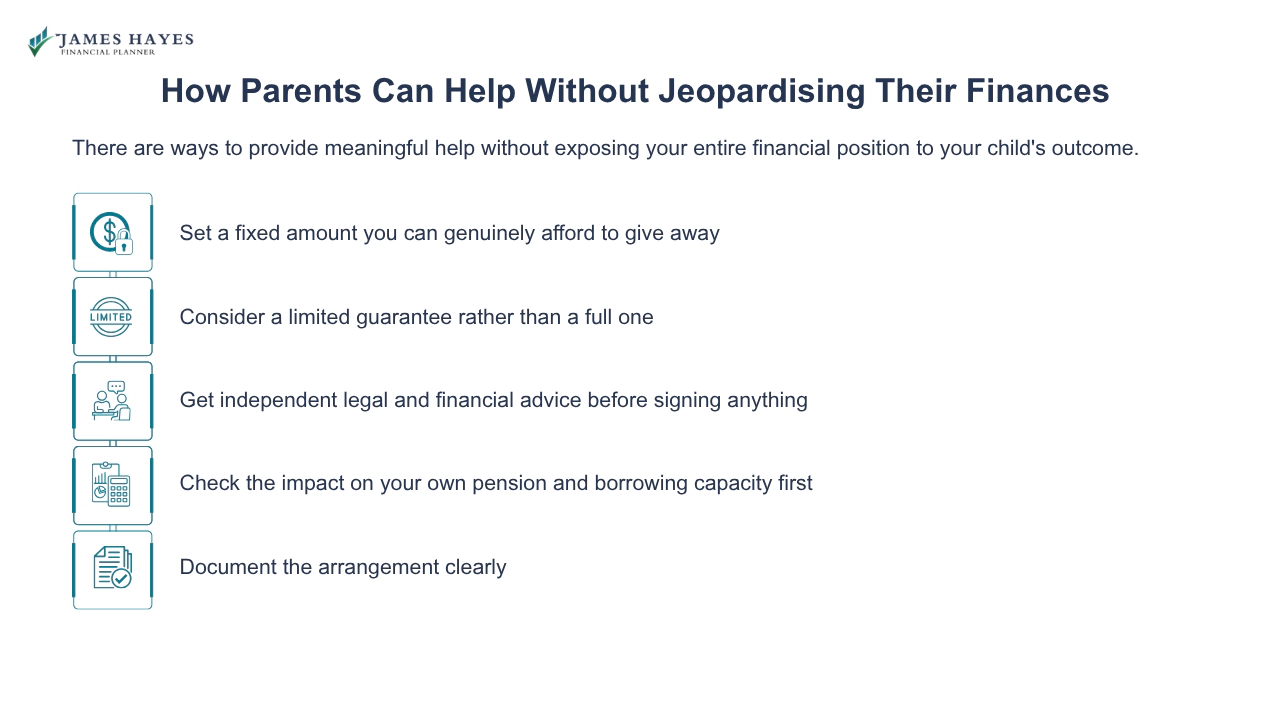
There are ways to provide meaningful help without exposing your entire financial position to your child’s outcome.
- Set a fixed amount you can genuinely afford to give away, treating it as gone rather than as savings you might need to draw on later.
- Consider a limited guarantee rather than a full one, which caps your exposure to a defined portion of the loan rather than the whole amount.
- Get independent legal and financial advice before signing anything, particularly for a guarantee, since the certificate of independent advice exists to confirm you genuinely understand the risk.
- Check the impact on your own pension and borrowing capacity first, rather than assuming a gift or guarantee has no bearing on your own finances.
- Document the arrangement clearly, whether it’s a gift, loan, or guarantee, so expectations are recorded rather than relying on memory if circumstances change.
If family assistance isn’t available, or doesn’t close the gap on its own, it’s worth weighing it against other paths into the market, including how long-term renting compares with buying and what other strategies exist for building a deposit without family support. We cover exactly that comparison in our next post on renting, buying, and alternative strategies.
Structure Family Assistance the Right Way
Whether you’re the buyer asking for help or the parent considering how to give it, getting the structure right protects everyone involved. James Hayes, an AFP®-accredited financial planner (opens in a new tab) based in Caringbah, works through gifts, loans and guarantees with first home buyers and their families across the Sutherland Shire and Greater Sydney. Book a free 15-minute call to make sure family help is structured to protect both generations.