
First Home Buying
Rent or Buy? Understand your options into Property Market
Written & Reviewed by James Hayes ·

Renting, buying now, rentvesting, and buying with a partner or a friend all get you into the property market differently, and each path forfeits or preserves different government schemes and tax positions. The right choice depends on where you want to live, how much flexibility you need, and whether the property might become an investment later.
Introduction
Buying your first home the traditional way, saving a deposit and purchasing where you want to live, is only one path into the property market. Rentvesting, buying a smaller property first, and buying with a partner or a friend are all legitimate alternatives, and the right one depends on your income, your target suburb, and how much flexibility you need over the next five to ten years.
If you’re weighing up which path fits your situation, James Hayes’s First Home Buyers Advice service can work through the numbers for each option with you.
Should You Keep Renting or Buy Your First Home?
The rent-versus-buy decision comes down to more than a monthly cost comparison, since buying commits you to a specific property and location in a way renting doesn’t.
Renting keeps you flexible if your job, relationship, or plans might change in the next few years, and it avoids the upfront costs of buying, stamp duty, conveyancing, and inspections, that don’t apply to a lease.
Buying builds equity in an asset you own and stops rent increases from affecting your own housing costs, but it exposes you to property price movements, ongoing maintenance, and the cost of selling if your circumstances change sooner than expected. There’s no fixed timeline that makes buying the right call for everyone: a buyer confident in their location and job for the next five years or more is in a stronger position than one who might relocate within two.
Rentvesting vs Buying Your First Home
Rentvesting means renting where you want to live while buying an investment property somewhere more affordable, and it’s grown rapidly as a first home buyer strategy.
The Australian Bureau of Statistics recorded 8,283 first home buyers taking out investment property loans in 2024 (opens in a new tab), a 12% increase on the previous year, and Westpac’s 2025 Home Ownership Report found 54% of first home buyers are now considering rentvesting, rising to 61% in NSW specifically (opens in a new tab). The appeal is straightforward: you can buy in a more affordable market while continuing to live in the suburb you want, rather than compromising on location to afford an owner-occupied purchase.
The trade-off is that rentvesting doesn’t qualify for the First Home Guarantee (opens in a new tab) or state grants designed for owner-occupiers, since these require you to live in the property, and because most first home buyer schemes are one-time entitlements, using them later on an owner-occupied purchase may no longer be available depending on your circumstances.
It’s also worth noting that changes announced in the 2026 Federal Budget mean established properties purchased after 12 May 2026 lose the ability to offset rental losses against your salary from 1 July 2027 (opens in a new tab), while new-build properties remain fully exempt from this change, which shifts the maths for anyone considering rentvesting into an established property from that date.
Should You Buy an Apartment or Keep Saving for a House?
The price gap between houses and units in Sydney is substantial, and it’s worth treating this as a genuine trade-off rather than defaulting to whichever type feels more familiar.
Sydney’s median house price is above $1.5 million (opens in a new tab), while units typically run $600,000 to $900,000 lower depending on the specific data provider and month, which means an apartment can bring a purchase within reach years sooner than saving for a house in the same suburb.
Apartments also carry ongoing strata fees that houses don’t and typically show slower capital growth over the long term than houses in the same area, since land value, rather than the building itself, tends to drive most price growth over time.
For a first home buyer prioritising getting into the market sooner, in a specific location, an apartment is often the more realistic entry point. For a buyer prepared to wait longer for land content and stronger long-term growth, continuing to save for a house may be worth the additional years.
Should You Buy a Smaller Home Now or Wait for Your Ideal Property?
Buying a smaller or less ideal property now, with a plan to upgrade later, is a common strategy for first home buyers priced out of their ideal property today.
The advantage is time in the market because you start building equity and benefiting from any capital growth years earlier than if you kept saving for a larger deposit on your ideal property. The cost is the expense of moving twice, including stamp duty, conveyancing, and selling costs on the first property, which reduces the net benefit compared with buying your ideal property outright.
This strategy generally suits buyers in a strong, established property market where prices are likely to keep rising while they save, since waiting in that scenario risks the target property moving further out of reach. It suits fewer buyers in a flat or falling market, where the cost of moving twice may outweigh any advantage from entering sooner.
Buy Your First Home Alone or with a Partner?
Buying with a partner roughly doubles your combined borrowing capacity, but it also means both of your financial futures are tied to the same asset and the same loan.
A joint application combines both incomes for serviceability, which increases the property price you can afford, and shares the deposit target between two people rather than one. It also means both parties are equally liable for the full loan under most ownership structures, regardless of who contributed more to the deposit or who earns more, unless a formal agreement specifies otherwise.
Buying alone gives you full control over the property and the decision to sell, but it means saving the entire deposit and covering the full loan on a single income, which can significantly limit your price range or timeline compared with a joint purchase.
Should You Buy with a Friend to Get into the Property Market?
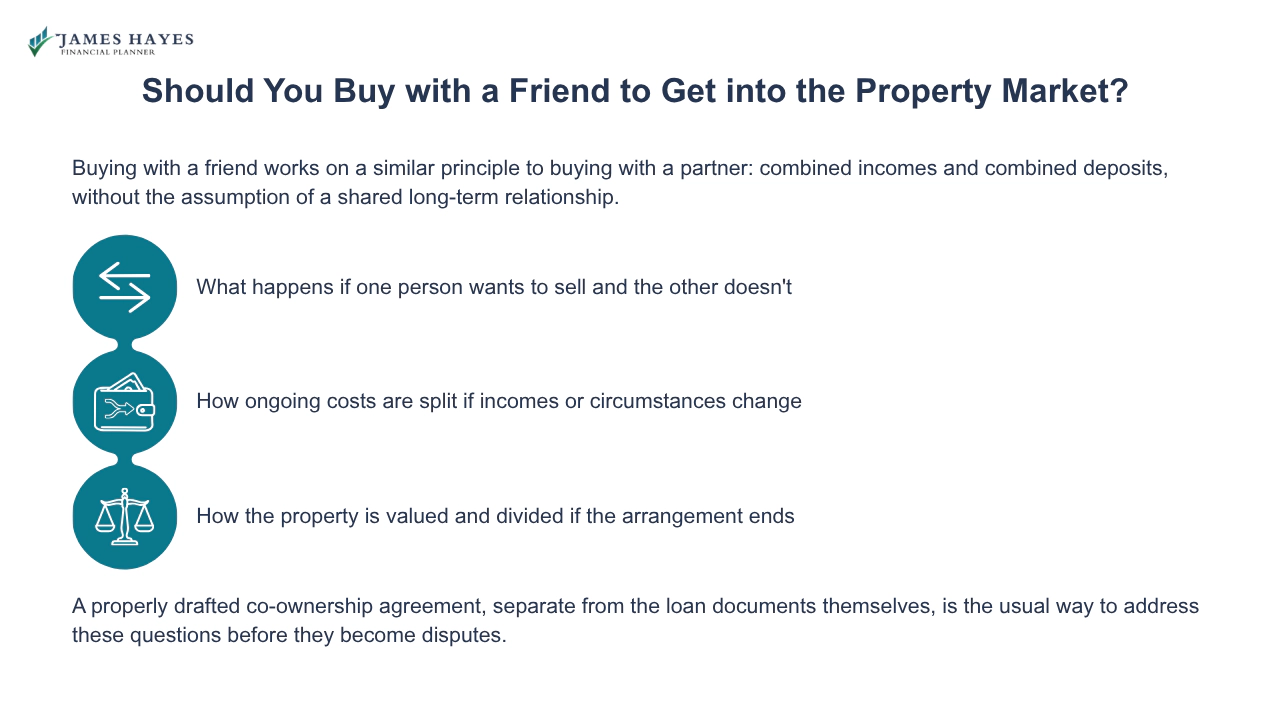
Buying with a friend works on a similar principle to buying with a partner: combined incomes and combined deposits, without the assumption of a shared long-term relationship.
This can bring forward your entry into the property market by years, particularly in an expensive city like Sydney, but it introduces a set of practical questions a partner purchase doesn’t:
- What happens if one person wants to sell and the other doesn’t
- How ongoing costs are split if incomes or circumstances change
- How the property is valued and divided if the arrangement ends
A properly drafted co-ownership agreement, separate from the loan documents themselves, is the usual way to address these questions before they become disputes.
We cover exactly how to structure a joint purchase with a partner or a friend, including ownership splits, exit clauses, and what a co-ownership agreement should include, in our next post in this series.
How Your First Home Purchase Could Affect Your Future Investment Plans
Your first purchase shapes your options later, particularly around tax, so it’s worth thinking a step ahead even if buying an investment property isn’t part of your immediate plan.
If you buy and live in a property as your main residence, then later move out and rent it out, the ATO’s six-year rule (opens in a new tab) generally lets you continue treating it as your main residence for capital gains tax purposes for up to six years while it’s tenanted, provided you don’t claim the exemption on another home during that period. This can preserve a full or partial CGT exemption on a property that’s become an investment, which is a meaningful advantage over a property that was purchased as an investment from day one and was never your main residence.
Using a scheme like the First Home Guarantee (opens in a new tab) also generally requires you to live in the property for a minimum period, so buying with a firm intention to convert to an investment property immediately after settlement can put your scheme eligibility at risk if you don’t meet that occupancy requirement first.
Planning to Buy a First Home and Investment Property Later?
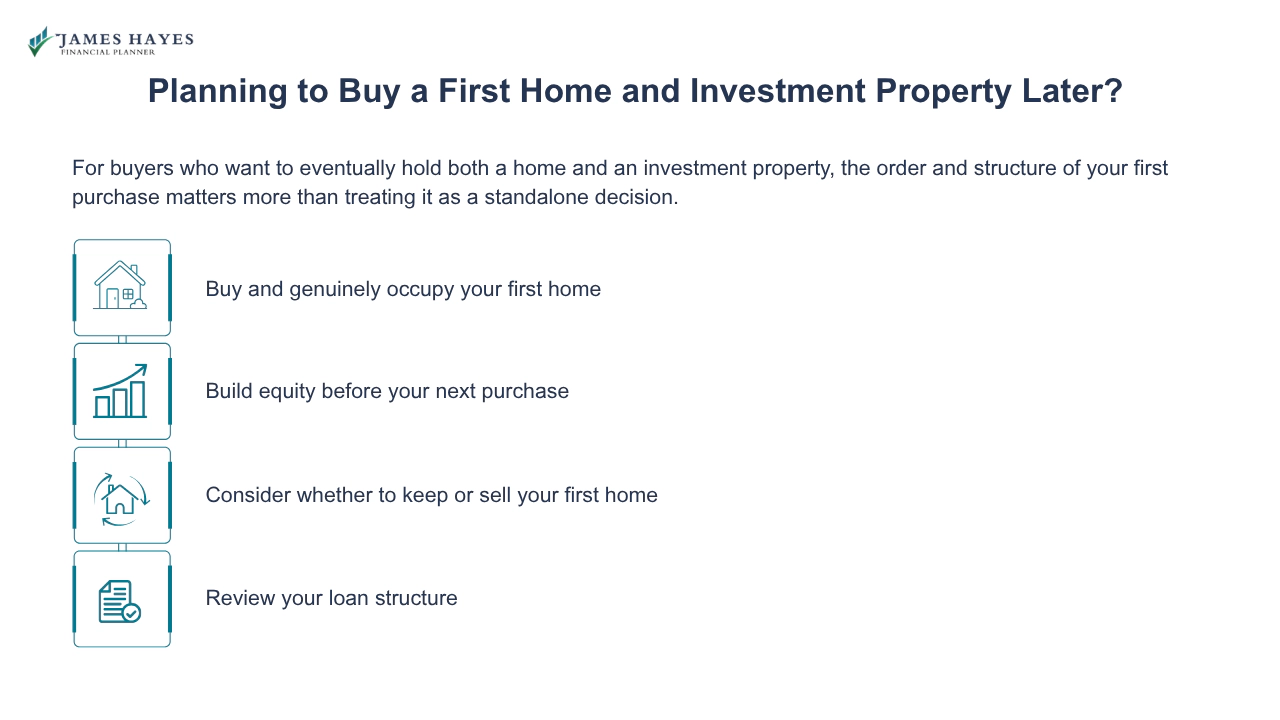
For buyers who want to eventually hold both a home and an investment property, the order and structure of your first purchase matters more than treating it as a standalone decision.
- Buy and genuinely occupy your first home for the period required under any government scheme you’ve used, since exiting early can trigger repayment obligations or disqualification.
- Build equity before your next purchase, either through repayments, an offset balance, or capital growth, since this equity often becomes the deposit or security for an investment property later.
- Consider whether to keep or sell your first home when you’re ready to upgrade, since keeping it as an investment and using the six-year CGT rule can be more tax-effective than selling and starting again, depending on your plans and the property’s growth.
- Review your loan structure before converting a home to an investment property, since an offset account preserves interest deductibility on that portion of the loan in a way a redraw facility may not, as covered in our earlier post on loan structure and mortgage strategy.
Plan Your Path into the Property Market
Whether renting a little longer, rentvesting, or buying with a partner or a friend fits your situation depends on your income, your goals, and how you want your finances to look in five years. James Hayes, an AFP®-accredited financial planner (opens in a new tab) based in Caringbah, works through these strategies with first home buyers across the Sutherland Shire and Greater Sydney. Book a free 15-minute call to find the path into the property market that suits your circumstances.