

Summary
Buying a first home costs more than the deposit and stamp duty: conveyancing, inspections, and loan fees add up before settlement, while council rates, water, insurance, and strata continue afterward. Keeping cash in reserve after settlement, rather than spending every dollar saved on the deposit, protects against the costs that start the moment you move in.
NSW first home buyer eligibility checklist. Download Free Checklist.
Introduction
Most first home buyers budget carefully for their deposit and stamp duty, then get caught out by everything else. Conveyancing fees, building and pest inspections, loan application costs, and moving expenses all fall due before you get the keys, and council rates, water, insurance, and strata fees start the day you move in.
If you’d like a full breakdown of what your specific purchase in the Sutherland Shire or Greater Sydney will actually cost, James Hayes’s First Home Buyers Advice service can map out every cost before you make an offer.

The Real Cost of Buying Your First Home in Australia
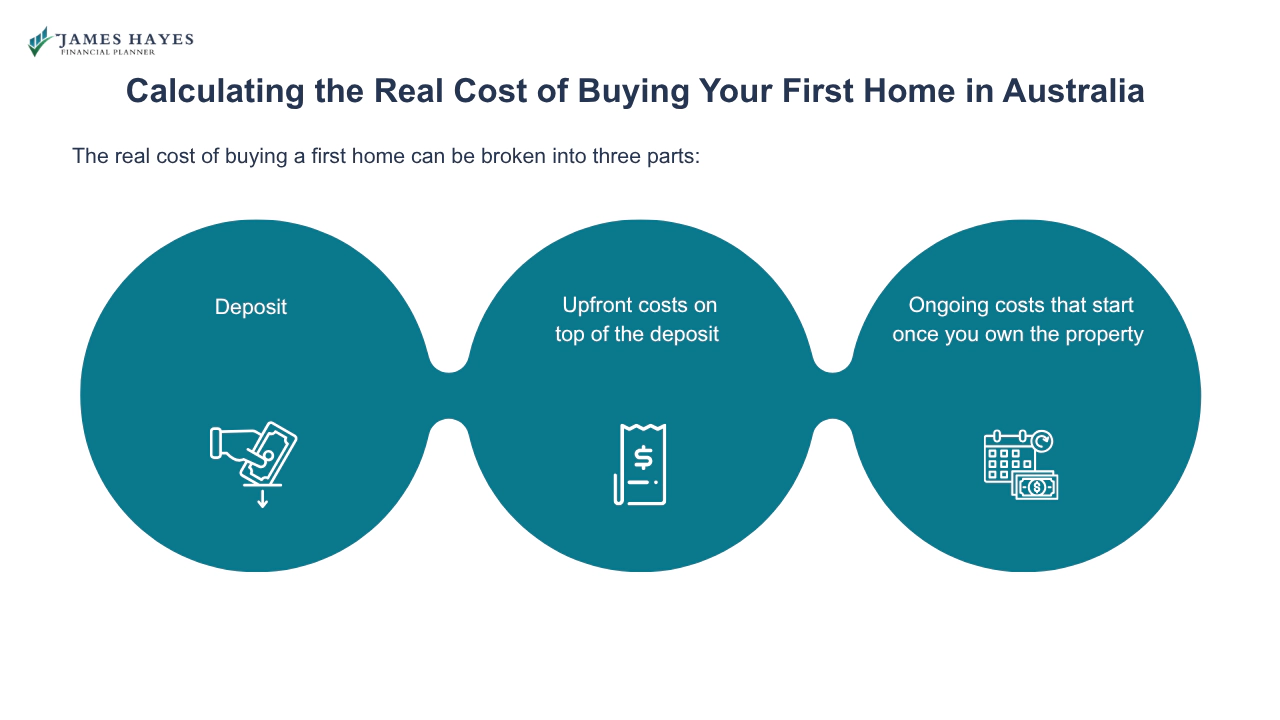
The real cost of buying a first home can be broken into three parts:
- Deposit
- Upfront costs on top of the deposit
- Ongoing costs that start once you own the property
For an established $750,000 home in the Sutherland Shire, a 5% deposit under the First Home Guarantee (opens in a new tab) comes to $37,500. On top of that, budget for conveyancing, inspections, and government fees, which typically add $2,500 to $4,000 for an established home under NSW’s stamp duty exemption threshold. Once you’ve settled, ongoing costs including council rates, water, insurance, and loan repayments continue every month.
Treating the deposit as the total cost of buying is the single most common budgeting mistake first home buyers make, and it’s the one that leaves people short of cash in the first few months of ownership.
Budgeting Beyond the Deposit?
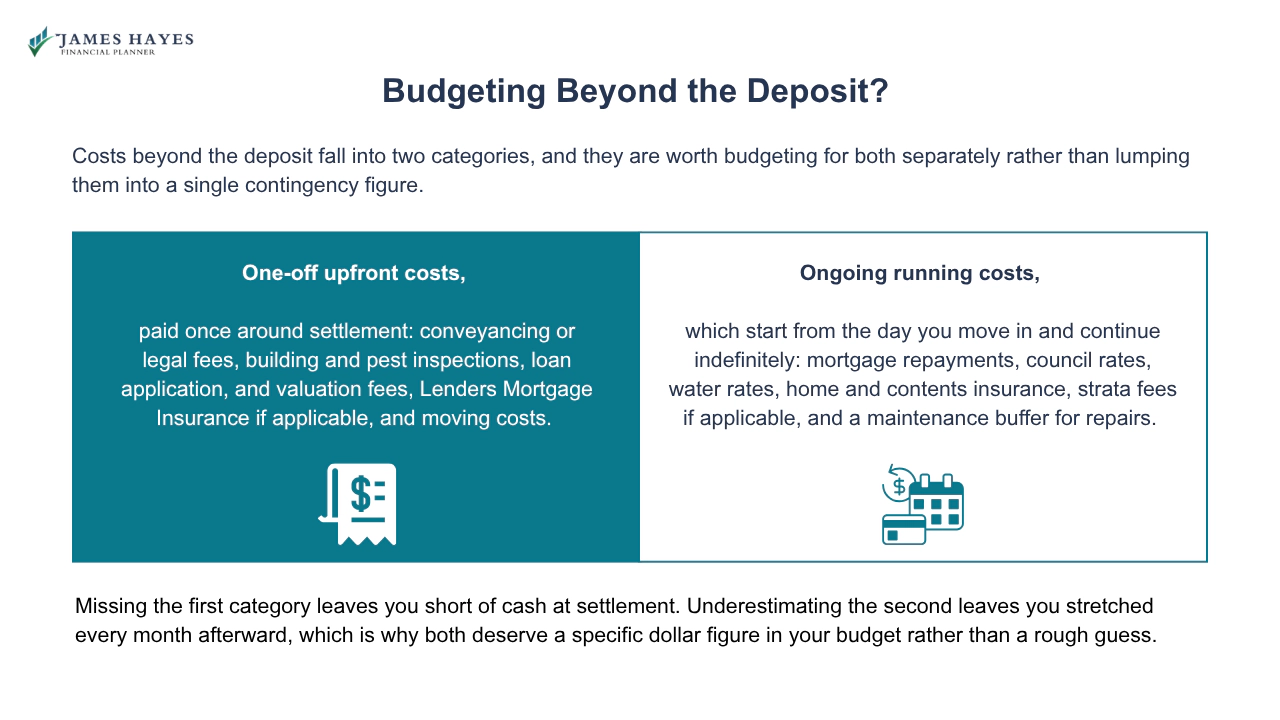
Costs beyond the deposit fall into two categories, and they are worth budgeting for both separately rather than lumping them into a single contingency figure.
- One-off upfront costs, paid once around settlement: conveyancing or legal fees, building and pest inspections, loan application, and valuation fees, Lenders Mortgage Insurance if applicable, and moving costs.
- Ongoing running costs, which start from the day you move in and continue indefinitely: mortgage repayments, council rates, water rates, home and contents insurance, strata fees if applicable, and a maintenance buffer for repairs.
Missing the first category leaves you short of cash at settlement. Underestimating the second leaves you stretched every month afterward, which is why both deserve a specific dollar figure in your budget rather than a rough guess.
Upfront Costs
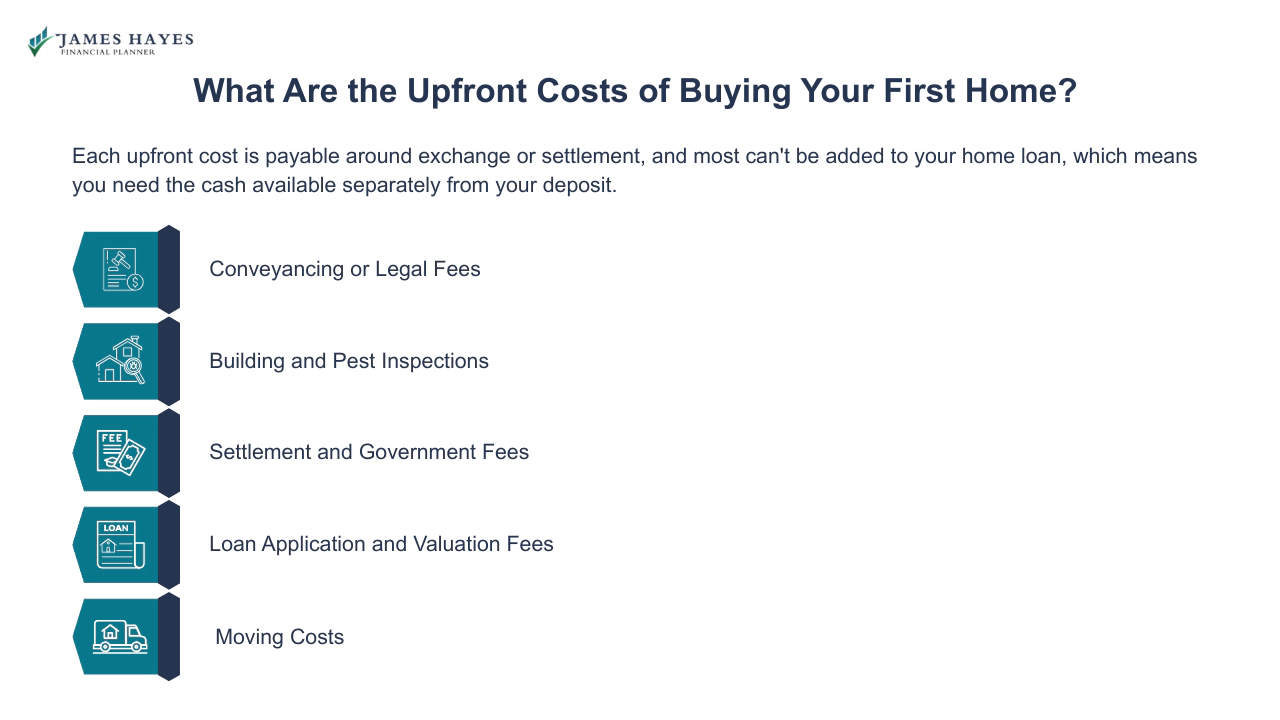
Each upfront cost is payable around exchange or settlement, and most can’t be added to your home loan, which means you need the cash available separately from your deposit.
- Conveyancing or legal fees in NSW typically run $1,000 to $3,000 for a metro purchase, depending on whether you use a licensed conveyancer or a solicitor.
- A combined building and pest inspection in Sydney generally costs $475 to $850 for a standard house, and is worth arranging before you exchange contracts rather than after.
- Settlement itself carries smaller government charges, such as a PEXA fee of roughly $146 for the electronic settlement platform, and a Land Registry Services lodgement fee of around $186.50.
- Loan application and valuation fees vary by lender, and some waive them for first home buyers, so it’s worth asking directly.
- Moving costs, whether a removalist or a van hire and a few days of your own labour, typically add a few hundred to a couple of thousand dollars depending on how far you’re moving and how much you own.
Lenders Mortgage Insurance (LMI)
LMI applies when you’re borrowing more than 80% of a property’s value (opens in a new tab) without a government guarantee, and it’s one of the largest single costs a first home buyer can face if it applies.
LMI protects the lender, not you, against the risk of a low-deposit loan, and the cost is typically added to your loan amount rather than paid upfront in cash. Depending on your deposit size and loan amount, LMI can run anywhere from roughly $15,000 to $35,000 on a loan the size of a typical first home purchase.
The First Home Guarantee removes this cost entirely for eligible buyers, since the government’s guarantee replaces the insurance the lender would otherwise require, which is why checking your eligibility for the scheme before applying for a loan can be worth tens of thousands of dollars.
If you don’t qualify for the guarantee and your deposit sits below 20%, it’s worth getting an LMI quote from your lender or broker early, since it changes your total loan amount and therefore your monthly repayment.
Ongoing Costs
Ongoing costs start the day you settle and continue for as long as you own the property, which makes them a permanent addition to your monthly budget rather than a one-off expense.
Beyond your mortgage repayment, expect council rates, water and wastewater charges, home and contents insurance, and, for an apartment or townhouse, strata fees.
It’s also worth budgeting a separate maintenance reserve, since a building and pest inspection identifies existing issues but can’t predict a hot water system failing in year three or a fence needing replacement after a storm.
A reasonable starting point is setting aside 1% of the property’s value each year for maintenance and unexpected repairs, adjusted up for an older property or down for a near-new one.
Council Rates, Insurance & Strata
These three costs vary the most by property type and location, so it’s worth checking the actual figures for your property rather than relying on a national average.
Sutherland Shire Council’s minimum general rate for 2026–27 is $1,147.87, though most established homes pay above the minimum, since rates are calculated against land value rather than a flat fee.
Sydney Water charges a household around $1,388 a year for combined water and wastewater services, or roughly $347 a quarter, based on standard usage.
Home and contents insurance in NSW has risen sharply in recent years, with the state’s average annual premium now well above $2,600 and closer to $3,900 to $4,000 in Sydney specifically, depending on the property’s rebuild value, location risk, and level of cover.
If you’re buying an apartment, townhouse, or villa, strata fees add another cost on top of council rates and insurance and can range from several hundred to well over a thousand dollars a quarter depending on the building’s age, amenities, and any planned capital works. Ask for the strata report and recent levy notices before you exchange, since a scheduled special levy for major building works can add an unbudgeted cost soon after you move in.
Why You Shouldn’t Spend Every Dollar of Your Savings on Your Home Deposit
Directing every dollar you’ve saved toward the largest possible deposit feels like the responsible choice, but it can leave you exposed the moment something goes wrong after settlement.
A larger deposit reduces your loan size and monthly repayment, which is a genuine benefit, but it only helps if you can still cover the upfront costs, the first few months of ongoing expenses, and an unexpected repair without borrowing again at a worse rate or falling behind on the mortgage itself.
First home buyers who empty their savings account to maximise their deposit are the ones most likely to face financial stress in the first year of ownership, precisely because there’s no buffer left once council rates, insurance, and a hot water system replacement all land in the same few months.
How Much Cash Should You Have Left After Settlement?
As a general guide, aim to have at least one to two months of ongoing costs, mortgage repayment, rates, insurance, and living expenses, available in cash immediately after settlement, on top of whatever you’re holding as an emergency fund.
This isn’t the same as your emergency fund; it’s a working buffer for the costs that tend to cluster in the first few months of ownership: connecting utilities, buying furniture or appliances you didn’t need in a rental, and covering the first insurance premium and rates notice before your budget settles into a routine. Buyers who arrive at settlement with exactly enough for the deposit and upfront costs, and nothing else, often find themselves relying on credit cards for these early expenses, which adds interest cost on top of an already large financial commitment.
How Much Should You Keep in an Emergency Fund After Buying Your First Home?
Separate from your settlement buffer, a genuine emergency fund of three to six months of essential expenses, including your mortgage repayment, protects you against a job loss, illness, or major unexpected repair.
For most first home buyers, this means calculating your mortgage repayment plus council rates, insurance, utilities, and essential living costs on a monthly basis, then multiplying by three to six depending on how stable your income is.
A single income household, or one with less job security, is better at the higher end of that range, while a dual-income household with stable employment can reasonably sit at the lower end.
It’s worth rebuilding this fund gradually after settlement if you’ve drawn it down for upfront costs, rather than treating the property purchase as the end of your savings goals.
Get a Full Cost Breakdown Before You Make an Offer
Knowing your deposit figure is only part of the picture. James Hayes, an AFP®-accredited financial planner (opens in a new tab) based in Caringbah, works through the full cost of buying, upfront and ongoing, with first home buyers across the Sutherland Shire and Greater Sydney, so there are no surprises after settlement. Book a free 15-minute call to get a complete picture of what your purchase will cost.