
First Home Buying
Managing Your Finances After Buying Your First Home
Written & Reviewed by James Hayes ·

Summary
The months after settlement call for a different financial plan than the years spent saving a deposit: rebuilding your emergency fund, reviewing insurance, and deciding how to split surplus income between extra mortgage repayments, superannuation, and other investments. Getting this sequence right early sets the pace for building wealth over the following decade.
Financial health and savings checklist. Download Free Checklist.
Introduction
Settlement day ends one financial plan and starts another. The habits that got you to a deposit, aggressive saving, tight budgeting, and a single-minded focus on one goal, need to shift once you own the property, since your priorities now include rebuilding your buffer, protecting your income, and deciding how surplus money should work for you over the next decade.
If you’d like a plan for your first 12 months of homeownership, James Hayes’s First Home Buyers Advice service can help set the right order of priorities for your situation.

Finances After Buying Your First Home
The first task after settlement is understanding what your budget looks like now that a mortgage repayment, council rates, and insurance are ongoing costs rather than projected ones.
Track your spending for the first two or three months of ownership before making any new financial commitments, since your real running costs, especially utilities, maintenance, and the small purchases that come with settling into a new home, often differ from what you budgeted before buying.
Once you have a clear picture of your monthly surplus or shortfall, you’re in a position to prioritise rebuilding savings, reviewing insurance, and deciding how much to direct toward extra repayments or investing, rather than guessing at these figures based on your pre-purchase budget.
First 12 Months of Homeownership
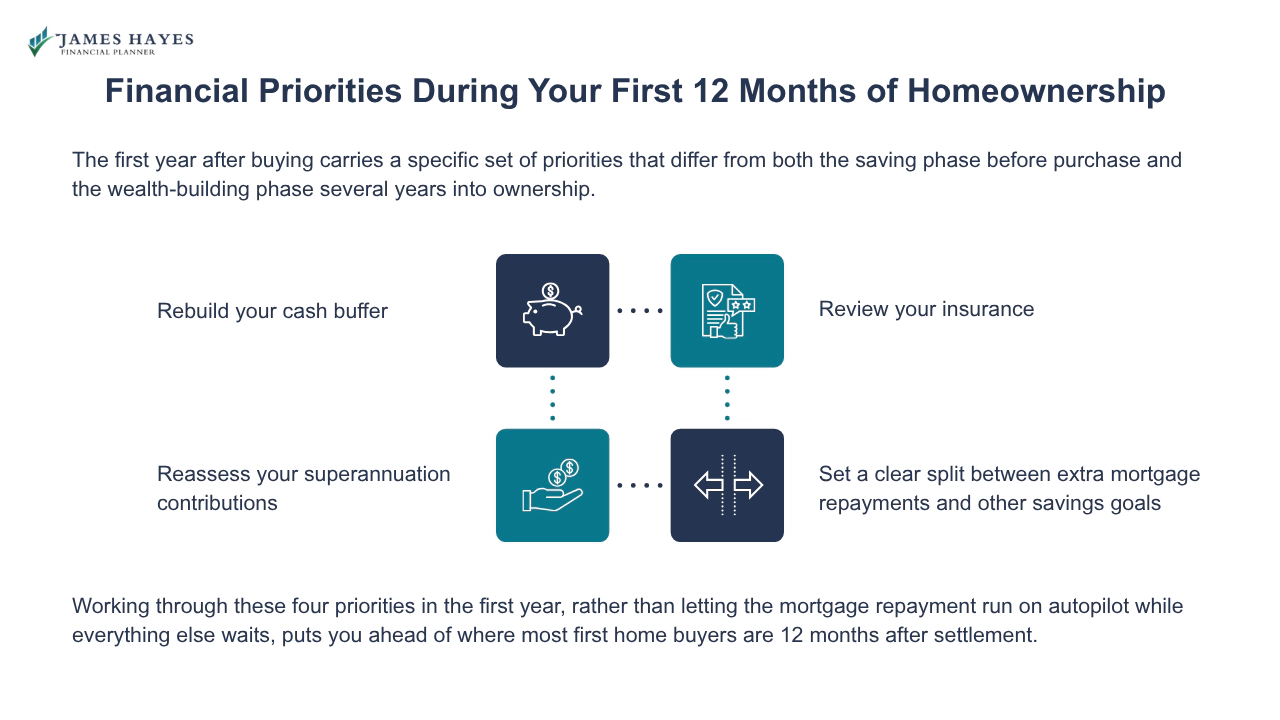
The first year after buying carries a specific set of priorities that differ from both the saving phase before purchase and the wealth-building phase several years into ownership.
- Rebuild your cash buffer to at least one to two months of expenses within the first few months, since most first home buyers draw this down to some degree for settlement and moving costs.
- Review your insurance, including home and contents cover at the correct rebuild value, and life and income protection insurance now that a mortgage sits against your name.
- Reassess your superannuation contributions, particularly if you paused or reduced them while saving your deposit, since compulsory employer contributions alone may not be enough to catch up on a gap.
- Set a clear split between extra mortgage repayments and other savings goals, based on your buffer size and comfort with debt, rather than defaulting to whichever option feels most familiar.
Working through these four priorities in the first year, rather than letting the mortgage repayment run on autopilot while everything else waits, puts you ahead of where most first home buyers are 12 months after settlement.
Rebuilding Savings
Most first home buyers draw their savings down close to the minimum needed for settlement, which leaves little room for the first unexpected cost that arrives after moving in.
Rebuilding a genuine emergency fund, generally three to six months of essential expenses including your mortgage repayment, should take priority over extra repayments or new investments in the months immediately after settlement, since this buffer is what prevents a temporary income drop or a large repair bill from turning into missed mortgage repayments.
An offset account is a sensible place to rebuild this buffer, since the balance reduces the interest charged on your loan while remaining fully accessible if you need it, unlike money paid directly onto the loan through a redraw facility with processing delays. Automating a fixed transfer into this buffer each payday, the same discipline that built your deposit, tends to rebuild savings faster than treating it as whatever’s left over at the end of the month.
Financial Goals After Buying Your First Home
Once your buffer is rebuilding, it’s worth setting specific new goals rather than assuming the mortgage itself is now your only financial focus.
Reviewing and, if needed, increasing your superannuation contributions is worth prioritising early, particularly if you reduced or paused them while saving your deposit or used the First Home Super Saver Scheme (opens in a new tab), since a gap in your early-career contributions compounds over the following decades.
For the 2026–27 financial year, the concessional contributions cap is $32,500 (opens in a new tab), and if your total super balance was under $500,000 on 30 June of the previous financial year, you can carry forward unused cap amounts from up to five previous years, which can be a useful way to catch up if your contributions dropped during your deposit-saving years.
Beyond super, it’s worth setting a specific goal for extra mortgage repayments, a separate investment portfolio, or a combination of both, rather than leaving surplus income undirected in a transaction account where it’s easy to spend without noticing.
Investing After Buying Your First Home
Starting to invest before your buffer and insurance are in order can leave you needing to sell investments at a bad time if an unexpected cost arrives.
A reasonable starting point is once you’ve rebuilt an emergency buffer of at least three months of expenses and reviewed your insurance cover, since investing surplus income before this stage means your first line of defence against a job loss or major repair is an investment portfolio that might be down in value exactly when you need to access it.
There’s no fixed dollar figure or exact month that applies to everyone, since it depends on how far your buffer was drawn down at settlement and how quickly your income allows you to rebuild it. For most first home buyers, this milestone falls somewhere between six months and two years after settlement, depending on their surplus income and how large a buffer they’re comfortable holding.
Should You Keep Investing?
If you were already investing before buying, whether through super, shares, or an investment property, it’s worth deciding deliberately whether to pause, reduce, or continue rather than letting the mortgage crowd out every other financial goal by default.
Continuing to invest, even at a reduced rate, keeps compound growth working over the full period you hold those investments, rather than restarting from zero once the mortgage feels more comfortable.
Pausing investment contributions temporarily to direct more toward your buffer or extra mortgage repayments is a reasonable short-term decision in the first year, provided it’s a deliberate choice rather than an indefinite default.
The right balance depends on your mortgage rate, your investment time horizon, and how much certainty you want from guaranteed mortgage interest savings versus the higher but less certain long-term returns typically associated with growth assets like shares.
Balancing Mortgage Repayments, Investing & Other Financial Goals
Splitting surplus income between extra mortgage repayments, investing, and other goals comes down to comparing a guaranteed return against an uncertain one.
Extra mortgage repayments deliver a guaranteed return equal to your loan’s interest rate, since every dollar reduces interest you’d otherwise pay, with no market risk attached.
Growth investments, such as shares or superannuation, have historically outperformed mortgage rates over long periods, but with genuine year-to-year volatility, which means the higher expected return comes with the risk of a loss in any given year, including the year you might need to draw on it.
A common approach is splitting surplus income across both by directing a portion to superannuation for its tax-effective long-term growth, a portion to extra mortgage repayments or an offset balance for guaranteed savings and flexibility, and holding the rest in accessible savings for shorter-term goals. Reviewing this split annually, rather than setting it once and forgetting it, lets you adjust as your income, mortgage rate, and other goals change over time.
Building Wealth While Paying Off Your Home
Building wealth alongside a mortgage is a matter of consistent decisions over years rather than a single strategy applied once.
It’s worth reviewing your loan structure periodically, since an offset account preserves flexibility and future tax-deductibility if the property ever becomes an investment, a point we covered in detail in our earlier post on loan structure and mortgage strategy.
Keeping superannuation contributions running throughout the life of the loan, rather than only after the mortgage is paid off, takes advantage of decades of compound growth that can’t be recovered later.
If you’re considering shares, an investment property, or other growth assets alongside your mortgage, it’s worth weighing the guaranteed return from extra mortgage repayments against the higher, less certain returns available elsewhere, and structuring your approach around your own risk tolerance and timeline rather than a one-size-fits-all rule.
Working through these decisions on your own is possible, but a lot of first home buyers find that a second opinion from a professional, someone who can see your full financial picture rather than just the mortgage, changes how they approach the years after settlement. Our next post looks at what financial advice involves for a first home buyer, and how to get the most out of working with an adviser.
Plan for Your Life After Settlement
The financial habits that got you to your deposit aren’t necessarily the ones that build wealth over the following decade. James Hayes, an AFP®-accredited financial planner (opens in a new tab) based in Caringbah, helps first home buyers plan their first 12 months of homeownership and beyond. Book a free 15-minute call (opens in a new tab) to set your financial priorities now that you own your first home.