
First Home Buying
Loan Structure & Mortgage Strategy for First Home Buyers
Written & Reviewed by James Hayes ·

Summary
Loan structure decisions, fixed versus variable, offset versus redraw, and whether to split the loan, affect both your monthly cash flow and your flexibility years down the track. The right structure depends on how stable your income is, whether the property might ever become an investment, and how much you value certainty over savings.
The first home buyer loan requirement. Download Free Checklist.
Introduction
Getting approved for a home loan is one thing. Structuring it is another, and it’s the one most first home buyers spend the least time on. The rate type you choose, whether you use an offset account or a redraw facility, and whether you split the loan between fixed and variable all affect how much flexibility you have if your income changes, or if the property you’re buying now ever becomes a rental later.
If you’d like your loan structure checked against your income pattern and longer-term plans, James Hayes’s offers First Home Buying Advice can work through the options with you.

Considerations When Choosing Your First Home Loan
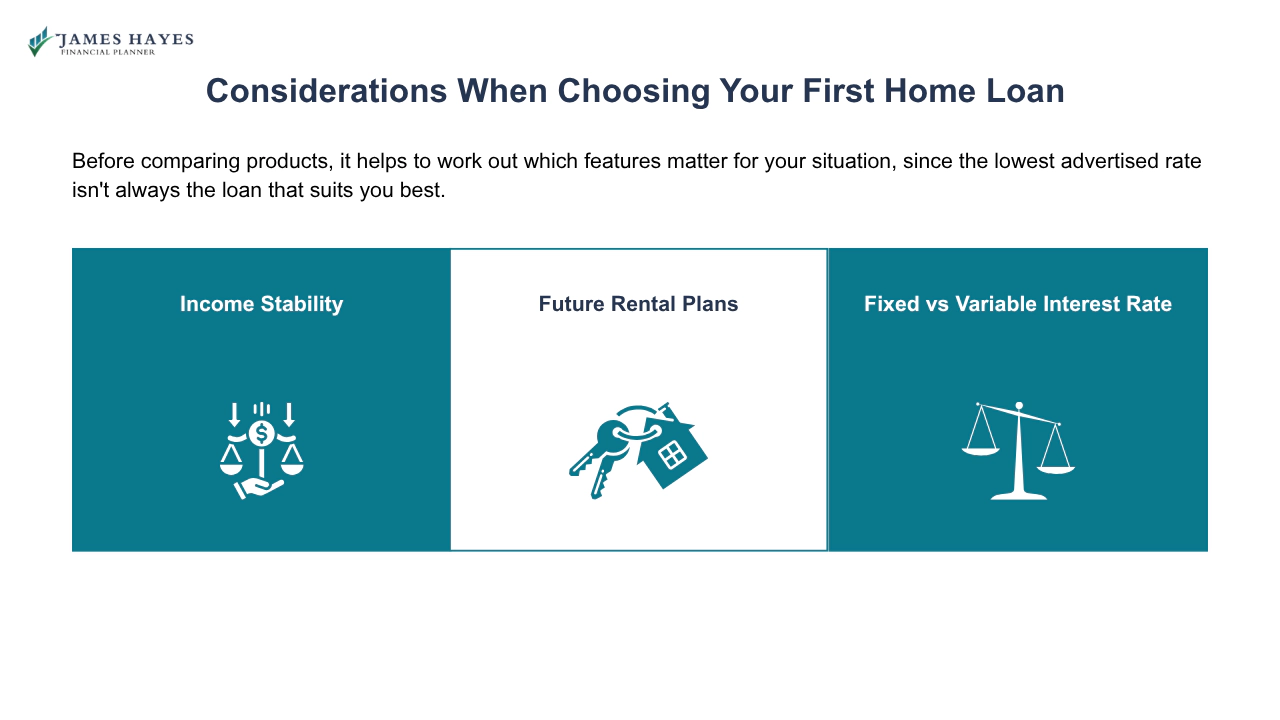
Before comparing products, it helps to work out which features matter for your situation, since the lowest advertised rate isn’t always the loan that suits you best.
- Start with how stable your income is. A salaried employee with predictable pay might prioritise a low rate over flexible features, while a contractor or commission-based earner might value an offset account and the ability to make extra repayments more than shaving a few basis points off the rate.
- Next, consider whether you might ever rent this property out, since that changes which features matter for tax purposes later.
- Finally, weigh up your appetite for repayment certainty against savings. A fixed rate locks in your repayment amount but limits flexibility, while a variable rate can move with the market in either direction.
Fixed vs Variable Home Loans
The vast majority of Australian first home buyers choose variable, but fixed rates suit specific circumstances well.
Variable Rate Loans
According to the Reserve Bank of Australia, roughly 98% of new owner-occupier loans in Australia are variable rate (opens in a new tab). A variable rate moves with the lender’s rate card, generally tracking the Reserve Bank’s cash rate decisions, which means your repayment can rise or fall over the life of the loan. Most variable loans also come with the flexibility of unlimited extra repayments, an offset account, and a redraw facility.
Fixed Rate Loans
A fixed rate locks in your repayment for a set term, usually one to five years, which gives you certainty for budgeting but usually limits extra repayments to a capped amount each year and doesn’t include an offset account. Break costs can also apply if you sell, refinance, or pay off a fixed loan early, which is worth checking before you fix, particularly if there’s a chance you’ll need to sell within the fixed term.
Split Loans
A split loan divides your borrowing between a fixed portion and a variable portion, which lets you combine the certainty of one with the flexibility of the other.
For example, you might fix 60% of your loan for three years to lock in a known repayment on the bulk of your debt, while keeping 40% variable so you retain an offset account and the ability to make unlimited extra repayments on that portion. This suits first home buyers who want partial protection against rate rises without giving up all flexibility, particularly if you expect a bonus, tax refund, or inheritance you’d want to direct straight into an offset account.
The trade-off is complexity. You’re managing two portions of the same loan, potentially with two different review dates, and comparing the true cost against a single fixed or variable loan takes more than comparing headline rates.
Offset Account vs Redraw
Both features reduce the interest you pay by the same mechanism in dollar terms, but they work differently, and the difference matters most if your circumstances change later.
Offset Account
An offset account is a separate transaction account linked to your loan. The balance in it is subtracted from your loan principal before interest is calculated each day, so $20,000 sitting in an offset against a $600,000 loan means you only pay interest on $580,000.
Redraw Account
A redraw facility works through extra repayments made directly onto the loan itself. Those extra repayments reduce your outstanding balance in the same way, and you can withdraw them later if you need the cash. For this loan, the interest savings are mathematically identical between the two.
Difference
The difference shows up if you ever convert the property to an investment. Money withdrawn from an offset account doesn’t affect the loan’s tax-deductible purpose, but redrawing funds for a private expense, such as a car or holiday, can permanently taint part of the loan for tax purposes, since the ATO looks at what the redrawn money was used for rather than which account it sat in.
How an Offset Account Helps Manage Cash Flow
Beyond the interest savings, an offset account functions as an everyday transaction account, which makes it a practical tool for first home buyers with variable income or an emerging emergency fund.
Because it’s a standard transaction account, you can have your salary paid into it, pay bills from it, and keep an emergency buffer in it, all while that balance continues reducing the interest charged on your loan. This is useful if your income varies month to month, since you’re not locking money into the loan itself through extra repayments, which some lenders make harder or slower to access than an offset balance.
Interest saved through an offset account also isn’t taxable income, unlike interest earned in a standard savings account, which means a dollar sitting in offset is worth more after tax than the same dollar earning interest elsewhere, for a borrower on a marginal tax rate above the lowest bracket.
Pay Off Your Mortgage Faster or Keep Money in Savings?
This trade-off comes down to the gap between your loan’s interest rate and what you could otherwise earn on that money, after tax.
Paying down your mortgage faster, whether through extra repayments or a growing offset balance, delivers a guaranteed return equal to your loan’s interest rate, since every dollar reduces interest you’d otherwise pay.
Keeping money in a separate high-interest savings account only comes out ahead if that account’s after-tax return exceeds your mortgage rate, which is uncommon for most owner-occupier borrowers once tax on savings interest is factored in.
The stronger argument for keeping some money outside the mortgage is liquidity. An offset account gives you the same interest-reduction benefit as extra repayments while keeping the funds fully accessible, which matters if you might need cash for an emergency, a car repair, or a change in income.
Extra Mortgage Payments
Extra repayments reduce both your interest cost and your loan term, but the right pace depends on what else your money needs to do.
Making extra repayments on a variable loan is usually unrestricted, and even a modest additional amount each month compounds meaningfully over a 25- or 30-year term, since it reduces the principal that interest is calculated on.
It’s worth building an emergency buffer of three to six months of expenses before directing surplus cash to extra repayments, since money paid into a redraw facility isn’t always instantly accessible, and some lenders apply minimum redraw amounts or short processing delays.
If you’re on a fixed rate, check your lender’s annual cap on additional repayments before committing to a regular extra payment, since exceeding the cap can trigger a break fee even on a partial repayment.
Choosing a Mortgage That Fits Your Longer-Term Financial Plan
Your loan structure should account for where your finances are headed over the next five to ten years, not just your position on settlement day.
If you’re planning to have children, take unpaid leave, or reduce your working hours in the next few years, a variable loan with a healthy offset balance gives you more room to adjust than a fixed loan with capped extra repayments.
If you think there’s a reasonable chance you’ll keep this property as an investment when you eventually upgrade, building your buffer in an offset account rather than through extra repayments protects your future ability to claim interest as a tax deduction on that property.
If you’re also directing money toward superannuation, other savings goals, or a First Home Super Saver Scheme (opens in a new tab) contribution, your loan structure should work alongside those goals rather than compete with them for the same surplus income.
Structuring Your Loan for Greater Financial Flexibility
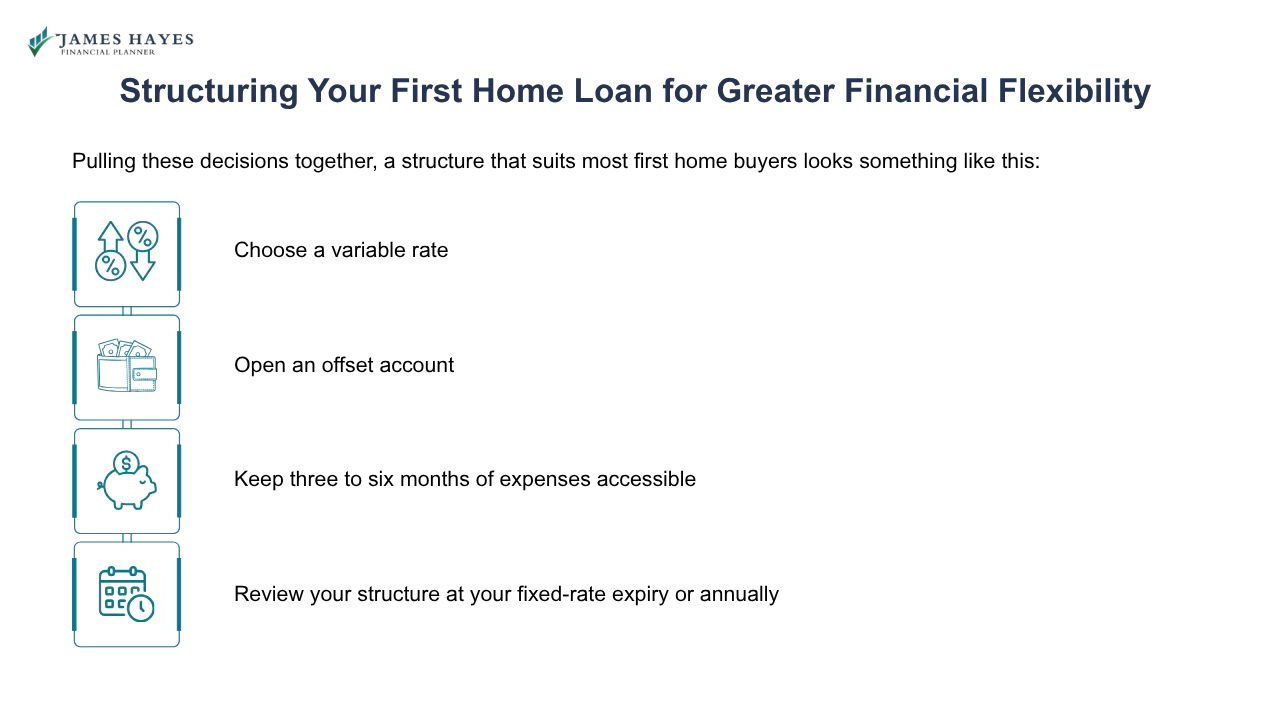
Pulling these decisions together, a structure that suits most first home buyers looks something like this:
- Choose a variable rate as your base, or a split with a majority variable portion, to retain access to an offset account and unrestricted extra repayments.
- Open an offset account from day one and direct your salary and savings into it, rather than making extra repayments directly onto the loan, to preserve flexibility and protect future tax deductibility if your plans change.
- Keep three to six months of expenses accessible in that offset balance before treating any surplus as available for other goals.
- Review your structure at your fixed-rate expiry or annually, since your income, family situation, and property plans can shift enough within a few years to change which structure suits you best.
Once your loan is structured, the next step is understanding the full cost of owning the property beyond the mortgage itself, including rates, insurance, and maintenance, which we cover in our next post on the real cost of buying a first home.
Get Your Loan Structure Checked Before You Commit
The right mix of fixed, variable, offset and redraw depends on your income pattern, your plans for the property, and your appetite for risk. James Hayes, an AFP®-accredited financial planner (opens in a new tab) based in Caringbah, works through loan structure with first home buyers across the Sutherland Shire and Greater Sydney, alongside your broader financial plan. Book a free 15-minute call to check your loan structure suits where your finances are headed.