
First Home Buying
Do You Need a Financial Adviser to Buy Your First Home?
Written & Reviewed by James Hayes ·

Summary
A financial adviser and a mortgage broker serve different purposes for a first home buyer: a broker compares and arranges loan products, while an adviser plans your deposit strategy, scheme eligibility, insurance, and superannuation around the purchase. Comprehensive advice costs $2,500 to $7,000, with scoped advice on a single issue available for less.
The first home buyer hidden costs checklist. Download Free Checklist.
Introduction
Most first home buyers work with a mortgage broker to compare loans, but far fewer consider a financial adviser, even though the two roles cover different ground. A broker’s job ends once your loan settles. A financial adviser’s role can start well before you’ve saved a deposit and continue long after you’ve moved in, covering your savings strategy, scheme eligibility, insurance, and superannuation as one connected plan.
If you’d like to see what this kind of planning looks like in practice, James Hayes’s First Home Buyers Advice service is built specifically around first home buyers.

What Does a First Home Buyer Financial Adviser Do?
A financial adviser working with first home buyers looks at your full financial position, not just the property purchase in isolation.
This covers working out how much you can realistically save each month, checking your eligibility for the First Home Guarantee (opens in a new tab), the First Home Super Saver Scheme (opens in a new tab), and any state grants or stamp duty concessions (opens in a new tab), and structuring your savings and super contributions to take advantage of the ones that apply to you.
It also covers reviewing your insurance needs once you’re carrying a mortgage and setting a longer-term plan for superannuation and other investments alongside the loan.
Unlike a mortgage broker, whose engagement is tied to the loan itself, a financial adviser’s role can continue well beyond settlement, since your finances keep evolving after you’ve bought.
Do You Need Financial Advice Before Buying Your First Home?
Financial advice isn’t a requirement for buying a first home, but it becomes more valuable the more moving parts your situation has.
A buyer with a straightforward income, no existing debt, and a single, clear savings goal may manage the process without formal advice, particularly with the information available through government resources and a good mortgage broker.
A buyer juggling multiple government schemes, family assistance, a joint purchase with a partner or a friend, or an existing investment or super strategy is more likely to benefit from advice that connects these pieces, since a mistake in how they interact, such as an FHSS release timed incorrectly or a scheme eligibility condition missed, can be costly to unwind after the fact.
It’s worth treating the decision as a cost-benefit question specific to your situation, rather than assuming advice is either essential for everyone or unnecessary for everyone.
How Can a Financial Planner Help with Your Purchase?
Beyond the specific schemes and structures covered throughout this series, a financial planner adds value in a few consistent ways.
They can model your savings timeline against realistic numbers, rather than a rough mental estimate, and identify where the First Home Super Saver Scheme, extra super contributions, or a different savings account structure would speed up your deposit.
They can check scheme eligibility against your specific circumstances before you commit to a property, since price caps, income tests, and occupancy requirements vary and are easy to misjudge from a quick read of a government website. They can also look at your situation as a whole, including how a family guarantee, joint ownership structure, or planned future investment property affects both this purchase and your broader financial position, rather than treating the home loan as a standalone decision.
Financial Adviser vs Mortgage Brokers for First Home Buyers
These two roles are often confused, but they cover different parts of the process and are paid in different ways.
Mortgage Broker
A mortgage broker compares loan products across multiple lenders, arranges your application, and is generally paid by the lender through an upfront commission, typically 0.55% to 0.70% of the loan amount at settlement, and an ongoing trail commission of around 0.15% to 0.25% a year on the remaining balance. This means most first home buyers pay nothing directly for broker services, and brokers are legally required under the Best Interests Duty (opens in a new tab) to recommend the loan that suits your circumstances rather than the one paying the highest commission.
Financial Adviser
A financial adviser charges a fee for service, either a one-off fee for a Statement of Advice or an ongoing annual fee, and covers a broader scope than loan selection: savings strategy, scheme eligibility, insurance, and how the purchase fits your wider financial position. Many first home buyers use both: a broker to secure the loan itself, and an adviser to plan the deposit, scheme eligibility, and everything around the purchase.
When Should You See a Financial Adviser?
The earlier you see an adviser relative to your target purchase date, the more of your savings and scheme strategy they can influence.
Seeing an adviser before you’ve set a firm savings target lets them help shape that target from the start, including whether the First Home Super Saver Scheme or a particular deposit size makes sense for your income and timeline. Seeing one only once you’re ready to apply for pre-approval limits their input mostly to reviewing decisions you’ve already made, rather than helping you make them.
If you’re more than a year from buying, there’s meaningful benefit in starting the conversation early, since strategies like FHSS contributions and structured saving compound in value the longer they’re in place before you need the money.
How Much Does Financial Advice Cost?
Advice costs vary depending on the scope of what you need, and reputable advisers are required to disclose their fees clearly before any work begins.
- A comprehensive Statement of Advice (opens in a new tab), covering savings strategy, scheme eligibility, insurance, and superannuation together, typically costs $2,500 to $7,000 depending on the complexity of your situation.
- Scoped or single-issue advice, focused on one specific question such as FHSS eligibility or a savings strategy alone, is generally cheaper, often in the range of $1,200 to $3,300.
- Ongoing advice, if you continue working with an adviser after your purchase, is typically quoted as an annual fee, with the median cost of ongoing advice in Australia being around $4,700 a year, though this varies based on the complexity of your ongoing needs.
Most advisers offer a free or low-cost initial conversation to scope what you’d need before quoting a fee for the work itself.
Is Financial Advice Worth It?
Whether advice is worth the fee depends on whether the strategies it uncovers save or earn you more than the cost of the advice itself.
For a buyer eligible for the First Home Guarantee, the FHSS scheme, and a state stamp duty concession, correctly combining all three, as covered in our earlier post on government schemes, grants and stamp duty, can be worth tens of thousands of dollars. Getting even one of these wrong, such as signing a contract before requesting an FHSS determination or missing a scheme’s occupancy requirement, can be costly enough that a single piece of advice pays for itself many times over.
For a simpler situation with a single scheme and a straightforward loan, the value of paid advice is more marginal, and a good mortgage broker combined with the free resources available from services like firsthomebuyers.gov.au (opens in a new tab) may be sufficient.
What Should You Look for in a First Home Buyer Financial Adviser?
Not every financial adviser has direct experience with first home buyer schemes, so it’s worth checking a few specific things before engaging one.
- Confirm the adviser holds an Australian Financial Services Licence (opens in a new tab) or is an authorised representative of one, which you can verify on ASIC’s Financial Advisers Register.
- Ask specifically about their experience with first home buyer schemes, since general retirement or investment planning experience doesn’t always translate to detailed knowledge of the First Home Guarantee, FHSS timing rules, or state-specific grants and concessions.
- Check that their fees are disclosed clearly and upfront, in writing, before any paid work begins, since this is both a regulatory requirement and a reasonable indicator of how transparently they operate.
- Look for an adviser who’s willing to have an initial conversation about your situation before quoting a fee, so you can assess fit before committing.
What Should You Ask a Financial Adviser?
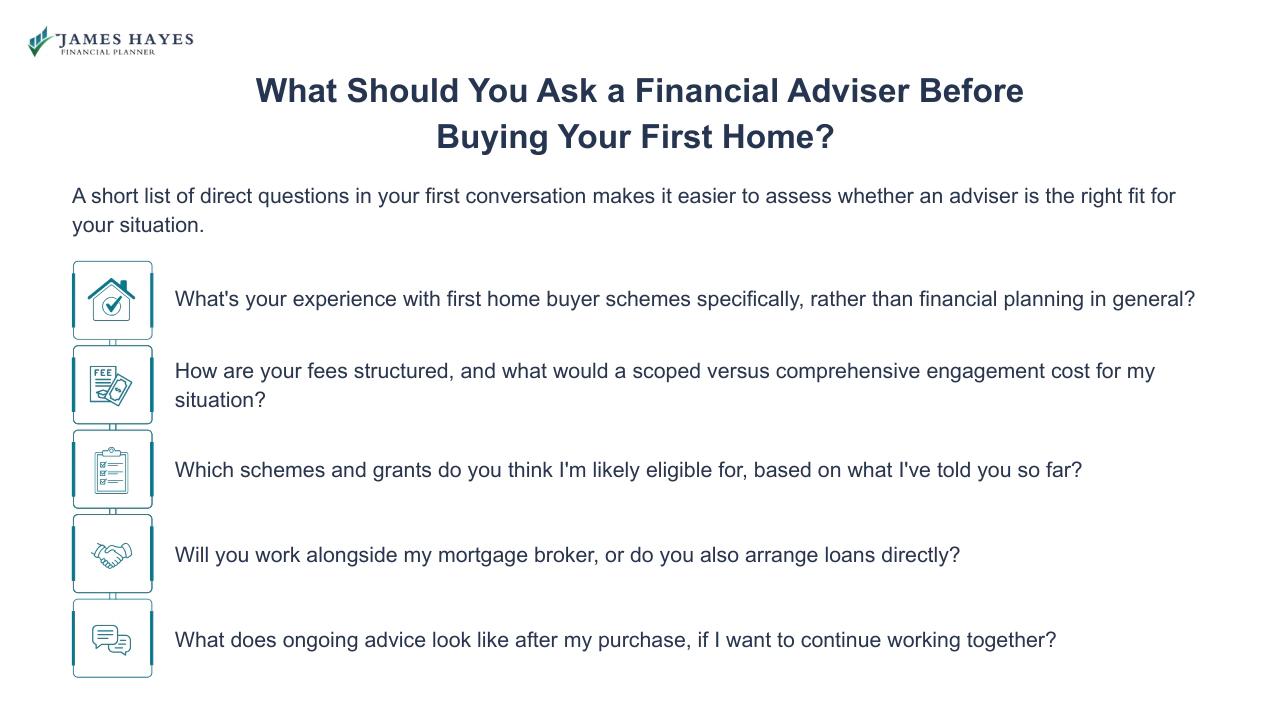
A short list of direct questions in your first conversation makes it easier to assess whether an adviser is the right fit for your situation.
- What’s your experience with first home buyer schemes specifically, rather than financial planning in general?
- How are your fees structured, and what would a scoped versus comprehensive engagement cost for my situation?
- Which schemes and grants do you think I’m likely eligible for, based on what I’ve told you so far?
- Will you work alongside my mortgage broker, or do you also arrange loans directly?
- What does ongoing advice look like after my purchase, if I want to continue working together?
How Financial Advice Can Help You Avoid Costly Mistakes
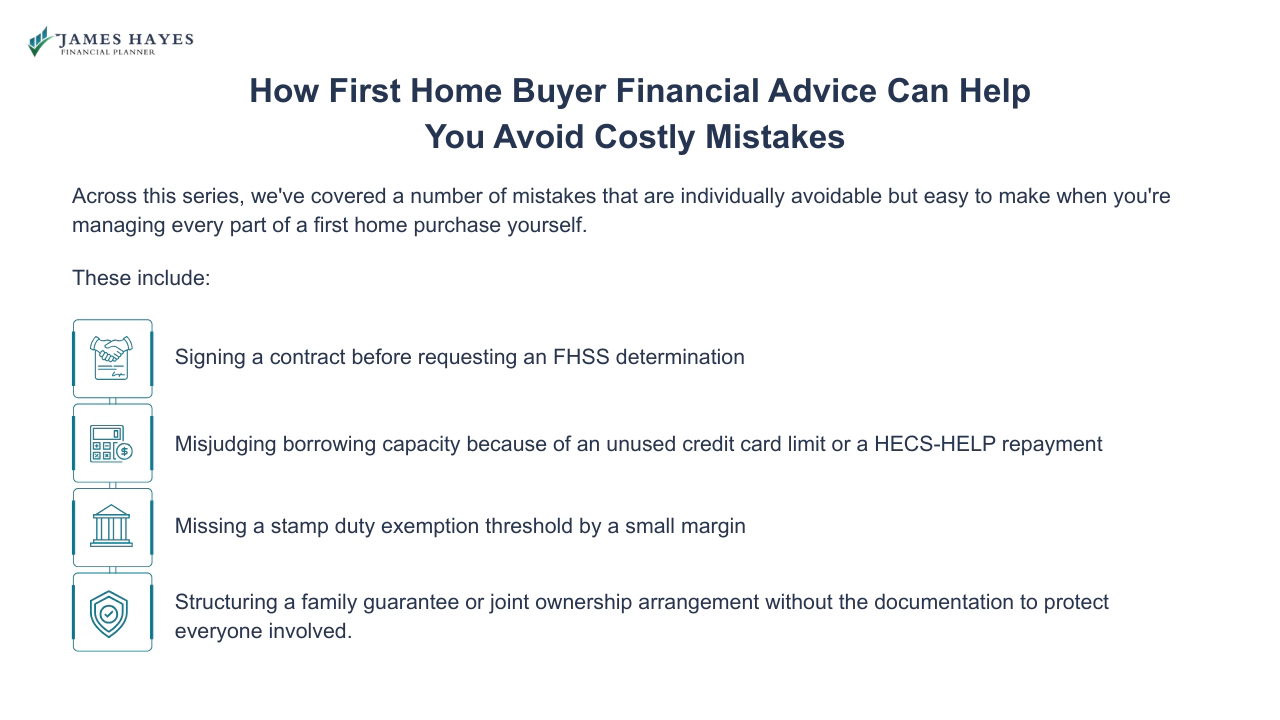
Across this series, we’ve covered a number of mistakes that are individually avoidable but easy to make when you’re managing every part of a first home purchase yourself.
These include:
- Signing a contract before requesting an FHSS determination
- Misjudging borrowing capacity because of an unused credit card limit or a HECS-HELP repayment
- Missing a stamp duty exemption threshold by a small margin
- Structuring a family guarantee or joint ownership arrangement without the documentation to protect everyone involved.
A financial adviser’s value in a first home purchase often comes down to catching these specific, avoidable mistakes before they happen, rather than any single piece of dramatic advice.
If you’d like to revisit any of these topics in detail, our series covers deposit-saving strategies, the First Home Super Saver Scheme, government schemes, grants and stamp duty, borrowing capacity, loan structure, and what to do with your finances after settlement.
Talk Through Your First Home Purchase with a Local Adviser
Whether you’re just starting to save or ready to make an offer, a conversation before you commit to a strategy is worth more than a conversation after. James Hayes, an AFP®-accredited financial planner (opens in a new tab) based in Caringbah, works with first home buyers at every stage of the process. Book a free 15-minute call to find out how advice could change your first home buying plan.