
First Home Buying
Borrowing Capacity & Loan Readiness for First Home Buyers
Written & Reviewed by James Hayes ·
Summary
Borrowing capacity depends on income, expenses, existing debt, and a 3-percentage-point buffer applied to your loan rate, not the advertised rate itself. HECS-HELP repayments, unused credit card limits, and living expenses assessed against a standard benchmark all shape the final number more than most first home buyers expect.
First home deposit savings quick guide and checklist. Download Free Checklist.
Introduction
Two people earning the same salary can be approved for very different loan amounts, once a lender factors in their debts, expenses, and financial habits. Borrowing capacity isn’t a single number tied to your income but the result of a calculation that includes a mandatory interest rate buffer, your existing debt obligations, and how a lender interprets your day-to-day spending.
If you want an accurate borrowing capacity estimate before you start inspecting properties, James Hayes’s First Home Buyers Advice service can work through your numbers with you.

How Much Can You Borrow?
There’s no fixed formula that applies to every borrower, since your income, expenses, existing debt, and the property you’re buying all feed into the final figure.
As a rough starting point, many lenders will consider lending five to six times your gross annual income, before expenses and existing debts are factored in. On a $90,000 salary, that could mean an initial capacity estimate somewhere between $450,000 and $540,000, but this figure moves substantially once a lender applies its full serviceability assessment.
From 1 February 2026, APRA also requires banks to limit how many loans they write (opens in a new tab) above a debt-to-income ratio of six times gross income to 20% of their new lending each quarter. Most first home buyers are below this ratio, so it rarely affects an individual application directly, but it’s a sign of how closely regulators are watching high-leverage lending.
How Lenders Calculate Your Borrowing Capacity
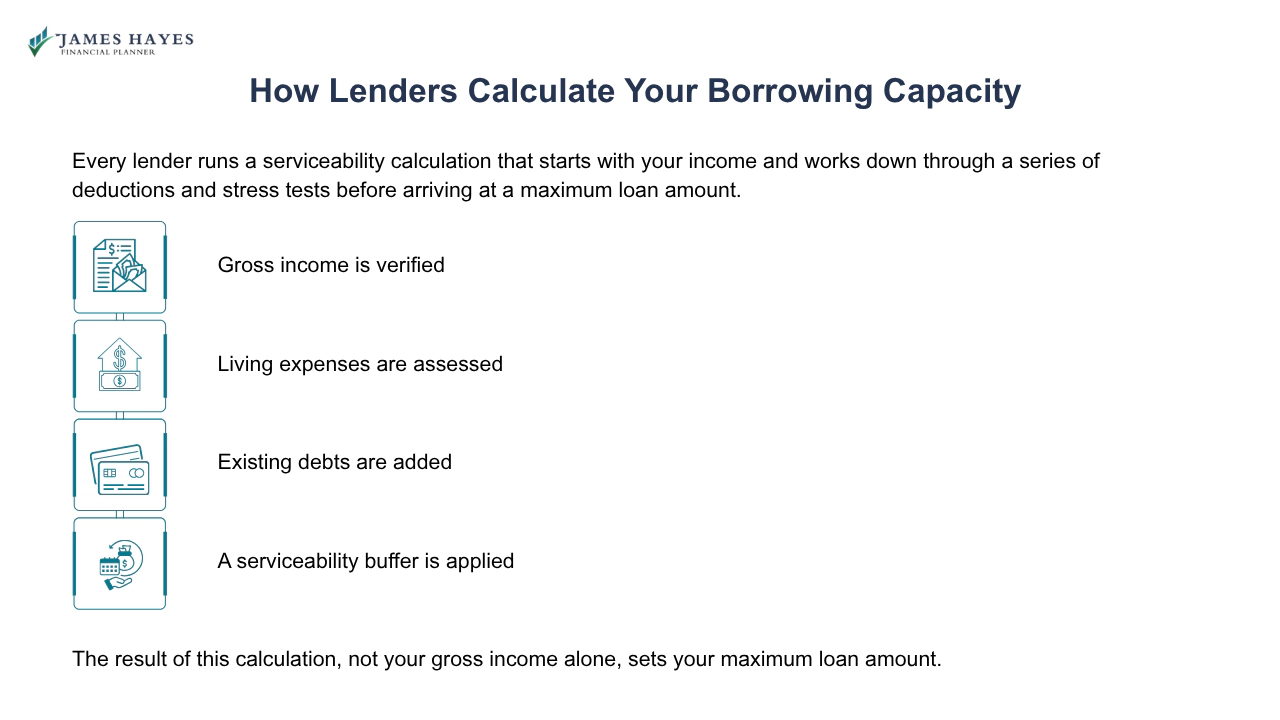
Every lender runs a serviceability calculation that starts with your income and works down through a series of deductions and stress tests before arriving at a maximum loan amount.
- Gross income is verified through payslips, tax returns, or a Notice of Assessment, with only a portion of less stable income types, such as overtime, bonuses, or casual shifts, counted.
- Living expenses are assessed against either your declared expenses or a standard benchmark such as the Household Expenditure Measure (opens in a new tab), whichever figure is higher.
- Existing debts are added, including credit cards (assessed at their full limit, not your balance), personal loans, car loans, and HECS-HELP repayments (opens in a new tab).
- A serviceability buffer is applied, adding 3 percentage points to your actual loan rate to test whether you could still make repayments if rates rose. A loan offered at 6% is typically assessed as though it were at 9%.
The result of this calculation, not your gross income alone, sets your maximum loan amount.
What Do Lenders Look for?
Beyond the serviceability calculation itself, lenders look for signs of financial stability that reduce their perceived risk.
- They generally want to see employment that’s been stable for six months or more, ideally in the same industry if you’ve changed jobs recently.
- They check for genuine savings, meaning your deposit has been in an account, term deposit, or similar for at least three months rather than appearing shortly before you apply.
- They review your credit file for missed payments, defaults, or a high number of recent credit enquiries, since applying to several lenders in a short period can itself lower your score.
- They also look at your transaction history for patterns that suggest financial stress, such as frequent overdrawn accounts, gambling transactions, or reliance on short-term credit like buy-now-pay-later services.
How Your Income and Expenses Affect Your Borrowing Capacity
Your net position, not your headline salary, is what drives your borrowing capacity. Lenders typically discount income types they consider less reliable. Overtime, bonuses, and commission are often counted at 80% of their historical average rather than in full, and casual or contract income may need 6 to 12 months of consistent history before it’s counted at all.
On the expense side, lenders compare your declared living costs against a standard benchmark, and use whichever figure is higher, so understating your expenses on an application doesn’t increase your capacity if the benchmark for your household size and location comes in above what you declared.
Rent you’re currently paying is also included as an ongoing expense if you don’t own your home yet, which can meaningfully reduce capacity for first home buyers.
How HECS-HELP Debt Affects Your Home Loan Borrowing Capacity
A HECS-HELP debt reduces your borrowing capacity through its repayment obligation, not through the outstanding balance itself.
For the 2026–27 financial year, compulsory repayments start once your income passes $69,528, at 15% of the amount between $69,529 and $129,717, and 17% above that up to $186,050. A lender factors this compulsory repayment into your expenses in the same way it would a car loan repayment, which reduces the income available to service a mortgage.
On an $85,000 salary, this works out to a compulsory HECS-HELP repayment of roughly $2,321 a year, an amount that lowers your assessed capacity even though it isn’t a traditional debt with a credit limit.
Because the repayment is based on income rather than the debt balance, a large HECS-HELP balance and a small one affect your borrowing capacity identically at the same salary, provided both are still being repaid.
Can Your Credit Card Limit Affect Your Loan Application?
Yes, and the effect is often larger than borrowers expect, because lenders assess your full credit limit rather than your outstanding balance.
A credit card with a $10,000 limit is assessed as though you owe close to that full amount, even if you pay it off in full every month and carry no balance at all. Lenders apply a notional monthly repayment of around 3% to 3.8% of the limit when calculating your expenses, which on a $10,000 limit adds roughly $300 to $380 a month to your assessed commitments regardless of your actual spending habits.
This is why reducing or cancelling unused credit cards before applying for a home loan is one of the more effective ways to increase your assessed borrowing capacity, since it removes a fixed deduction that has nothing to do with how you use the card.
What Reduces Your Borrowing Capacity?
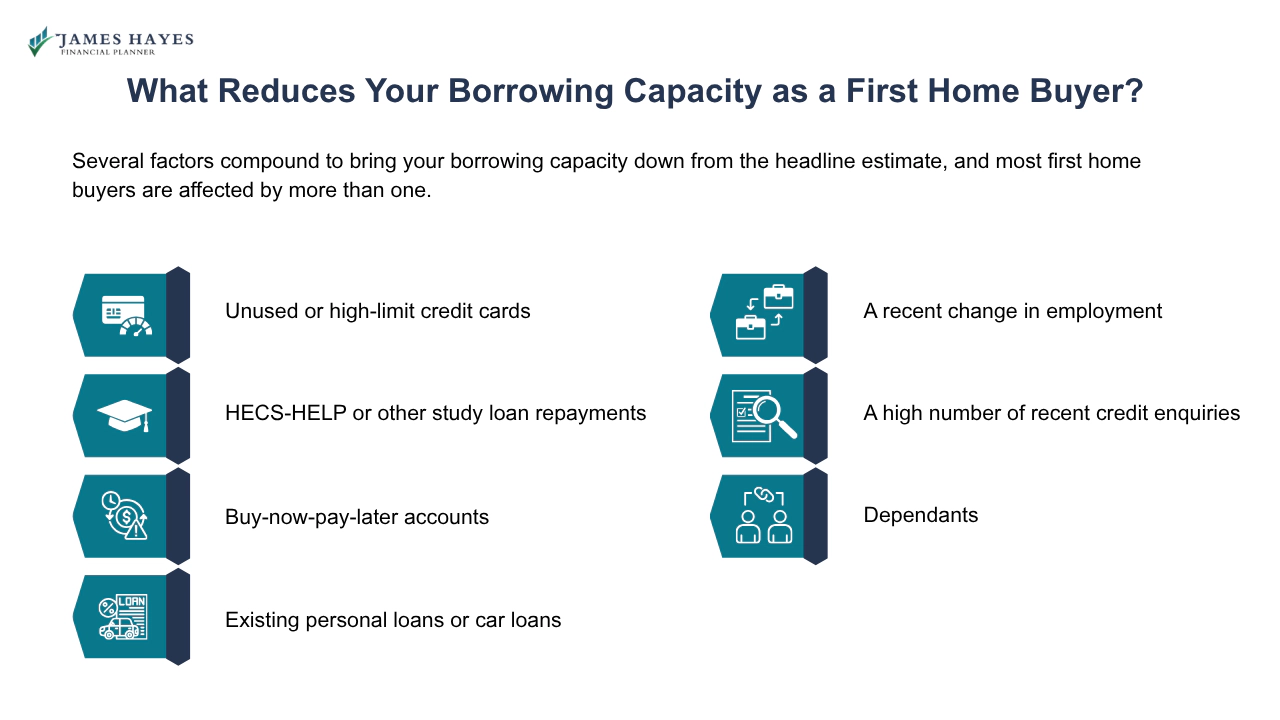
Several factors compound to bring your borrowing capacity down from the headline estimate, and most first home buyers are affected by more than one.
- Unused or high-limit credit cards, assessed at their full limit rather than your balance.
- HECS-HELP or other study loan repayments, deducted as an ongoing expense once your income passes the compulsory repayment threshold.
- Buy-now-pay-later accounts, which many lenders now treat similarly to a credit facility even though they don’t charge interest.
- Existing personal loans or car loans, counted at their full scheduled repayment regardless of how much you’ve already paid off.
- A recent change in employment, particularly a move to casual, contract, or probationary work, which can reduce how much of your income a lender is willing to count.
- A high number of recent credit enquiries, which can signal financial stress to a lender even if each individual application was approved.
- Dependants, since lenders factor the cost of children or other dependants into their expense benchmark regardless of your declared household spending.
Preparing Your Finances Before Applying
Getting your finances in order before you apply reduces the risk of a lower-than-expected approval or a delayed application.
Start by pulling a credit report from Equifax (opens in a new tab), illion, or Experian (opens in a new tab), and check it for errors, since an incorrect default or missed payment can be disputed and corrected before it affects your application.
Gather your last two payslips, three months of bank statements across every account, your most recent tax return or Notice of Assessment, and statements for every existing debt, including credit cards, car loans, and HECS-HELP.
Reduce or close credit cards you don’t use regularly, and pay down any buy-now-pay-later balances, since both are counted against your capacity regardless of your current balance.
Confirm your genuine savings have been in your account for at least three months, since a lender may ask for a plausible explanation of any large, recent deposit.
Improving Your Borrowing Position
Beyond the paperwork, a few changes to your finances can shift your assessed capacity over a few months.
- Consolidating or paying off a personal loan removes its scheduled repayment from your expenses entirely, rather than just reducing the balance.
- Switching from a high annual fee credit card to a lower-limit card, or cancelling a card you don’t use, removes the notional repayment lenders apply to its full limit.
- Building a track record of stable income, ideally in the same role or industry for six months or more, gives a lender more confidence in counting your full income rather than discounting it.
- If your HECS-HELP balance is manageable, making a voluntary extra repayment won’t change your compulsory repayment obligation, since that’s based on income rather than balance, so it’s rarely the most effective lever for improving borrowing capacity specifically, even though it may still be worth doing for other reasons.
Importance of Pre-Approvals
Pre-approval turns your estimated borrowing capacity into a lender’s written, conditional commitment, which changes how you can approach the property search.
Australian lenders issue pre-approval valid for 90 days, based on a full review of your income, expenses, debts, and credit file rather than a self-reported estimate. This gives you a confirmed budget to search within, rather than relying on a rough calculation that might not hold up under full lender scrutiny, and it signals to agents and vendors that you’re a serious, finance-ready buyer at auction or during negotiation.
Pre-approval isn’t a guarantee of final approval because the lender still needs to value the property you choose and confirm nothing material has changed in your finances between pre-approval and settlement.
Applying too early, well before you’re ready to make offers, risks your pre-approval expiring before you find a property, which means reapplying with updated documents and another credit enquiry.
Once you have pre-approval, the next decision is how to structure the loan itself, including your rate type, offset arrangements, and repayment frequency, which we cover in detail in our next post on loan structure and mortgage strategy.
Get Your Borrowing Capacity Checked Properly
A rough online calculator cannot account for your credit card limits, your HECS-HELP repayment, or how a lender treats your income type. James Hayes, an AFP®-accredited financial planner (opens in a new tab) based in Caringbah, works through a realistic borrowing capacity estimate with first home buyers. Book a free 15-minute call to find out what you can borrow before you start house hunting.